
Danaher vs Gordon Ryan Instructionals: Which Should You Buy?
John Danaher coached Gordon Ryan from his teens. Gordon took that jiu-jitsu to the top of the sport, and now both sell dozens of courses on BJJ Fanatics. Here is which one deserves your money, by topic and by belt.
Danaher has 49 courses on BJJ Fanatics, Gordon more than 40. They cover the same positions, often with the same ideas, because Gordon learned them in Danaher’s room. The price is not the same: a Gordon course costs $349, a Danaher course $197.
So when you’re staring at two guard passing instructionals and trying to decide between teacher and student, which one actually deserves your money?
The quick verdict
Buy Danaher If You Want…
- To understand WHY a move works before you drill it
- Escapes and guard retention first, the order he recommends himself
- Gi courses (the Go Further Faster series)
- Lower prices: $197 a course, about $150 less than Gordon
Start with:  Pin & Turtle Escapes (gi)
 Unpassable Guard (no-gi)
Buy Gordon Ryan If You Want…
- EVERY variation and the counter to the counter
- Competition-tested no-gi systems from the GOAT
- Live rounds with his commentary in many courses
- A whole course on body lock passing (Danaher has none)
Start with:  They Shall Not Pass
For most people on a budget: start with Danaher, graduate to Gordon.
I’ve watched hundreds of hours from both instructors. Here’s the honest breakdown of where each one excels, where they fall short, and exactly which instructional you should buy based on your level and goals. Where we reviewed a course in full, you see a clip from it next to the text.
Teaching style: the professor vs. the practitioner
The biggest difference between Danaher and Gordon Ryan instructionals isn’t the techniques. It’s how they teach.
John Danaher’s Teaching Style
Danaher teaches like a philosophy professor who happens to know jiu-jitsu. He starts every topic with first principles: why does this position exist? What are the mechanical advantages?
He uses precise, almost academic language and his own vocabulary: the straight, cross and reverse ashi garami, or the wedges that make a pin hold. He organizes jiu-jitsu into systems where every technique connects to the next.
The upside: you walk away knowing why it works. The downside: he is slow. Pin & Turtle Escapes runs 10 h 52 min, and you often hear an idea explained for a long time before you see the move. If you want the why, that is the point. If you want a move for tonight’s class, it tests your patience.
- Best for: Conceptual learners, coaches, jiu-jitsu nerds
- Pacing: Slow and methodical. Builds from first principles.
- Language: Academic, precise terminology
- Format: Philosophy first, then technique, then drilling
Gordon Ryan’s Teaching Style
Gordon teaches like a competitor sharing his playbook. He establishes a framework for each position, then methodically shows every variation: what happens if they react this way, what about that way, what if they do nothing?
He uses plain language and talks about his own matches, honestly too. In Half Guard 2.0 he admits a limit: against a guard player like Felipe Pena, he hasn’t been able to force chest to chest yet.
The catch: tangents and repetition. About 45 minutes of Half Guard 2.0 is recap, often seated, and in Systematically Attacking the Legs the jokes at his partner’s expense get old.
- Best for: Competitors, visual learners, practitioners who learn by doing
- Pacing: Long courses with tangents (They Shall Not Pass runs 11 h 48 min)
- Language: Plain, conversational, story-driven
- Format: Framework, then every variation, then counters to counters, often live rounds at the end

Danaher has said it himself: “At this point, he knows more than I do about Jiu-Jitsu. He knows everything I know and he has stuff that he’s invented himself, that I don’t know.”

Price comparison: Gordon costs $152 more per course
Let’s talk money, because the gap is big and it is the same on almost every course.
| John Danaher | Gordon Ryan | |
|---|---|---|
| List price per course | $197, every paid course | $349 for most; ADCC breakdowns $197, mindset and strength $150 |
| Half price on November 3 | 10 courses ($98.50) | 8 courses ($174.50) |
| With the Black Friday code (55% off) | $88.65 | $157.05 |
| Code on top of a half-price course | $44.33 | $78.53 |
| Gi courses | 13, eight of them in Go Further Faster | None, everything is no-gi |
Single courses only, no bundles or passes. Prices from BJJ Fanatics on November 3, 2026; the Black Friday code BLACKFRIDAY2026 was tested at checkout on November 23, 2026. Codes rotate and deals end, so the price at checkout is what counts.
Gordon costs $349 at list where Danaher costs $197. Almost nobody needs to pay list: BJJ Fanatics puts a rotating set of courses at half price, and a sitewide code comes off on top of that at checkout. Never buy either one at list.
Bottom line: Gordon is more expensive at every price point. If price decides it, Danaher gets you further per dollar. Gordon’s courses are long, though: at the code price, They Shall Not Pass came to $14 per hour of teaching.
Topic-by-topic comparison
Here’s where it gets practical. Both cover the same major positions, often with the same ideas, but they get there differently. For each topic: the course I’d buy from each of them, and the call.
Jump to: Guard passing · Guard retention · Escapes · Leg locks · Back attacks · Submissions
Guard Passing
For no-gi, the Danaher course to buy is The Fastest Way: Guard Passer (2024): one plan in 7 h 31 min, from camping with your head on him to passing half guard chest to chest, which he calls “the single best and most reliable method of passing guard in all of jiu jitsu.” In the gi, Passing the Guard (2020) teaches his five-step method around seven passes: knee cut, toreando, leg drag, smash pass, long step, over under and double under.
Gordon Ryan goes deeper on fewer passes. Systematically Attacking the Guard (2019) is his three-part passing system, the Body Lock Study (2022) gives the body lock ten volumes, and Half Guard 2.0 (2026) changes how he passes half guard: stay low while your partner can still post on your hip.


Also:  Passing the Guard (gi)
 Half Guard 2.0
 Body Lock Study
Danaher’s course has a pass he calls the Gordon Ryan special. Next to it, the pass that is new in Gordon’s 2026 course.
Camp with your head on him, run your feet around his legs and drop your knees into a north-south pin. Guard Passer, Vol 2 · 10:07 Our full review →Gordon gets his knee out from under her top leg, then inside her legs: the first step of his misdirectional knee cut. Half Guard 2.0, Vol 2 · 4:11 Our full review →Guard Retention and Guard Play
Danaher’s no-gi retention course is The Fastest Way: Unpassable Guard (2024): 5 h 13 min of solo movements, the knee shield and late recoveries. In the gi it is Guard Retention (2019) from the Go Further Faster series, which also has a course for closed, open and half guard.
Gordon Ryan’s They Shall Not Pass (2021) is the most complete course on not getting passed I have watched: 11 h 48 min on seated, leg and half guards, stacks and body locks, with 25 minutes of rolls and over an hour of his commentary. For attacking from bottom he has separate courses on closed guard, half guard and seated and supine open guard.
In the gi:  Guard Retention (gi)
Stuck in a locked body lock? Both move the passer’s head off center, for different reasons.
 Hands on his face, then swing out to an angle. Danaher uses it to get out, a late defense. Unpassable Guard, Vol 5 Our full review →Bat the head over and fall to a hip. Gordon uses it to sweep, straight away. They Shall Not Pass, Vol 5 Our full review →
Escapes and Defense
Danaher’s Pin Escapes & Turtle Escapes (2019) is the gi course: one way out of every pin and out of turtle, built on two escapes you can remember mid-roll. For no-gi he made New Wave: Positional Escapes (2021). Escapes are where he tells beginners to start.
Gordon Ryan’s The Pillars of Defense: Pin Escapes (2022) covers mount, side control, knee on belly and north-south in 8 h 44 min, with five live rolls and his voice-over. Back and turtle escapes are separate Pillars of Defense courses, like his strangle and leg lock escapes.

No-gi:  New Wave: Positional Escapes (no-gi)
Stuck under a heavy crossface? Same problem, two answers.
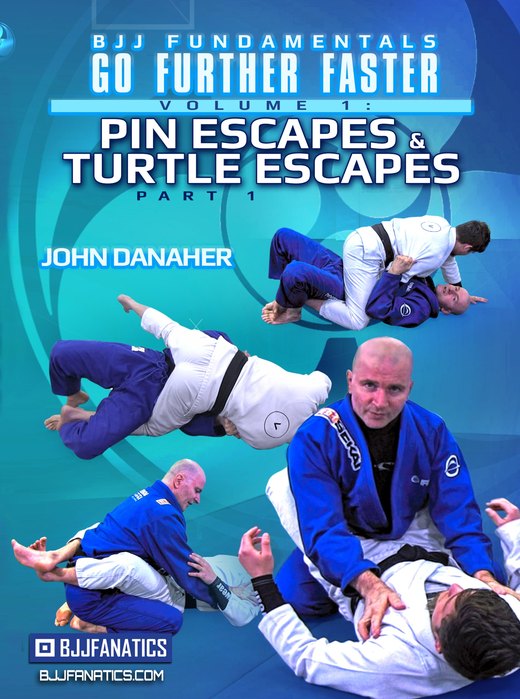 Danaher keeps his underhook and shoots that arm up past his partner’s head, the first step to taking the crossface away. Pin & Turtle Escapes, Vol 4 Our full review →
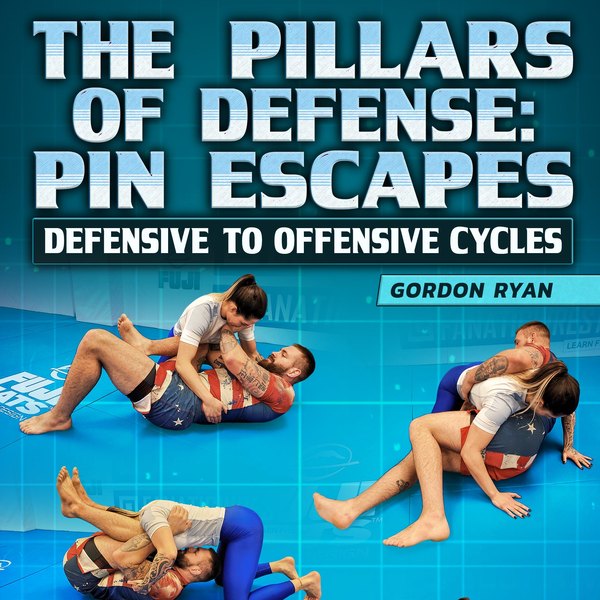 Gordon turns his face away and bridges: his partner’s shoulder slides over his head, and his knee comes in to meet his elbow. Pillars of Defense, Vol 2 · 3:04 Our full review →
Leg Locks
Danaher’s Leglocks: Enter The System (2018) is the course that started the modern leg lock game. In 9 h 47 min it builds the straight, cross and reverse ashi garami, the knee line and exposing the heel, then gives two volumes to entries. His newest leg lock course, Master the Move: The Ankle Lock (2026), spends almost five hours on one thing: a straight ankle lock that actually taps.
Gordon Ryan’s Systematically Attacking the Legs (2023) runs 8 h 21 min and starts where Danaher’s entries stop: finishing and controlling every lower-body submission, with 26 minutes of live rounds. It has no entries and no defense. Gordon says he didn’t watch Danaher’s set and kept the concepts light so he would not repeat it.


Danaher, 2026:  Master The Move: The Ankle Lock
Why a leg lock doesn’t finish: one detail from each of them.
His whole weight through a metal pipe on the Achilles, and no tap: why the old ankle lock fails. This course goes after the front of the ankle instead. The Ankle Lock, Vol 1 · 9:38 Our full review →Heel at the wristwatch, not the elbow: the further the heel slides toward the elbow, the more it slips. Attacking the Legs, Vol 2 · 40:50 Our full review →Back Attacks
Danaher’s Back Attacks: Enter The System (2018) is the foundation: getting to the back, staying there with the straight jacket and finishing the strangle, plus armlocks and the back crucifix.
Gordon Ryan’s Systematically Attacking the Back (2020) grows the system he built with Danaher into eight volumes: his own hand fighting on the overhook and underhook side, the high ball ride, strangles such as the garrote and the mandible choke next to armlocks and triangles, and five rolls with his commentary.


Submissions (Triangles, Omoplata and More)
Danaher gives each big submission its own course. The Enter The System series (2018 and 2019) does it theory first, Triangles included. His newer Master the Move courses (2024 to 2026) each take one move, like the omoplata below and the ankle lock in the leg lock section; both run about five hours.
Gordon Ryan used to teach submissions inside his position courses. Since 2023 he also has courses on single submissions. Systematically Attacking Triangles covers five kinds of triangle from closed, seated and supine guard, passing and pins, with rolls and commentary.


Danaher, 2026:  Master The Move: Omoplata
Why the omoplata underperforms: seated with your head higher than his, he just postures up. The fix, later in Vol 2: your hips over his shoulder. Master the Move: Omoplata, Vol 2 · 10:27 Our full review →Who should buy Danaher instructionals?
Buy Danaher If You Are…
- A white or blue belt building your first complete system. Danaher’s progressive structure is specifically designed for this.
- A conceptual learner who needs to understand WHY before you can execute. If you’re the type who reads textbooks before lab work, Danaher is your instructor.
- A coach or instructor looking for frameworks to teach your students.
- Stuck on the bottom a lot. His escape and guard retention courses are where he tells beginners to start.
- Over 30, or out-athleted by younger partners. His four-part Ageless Jiu Jitsu series (top and bottom, gi and no-gi) is built for that.
- A gi practitioner. The Go Further Faster series is built for the gi. Gordon’s catalog is entirely no-gi.
- On a tighter budget. Danaher’s courses cost $197 at list, Gordon’s mostly $349.
Start here: Pin & Turtle Escapes (gi) Unpassable Guard (no-gi) Guard Passer (no-gi passing) Passing the Guard (gi passing) Leglocks: Enter The System
For the complete breakdown, see our guide to all 43 Danaher instructionals, ranked.
Browse All Danaher InstructionalsWho should buy Gordon Ryan instructionals?
Buy Gordon Ryan If You Are…
- A purple belt or above who already understands basic systems and wants competition-tested detail.
- A competitor preparing for tournaments. Everything Gordon teaches has been used against the best grapplers alive.
- A no-gi specialist. Gordon’s entire catalog is built for no-gi grappling.
- Someone who wants to pass with the body lock. He gives it a ten-volume course: Body Lock Study
- Someone who wants to see it live. Many of his courses end with rolls and his commentary on them.
- Someone who already owns Danaher’s foundational sets and wants the “graduate level” expansion.
Start here: They Shall Not Pass (most people) Pin Escapes (if you get pinned) Attacking the Legs (leg locks) Attacking the Guard (passing) Half Guard 2.0 (if you already pass half guard)
For the complete breakdown, see our ranked review of all Gordon Ryan instructionals.
Browse All Gordon Ryan InstructionalsBeginners vs. advanced: a practical guide
Your belt level matters more than personal preference here. Here’s a blunt assessment:
White Belts
Buy Danaher. Full stop. Gordon’s content assumes you already know what an ashi garami is, what a knee shield does, and how guard retention works. Without those reference points, you’ll be lost. Danaher builds from the ground up, and his escape course is where he tells you to start.
Blue Belts
Mostly Danaher, with one exception. If you compete no-gi and your guard keeps getting passed, Gordon’s They Shall Not Pass works for a motivated blue belt. Everyone else: Danaher’s Pin & Turtle Escapes, Unpassable Guard and Guard Passer come first.
Purple Belts
This is where Gordon becomes the better investment for most people. You have enough context to follow his tangents, enough mat time to appreciate his competition details, and enough skill to actually implement his systems.
Brown and Black Belts
Gordon, almost exclusively. At this level, you don’t need someone to explain why the over-under pass works. You need someone to show you the 15 variations and which one to use when your opponent does X vs. Y vs. Z. That’s Gordon’s entire teaching model.
The best approach: build a combined library
The truth is, Danaher and Gordon aren’t really competitors. They’re complementary. Danaher builds the foundation; Gordon adds the details. Here’s the order I’d buy them in:
- Start with Danaher’s escapes and guard: Pin & Turtle Escapes in the gi or Unpassable Guard in no-gi.Pin & Turtle Escapes Unpassable Guard
- Then his passing and leg locks: Guard Passer (Passing the Guard in the gi) and Leglocks: Enter The System.Guard Passer Passing the Guard Leglocks: Enter The System
- Add Gordon’s competition-tested systems: They Shall Not Pass, his Pin Escapes once you own Danaher’s, Systematically Attacking the Legs once you reach the legs, and Systematically Attacking the Guard or the Body Lock Study for passing.They Shall Not Pass Pillars of Defense: Pin Escapes Systematically Attacking The Legs Systematically Attacking The Guard Body Lock Study
- Fill in gaps based on your game: Danaher for gi work. Gordon for back attacks, submission chains, and no-gi guard.
Wait for a deal. On November 3, ten of Danaher’s courses and eight of Gordon’s were half price, and on November 23 the Black Friday code took 55% off on top of daily deals at checkout. Build your library over time rather than buying everything at once.
FAQ
Is Gordon Ryan better than Danaher at teaching?
Not better, different. Danaher excels at conceptual frameworks and building understanding from first principles. Gordon excels at exhaustive technical coverage and real-world application. Danaher himself has said Gordon “knows more than I do about Jiu-Jitsu,” but knowing more doesn’t necessarily mean teaching better. Most practitioners benefit from both approaches at different stages.
Are Gordon Ryan instructionals worth the price?
At the $349 list price, only if you will use most of a long course. With the Black Friday code (55% off, tested November 23), a $349 course comes to $157.05, and to $78.53 on a day it is also half price. At the code price, They Shall Not Pass worked out to $14 per hour of teaching. Never pay list.
Which Danaher series should I start with?
Start where Danaher says to start: escapes and keeping your guard. In the gi that is Pin & Turtle Escapes from Go Further Faster; in no-gi, The Fastest Way: Unpassable Guard. Then The Fastest Way: Guard Passer for passing and Leglocks: Enter The System for leg locks. Our Danaher guide ranks all 43.
Which Gordon Ryan instructional should I start with?
They Shall Not Pass, his guard retention course, for most people. If you get pinned, start with The Pillars of Defense: Pin Escapes; for leg locks, Systematically Attacking the Legs; for passing, Systematically Attacking the Guard, or Half Guard 2.0 if you mostly pass half guard. Our Gordon Ryan ranking has the full list.
Can I learn leg locks from Gordon Ryan without watching Danaher first?
Yes, if you already get to the legs. Systematically Attacking the Legs has no entries: it starts once you have the leg and covers finishing and control. Gordon says he didn’t watch Danaher’s set and kept the concepts light so he would not repeat it. If you are new to leg locks, start with Danaher’s Leglocks: Enter The System, which has two volumes of entries.
Do Danaher and Gordon Ryan instructionals overlap?
Yes, more in goals than in moves. We checked 17 key moments from Danaher’s Pin Escapes against Gordon’s: 5 matched, 10 reached the same goal another way and only 2 were missing from Gordon’s course. Their guard retention courses work the same way: same method, different answers. You don’t need both on the same topic unless you want maximum depth.
Are there topics where one is clearly better than the other?
Gordon is clearly better for body lock passing (a ten-volume course; Danaher has none), back attacks, finishing leg locks and no-gi depth with live rounds. Danaher is clearly better for the gi, for a first course on leg locks or escapes, and for shorter, cheaper plans. For guard retention it is a choice of style: Danaher’s short plan or Gordon’s complete system. For escapes it is the same skeleton with a different goal: Danaher gets you back to guard, Gordon straight to offense.
Build the library, not just one DVD
Most people are best served starting with Danaher for the foundation, then graduating to Gordon for competition-tested detail. Wait for a deal on BJJ Fanatics and build it over time.