
BJJ instructionals are one of the fastest ways to improve, but they aren’t cheap. So see what’s on the DVD first: right below are my reviews with clips from inside each set. After that: how to pick one, which one to start with, and how to actually learn from it instead of just watching.
See what’s on the DVD before you buy it
Know what you’re buying before you pay. Each of these 18 reviews shows short clips from inside the DVD, so you see the key details and how they’re taught. Here they are by instructor.
 Pillars of Defense: Pin Escapes (Gordon Ryan). Mounted, then out in one move: Gordon’s kip, the escape he is known for. Vol 6 · 46:32 Our full review →
 Master The Move: The Ankle Lock (John Danaher). Why the old ankle lock doesn’t tap: his whole weight through a metal pipe on the Achilles, and nothing. This course goes after the front of the ankle instead. Vol 1 · 9:38 Our full review →
John Danaher
5 reviews with clips · all 43 ranked →
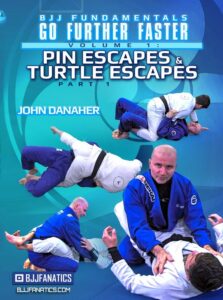 Pin & Turtle Escapes (Go Further Faster)One way out from every pin. The catch: ten slow hours.
 The Fastest Way To Develop An Unpassable GuardFor when you keep getting passed in no-gi and want one plan, not loose clips.
 The Fastest Way: Effective Guard PasserFor when you spend whole rounds stuck in people’s guard.
 Master The Move: OmoplataFor when you get to the omoplata but he rolls out or stands up.
- Master The Move: The Ankle LockFor when you get to the legs but your ankle locks never get the tap.
Gordon Ryan
4 reviews with clips · all 36 ranked →
 They Shall Not PassFor when you’re tired of getting passed: an answer to every way people pass you.
- Pillars of Defense: Pin EscapesFor when you’re stuck under side control and mount: how to get out, and end up on top.
 Systematically Attacking The LegsFor when people slip out of your heel hook before you finish.
 Systematically Attacking The Half Guard 2.0For when you get on top in half guard, try to pass and get rolled over.
Craig Jones
5 reviews with clips, plus one head to head · all 24 ranked →
 Power RideBuy it first if people keep escaping once you get on top.
 Power Ride 2.0For when you keep landing in half guard on top and want a pin that costs you nothing.
 Make Z Guard Great AgainFor when your half guard keeps getting passed: one system that holds and attacks.
 The Anti-Wrestling EquationFor when they turtle or come back up to their hands, and you don’t know what’s next.
 Octopus Guard 2.0For when you’re stuck under side control and want to get up and take the back.
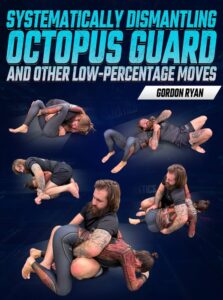 Craig vs Gordon: who wins the octopus guard?Craig’s DVD is the better buy.
Jozef Chen
3 reviews with clips · all 3 ranked →
 Tripod PassingFor when butterfly hooks keep lifting you off as you try to pass.
 Engaging Without RegretsFor when seated guys tie up your arms or stand up before you can start passing.
 J-Point CampingFor when you get to his side but can’t stay there long enough to pass.
Pawel Jaworski
1 review with clips
 Inside Leglocks & False ReapsFor when you keep losing the legs before you get to the heel hook.
Browse all my BJJ instructional reviews
I’ve reviewed a lot of grappling and BJJ instructionals over the years. Here are my rankings and reviews by topic, instructor and platform, so you can go straight to whatever you’re trying to learn.
Start here: best overall
If you only read one page, make it this one.
- The 30 Best BJJ Instructionals, rankedMy main buying guide: read this first.
- Best Instructionals for Beginners & White Belts
- Free BJJ Instructionals (and how to get them)
By instructor
Pick one coach and learn their system.
- Best John Danaher Instructionals (all 43 ranked)
- Best Gordon Ryan Instructionals (all 36 ranked)
- Danaher vs Gordon Ryan: which should you buy?
- Best Craig Jones Instructionals (all 24 ranked)
- Best Lachlan Giles Instructionals
- Best Giancarlo Bodoni Instructionals
- Best Mikey Musumeci Instructionals
- Best Jozef Chen Instructionals (all 3 ranked)
By topic & position
Focus on one area of your game.
By platform
Where to actually learn BJJ online.
More reviews
Older single-set reviews, without clips.
 Get Off My Legs GringoCraig Jones
 Systematic Submission DilemmasCraig Jones
 Power BottomCraig Jones
 Pillars of Defense: Strangle EscapesGordon Ryan
 Feet to Floor (Vol 1-3)John Danaher
What are BJJ instructionals?
BJJ instructionals are video courses taught by top BJJ coaches and competitors, usually split into volumes. The topic depends on the instructor, but most focus on one area of the game, like guard retention, guard passing or leg locks. The 18 I’ve reviewed with clips run from 1 h 19 min to 11 h 48 min; 14 of them land between 2 and 9 hours.
Do BJJ instructionals help you improve?

Yes, a lot, if you use them well. Here’s what they give you that a normal class often doesn’t:
- Access to high-level instruction: Many are taught by world-class competitors and coaches, with detailed explanations and demonstrations you rarely get in a regular class.
- Learn on your own schedule: Watch when you have time, at your own pace, and rewind a detail as often as you need. Useful if you can’t make every class.
- Supplement your training: They don’t replace class, but they’re a great way to learn new techniques, review old ones, or work on one part of your game.
- Focus your training: Normal classes often train one topic this week and a completely different one the next. An instructional lets you stay on one area for weeks.
I’ve noticed many times that a training partner suddenly makes a ‘jump’ in their progress, and it’s almost always because they’re studying an instructional.
Are BJJ instructionals worth it?
It depends on your goals, your budget and how you like to learn. A few things to weigh:
- Cost: Anything from free videos to bundles and All Access Passes well over $1,000. Decide what you’re willing to spend before you start browsing.
- Learning style: Some people learn better from video than from a busy class. If you like to understand why something works, instructionals can be a great fit.
- Specific goals: If you want to compete or fix one position, the right instructional gives you the details that actually move the needle.
Compared with a private lesson, instructionals are cheap: an eight-hour set at $200 to $300 works out to $25 to $37.50 an hour. But that’s recorded teaching, not eight hours of someone fixing your mistakes. Judge a set by how much of it you’ll actually drill, not by its runtime.
Also read: Are BJJ Instructionals Worth the Money?
What to look for in a BJJ instructional?
When you’re choosing one, look at five things:
- Instructor: A high-level black belt, but more importantly a good teacher. Teaching takes more than knowing techniques: you have to explain them clearly and understand how students learn.
- A common thread: Something that ties the techniques together, so you learn one system instead of a bunch of random moves. Unfortunately, many instructionals lack this.
- Fit with your game: It should match what you want to learn and what you can actually use in training. Beginners want fundamentals; competitors want high-level competition techniques.
- Production quality: Clear instruction, sharp video and good audio. Most modern instructionals are well produced, though some older ones look dated.
- Something new: This matters less at white belt, but if you’re more experienced, look for concepts you haven’t seen before. That’s how you add new tools to your game and surprise your training partners.
What a common thread looks like: Danaher builds his whole Pin Escapes & Turtle Escapes set on one test from Volume 1. Full weight but no wedges, and his partner is back in guard in seconds. No weight but three wedges, and he can’t move. Every escape after that is the same job: get your elbow, knee and hand inside his wedges.
 Pin Escapes & Turtle Escapes (John Danaher). Chest to chest, full weight, no wedges: with Danaher’s hands behind his back, Matthias puts him back in guard in seconds. Vol 1 · 1:09:52 Our full review →
Also read: The 7 Best BJJ Instructors: Choose wisely who to learn from
Which BJJ instructional should I start with?
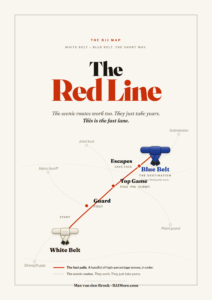
If you’re a white belt, start with something that gives you the map before you spend on a deep video set. That’s exactly why I wrote The BJJ Map: it’s text-based, quick to read, and it shows you what a blue belt actually needs to know and in what order. You can read the first chapters for free (email required) first.
After that, buy an instructional on a relatively easy topic. The most commonly suggested topic for a white belt is closed guard, but I think half guard is at least as good a starting point (my half guard ranking says which set to buy first). Many beginners also like John Danaher as an instructor, because he explains everything in detail. Good first buys:
 Closed guard, gi: Closed Guard: Go Further FasterJohn Danaher, from his BJJ Fundamentals series.
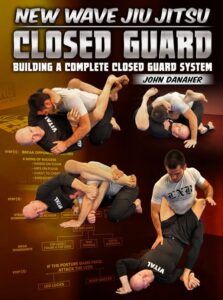 Closed guard, no-gi: New Wave Jiu Jitsu: Closed GuardJohn Danaher’s complete closed guard system.
- Escapes: Pin Escapes & Turtle Escapes (John Danaher)For when you’re stuck under mount and side control: one way out from every pin. The catch: ten slow hours, so start with the 13 core chapters my review lists.
Want more options? Here are my 10 picks for beginners, ranked.
How to use BJJ instructionals to improve fast
Watching isn’t learning. To get the most out of an instructional, you have to do more than watch it on the couch. Here’s what works:
- Set goals: Before you start, decide which technique or position you want to improve. Then you’ll use the instructional more efficiently, and you’ll know when you’ve got what you came for.
- Watch the core first: You don’t have to watch every hour. Find the chapters on the problem you have right now, drill those, and come back for the rest later.
- Focus on one topic at a time: Avoid jumping from one instructional to another (like I always do…). Pick one technique or position and drill it until it works. Repetition is essential for mastering any skill, and BJJ is no different.
- Take notes: Write down the details while you watch, and read them again before training, so you won’t forget what you wanted to drill.
- Practice, practice, practice: Learn the theory from the video, then drill it with a partner at open mats. That’s how you build timing, precision and confidence.
- Find a partner: What works best for me is watching an instructional together with a friend, then meeting up before and after class to drill the techniques. It helps you troubleshoot, it’s more fun, and it keeps you accountable.
Where do you buy BJJ instructionals?
There are many places to buy BJJ and grappling instructionals nowadays. The main ones:
- BJJMore: My own written guide, The BJJ Map, lays out every technique in jiu-jitsu, which ones actually matter, and what to learn first. It’s the best starting point before you spend on a video set. You can read the first chapters for free (email required) to see if it’s for you.
- BJJ Fanatics: One of the biggest and most popular sites for buying grappling and BJJ instructional videos, with courses from many well-known instructors on just about every topic. It was co-founded by Bernardo Faria, a five-time world champion.
- Submeta: A budget-friendly subscription created by Lachlan Giles, a world-class coach and competitor, with a deep library of courses on different techniques and positions.
- BJJ Mental Models: A community and platform with audio courses by BJJ black belt Steve Kwan and other high-level competitors. The focus is on the underlying principles and concepts of BJJ rather than just memorizing techniques.
- Jiu-Jitsu X: A platform from Keenan Cornelius. Not my personal favorite, but it offers a variety of courses from Cornelius and other top athletes.
- Grapplers Guide: A site from BJJ black belt Jason Scully that’s been around a long time and offers lifetime access for one payment. Some people still enjoy it, though I think it’s been overtaken by the competition.
- Individual publishers: Some coaches sell their own material on their own websites or on platforms like Teachable. Great if you want to learn from one specific instructor. Examples: Jon Thomas, Dominique Bell, Roy Dean, Andre Galvao, Stephan Kesting, Roger Gracie, Rob Biernacki, Rener Gracie, Travis Stevens and Shintaro Higashi (for judo).
BJJ instructional books
Most BJJ instructionals are video series, but some people prefer instructional books. That’s one of the reasons I wrote my own, a digital guide with checklists and flowcharts. There are some other good BJJ books too:
- The BJJ Map: My own guide, written for beginners and anyone who feels lost about what to learn first. It maps out the whole sport, shows which techniques actually matter, and gives you an order to learn them in. The first chapters are free (email required).
- Jiu-Jitsu University: an absolute classic, but a little dated now. It uses photos to illustrate techniques and covers the basics well, though some of the suggestions are very pre-2010 and don’t fully hold up against modern grappling.
- Mastering Jiu-Jitsu: written by John Danaher and Renzo Gracie, this is a classic too. It’s more theoretical than Jiu-Jitsu University with fewer technique photos, but it’s good. I liked it.
- Mastering the 21 Immutable Principles of Brazilian Jiu-Jitsu: my favorite BJJ book (other than my own). It does a great job introducing concepts you’ll use throughout your whole BJJ journey.
Ready to pick one?
Before buying, preview the 40/40/20 training split and beginner guard choices in The BJJ Map. Email is required; signup includes BJJMore training emails, and you can unsubscribe. If you already know what to study, use my ranked shortlist.
FAQ
Where can you get BJJ instructionals for free?
Read the opening Map chapters free for the 40/40/20 training split and beginner guard choices. Email is required; signup includes BJJMore training emails, and you can unsubscribe. For other free videos and courses, use the free BJJ instructionals guide, which separates free resources from paid follow-ups. Check each publisher’s current access terms.
Can you pirate BJJ instructionals?
Although you might be able to pirate BJJ instructionals, I’d caution against it. It’s illegal because it violates copyright law, and it doesn’t help support our athletes and grow our sport. And there are affordable legal options, such as Submeta.
Why are BJJ instructionals so expensive?
They can still be good value, as long as you pick material you’ll use. An eight-hour set at $200 to $300 works out to $25 to $37.50 per recorded hour: that’s recorded teaching, not an hour of someone coaching you. Top athletes in other sports sell video courses too: MasterClass publishes Stephen Curry’s basketball class. Choose a set you’ll actually drill, not the one with the longest runtime.
Why are instructionals so popular in BJJ?
BJJ instructionals are more popular than in other sports for a few reasons.
Firstly, BJJ is an incredibly technical martial art, and there are countless techniques and positions to learn. Secondly, unlike other sports, BJJ does not have as many opportunities for athletes to make money through sponsorships or competitions, so they turn to making instructionals. Finally, BJJ has an adult and relatively affluent audience.