
Home / Reviews / Craig Jones / Power Ride Review
Craig Jones Power Ride Review: Still the One to Buy First
Buy it first if people keep escaping once you get on top: Craig pins the legs to keep their feet off the mat.
See Power Ride on BJJ Fanatics$88.65 with code instead of $197. Tested at checkout on Nov 23.
 Reviewed by Max, black belt. My score: 10/10. BJJMore earns a commission when you buy through our links, at no extra cost to you.
14 details that are worth the money
Sorted by what he does to get out, not by volume. Count how many of these you already do.
Tick the clips you already do in rolls. Each tick puts a stripe on the belt at the bottom of the screen.
Toes curl round the top leg
When he starts to recover from side control, step over his top leg, curl your toes round it, then extend your foot: his heel can’t come in. Vol 5 · 5:00.
Leg drag, let the leg fall
Finish the leg drag by letting his lower leg fall to the mat: now you’re in a leg split, which is worse for him than the leg drag. Vol 5 · 27:30.
Face his hips
In the dope mount, turn your hips to face his hips instead of sitting square, and your calf pins his top leg away. Vol 2 · 7:54.
Hook the Achilles
Hook his Achilles with your own and push your hips in: he can’t plant that foot or pull the leg back. Vol 2 · 17:34.
Shelf both legs
Step over both Achilles and cross your feet: his legs sit on your shelf and his feet can’t reach the mat. Vol 2 · 21:56.
If most of these are new to you, this course will change your game.
9 more details from the course
Shallow claw, shoulder on the head. Keep the neck grip shallow and put your shoulder on his head, then flare your elbow so his elbow can’t come back in. Vol 3 · 10:03.
Two hands on the wrist. The wrist ride needs both hands: hold it with one and he swims his arm out, because it is only a pulling grip. Vol 3 · 19:02.
Heel over his foot. On the turtle, set your heel over his foot and pull your knee toward you: that foot can’t touch the mat. Vol 4 · 3:29.
Single hook, feet crossed. With one hook in, cross your feet and hip in: he can’t shake you off the way he can against a seatbelt. Vol 4 · 18:03.
Attack the inside of the elbow. For true diagonal pressure, hook the inside of his posted elbow: the arm buckles and he sinks under your weight. Vol 4 · 15:41.
Claw plus spiral ride. Use open hands, a claw and a spiral ride: you twist his spine so he can’t Granby or take an underhook. Vol 4 · 22:38.
Under the chin, belly down. Come under the chin instead of a claw, lift it and bridge your hips forward: he goes belly down for the rear naked. Vol 6 · 18:13.
One hook lifts the thigh. Belly down, one reinforced hook kicks his whole front thigh off the mat while your weight lies diagonal across his back. Vol 3 · 36:39.
Failed arm triangle to gift wrap. If he keeps his shoulder up against the arm triangle, switch to a shallow claw, bring your knee high and step into the gift wrap. Vol 6 · 52:25.
Does it work?
The volumes have no live rounds, and I found no competition match where I could confirm Craig using these rides. So the proof is my own three months on the mat, plus two B-Team training videos of Craig.
My 3 months training Power Ride
- Day one: the pins work: people have no escapes Phase 1
- The next weeks: lots of control, few finishes: rewatch Phase 2
- Month three: handcuff + rear naked grip: the taps come Phase 3
I don’t use the normal pins anymore against big, explosive, MMA-type people. I feel much safer riding their legs.
The three phases, in full
Phase 1. I watched the whole instructional on a Saturday before training. I could immediately pin people’s legs, keep people pinned forever with no chance to escape, and get to the belly down back mount (once). Super happy about this.
Phase 2. Over the following weeks my experience stayed the same: the pins are extremely effective and people literally have no escapes for them. But it was hard to progress to a submission, so I watched the instructional again for more details.
Phase 3. The main thing I was not using yet was the Dagestani handcuff with the rear naked choke grip (details 07 and 12). These grips are how you force someone belly down. Without them, people can stall out in a defensive position on their side or back. I now tap out a lot of people using this sequence, some of whom are better than me. What I appreciate even more than the submissions is the control. I can really control and submit people now that I could not two months ago.
The prerequisite I didn’t notice at first: my smash pass was already good, which is why the entries worked on day one.
Training: Craig on top of Jozef Chen, head and arm to the arm triangle

The instructional, Vol 6 at 6:50: choking hand palm down: palm up leaves a gap at your bicep, palm down closes it.
“Sensei Craig Jones Teaches Disciple Jozef Chen in Ways of Guard Passing & Top Pressure”, The B-Team, November 6, 2023. A training round: Craig on top, head and arm trapped, finishing with the arm triangle that Volume 6 builds toward.
Training: watch his partners’ feet

The rule, Vol 1 at 19:02: “He can bridge if his feet are on the floor. He can hip escape if his feet are on the floor.”
“Power Pins with Craig Jones”, The B-Team, February 18, 2022: 37 minutes of training rolls, no instruction, posted six weeks before the release. It starts at 1:22, where Craig is riding a flattened partner: watch how often their feet are off the mat.
Who should buy Power Ride
Buy it
- No-gi, sub-only or MMA. Control matters more than points: these pins score nothing and keep people flat.
- Older or lighter on top. Riding the legs is safer than holding side control on big, explosive people.
- Blue belt with a smash pass. Your passing gets you to his legs; this is what you do once you are on them.
- Your partners turtle. Volume 4 rides the turtle instead of letting it stall.
- Own Power Ride 2.0. 2.0 skips the leg rides, turtle rides and entries: this is that toolkit.
Maybe
- Gi guard player. Taught no-gi; the leg rides need no grips, but collars change the turtle work.
- Leg locker. Leg rides, not leg locks: here the legs are for pinning.
Skip it
- White belt. Wait until your passing gets you to the legs: every ride starts there.
- IBJJF points competitor. Most of these positions score nothing under IBJJF points.
What BJJ Reddit says: three takes, with my answer
Mostly loved, often called someone’s favourite. The split is on Power Ride 2.0.
One grappler February 2026 I think his best instructional is power ride IMO it changed a lot of my game
Common
It matches my three months, and it is the take I come across most. Some go further and call it their favourite instructional ever.
Top comment in a Power Ride thread November 2022 Its not really a passing system. I use this stuff most once I am already past legs or attacking turtle.
Correct
Volume 5’s eight entries all start from positions you already reached: side control, mount, knee ride, the back, leg drag, smash pass, dope mount, body lock. Bring your own passing.
Top comment in the Power Ride 2.0 thread October 2026 it looks like it’s just him capitalizing on the popularity of power ride without it being a true power ride 2.0.
Partly right
2.0 is narrower, not a cash-in. It’s one position, built on this course. A reply under that comment says it well: the first Power Ride is the concept, this one a real life example that applies it. Craig has not dropped the first one either. Power Ride 1 is the general course, 2.0 one targeted use of it. The full map is below.
What could be better
- Zero live rounds: inside the volumes you never see it against resistance
- No competition match where I could confirm Craig using these rides; what exists outside the volumes is B-Team training
- The finishes took me weeks, and Volume 3 (the upper body tools) needed a rewatch
- Not a passing system: Volume 5 assumes your passing already gets you to the legs
- The camera sits wide, so on the small details (a toe curl, a heel over the foot) you’ll want full screen
- Very Craig: a 1:31 prison skit opens Volume 1, and 72 seconds of outtakes sit in Volume 6
Power Ride or Power Ride 2.0?
Power Ride 2022 · 6 volumes
The whole toolkit: legs, upper body, turtle, entries and eight finishing chapters. 4 h 07 min of teaching.
$197 $88.65 with BLACKFRIDAY2026
Power Ride 2.0 2026 · 5 volumes
One position, top half guard, rebuilt from scratch. 2 h 00 min of teaching plus 50:40 of live rounds.
$197 $88.65 with BLACKFRIDAY2026 Read our 2.0 review · BJJ Fanatics
- Power Ride (2022)
- Power Ride 2.0 (2026)
Runtime
Power Ride 4:09:07
2.0 3:02:35
Teaching
Power Ride 4 h 07 min (99%)
2.0 2 h 00 min (66%)
Live rounds
Power Ride none
2.0 50:40
$ per teaching hour (dashed: list price)
Power Ride $20 ($48 at list)
2.0 $41 ($98 at list)
Code price: BLACKFRIDAY2026 (55% off), tested at checkout on November 23, 2026 on both products. Teaching = runtime minus live rounds, intro and promo. 2.0 opens with an 11:46 promo that is free on YouTube word for word.
The same numbers as a table
| Instructional | Runtime | Teaching | Live rounds | Price (list / code) | $ per teaching hour (list / code) |
|---|---|---|---|---|---|
| Power Ride (2022) | 4:09:07 | 4 h 07 min (99%) | none | $197 / $88.65 | $48 / $20 |
| Power Ride 2.0 (2026) | 3:02:35 | 2 h 00 min (66%) | 50:40 | $197 / $88.65 | $98 / $41 |
Every big idea of both courses, side by side. Each row shows which course teaches it: the cover in colour means it’s in that one.
- 5 only in Power Ride 1
- 5 changed in 2.0
- 3 in both, extended in 2.0
- 3 same idea in both
- 2 only in Power Ride 2.0
2.0 Changed in 2.0
What you control first
The order flips. Power Ride 1 starts with the legs, because every escape starts there, and adds the upper body in Vol 3. In 2.0 the legs are “mere obstacles” and the upper body grip is the goal: a leg pin without it “would be kind of like power ride one”.
Power Ride ch 1.3 at 14:52 · 2.0 Vol 3 at 3:20, Vol 4 at 3:56
2.0 Changed in 2.0
Half guard
Power Ride 1 re-pins the legs before he can recover half guard, though Vol 1 already praises Khabib for staying in it. 2.0 builds everything there: “Half guard is a pin. It is not a guard.”
Power Ride ch 5.1 at 0:42 · 2.0 Vol 2 at 9:46, Vol 3 at 31:51
2.0 Changed in 2.0
Best position
Power Ride 1: belly down with rear mount, “the best position in all of jujitsu”. 2.0: top half guard, “the best control position in all high stakes grappling”.
Power Ride ch 2.6 at 27:32 · 2.0 Vol 3 at 31:51
2.0 Changed in 2.0
Crossface
Power Ride 1 reaches the middle finger to the far armpit. In 2.0 Craig calls that “what’s been taught and even I’ve stolen it” and cups the near shoulder instead.
Power Ride ch 3.2 at 4:05 · 2.0 Vol 3 at 0:36
2.0 Changed in 2.0
Splitting the legs
Power Ride 1 splits the legs off the leg drag. 2.0 keeps the half guard leg trapped as “an anchor”, but still splits a turtled opponent in its live rounds.
Power Ride ch 2.2 at 5:39 · 2.0 Vol 1 at 6:35, Vol 5 at 37:28
- Vol 2 split, ride, Turk, shelf, rear mount
- Vol 3 claw, open elbow, Dagestani handcuff, half nelson
- Vol 4 kosoto, cradle, diagonal ride, spiral ride, underclaw
- Vol 5 side control, mount, knee ride, back, leg drag, smash pass, dope mount, body lock
- Vol 6 belly-down rear naked, rear Ezekiel, cow catcher, gift wrap, half nelson
2.0 Only in Power Ride 2.0
Near side underhook, octopus counters, quad lemma
A top half guard system Power Ride 1 doesn’t touch.
2.0 Parts 1 to 3
2.0 Only in Power Ride 2.0
Live rounds
50:40 of rolling in 2.0. Power Ride 1 has none: 4 h 07 of its 4 h 09 is teaching.
2.0 Part 5 (50:40)
The six ideas taught in both (some extended in 2.0), with the D’Arce side by side
2.0 In both, extended in 2.0
Grey areas
Power Ride 1 coined it, and 2.0 says so itself (“Power Ride 1 focused on controlling gray areas”). 2.0 makes top half guard its grey area.
Power Ride ch 1.2 at 10:09, ch 1.4 at 19:39 · 2.0 Vol 1 at 10:34
2.0 In both, extended in 2.0
Keep him in the loop
Power Ride 1 builds a loop of rides; 2.0 builds a loop of half guard threats around the quad lemma.
Power Ride ch 4.9 at 38:20 · 2.0 Vol 3 at 29:21
2.0 In both, extended in 2.0
D’Arce
Both trap the leg first and tire the neck. Power Ride 1 has two deep setups; 2.0 adds the short D’Arce with a shallow grip.
Power Ride ch 6.7 at 27:43 · 2.0 Vol 2 at 11:55, Vol 4 at 13:54
2.0 Same idea in both
Points are not control
Same thesis in both: the IBJJF points system shaped how we pin, and control is the real goal.
Power Ride ch 1.2 at 1:35 · 2.0 Vol 1 at 3:12
2.0 Same idea in both
Feet off the floor
No feet on the mat, no bridge, no hip escape: the core rule of both.
Power Ride ch 1.4 at 18:51 · 2.0 Vol 4 at 5:56
2.0 Same idea in both
Arm triangle
The same palm-down choking hand in both. Power Ride 1 sets it up off a failed bridge from a leg pin, 2.0 from top half guard.
Power Ride ch 6.2 at 6:52 · 2.0 Vol 3 at 26:54
If you own neither, start with Power Ride 1: it’s the toolkit, and 2.0 builds on it. Craig even uses it as the reference point, telling you in 2.0 that a leg pin without the upper body grip “would be kind of like power ride one”.
All 18 calls as a table, with volume and time
| Idea | Relation | Power Ride (vol.chapter time) | Power Ride 2.0 (vol time) | The call |
|---|---|---|---|---|
| Leg rides (split, ride, Turk, shelf, rear mount) | Only in Power Ride 1 | Vol 2 (30:47) | – | The whole lower body toolkit. 2.0 never teaches a Turk or a shelf. |
| Upper body tools (claw, open elbow, Dagestani handcuff, half nelson) | Only in Power Ride 1 | Vol 3 (38:59) | – | No wrist ride, no claw, no half nelson in 2.0. |
| Turtle rides (kosoto, cradle, diagonal ride, spiral ride, underclaw) | Only in Power Ride 1 | Vol 4 (42:40) | – | 2.0 skips the turtle: from half guard, “you can’t turtle”. |
| Entries from side control, mount, knee ride, back, leg drag, smash pass, dope mount, body lock | Only in Power Ride 1 | Vol 5 (44:52) | – | How to find the rides from the positions you already reach. |
| Submissions off the rides (belly-down RNC, rear Ezekiel, cow catcher, gift wrap, half nelson) | Only in Power Ride 1 | Vol 6 (1:04:03) | – | 2.0 finishes with the kimura, head and arm and D’Arces from half guard instead. |
| What you control first | Changed in 2.0 | 1.3 14:52-14:56 | 3 0:03:20-0:03:32; 4 0:03:56-0:03:59 | The order flips. Power Ride 1 starts with the legs, because every escape starts there, and adds the upper body in Vol 3. In 2.0 the legs are “mere obstacles” and the upper body grip is the goal: a leg pin without it “would be kind of like power ride one”. |
| Half guard | Changed in 2.0 | 5.1 0:42-1:06 (also 1.2 3:43-4:59) | 2 0:09:46; 3 0:31:51 | Power Ride 1 re-pins the legs before he can recover half guard, though Vol 1 already praises Khabib for staying in it. 2.0 builds everything there: “Half guard is a pin. It is not a guard.” |
| Best position | Changed in 2.0 | 2.6 27:32 | 3 0:31:51 | Power Ride 1: belly down with rear mount, “the best position in all of jujitsu”. 2.0: top half guard, “the best control position in all high stakes grappling”. |
| Crossface | Changed in 2.0 | 3.2 4:05 | 3 0:00:36-0:01:19 | Power Ride 1 reaches the middle finger to the far armpit. In 2.0 Craig calls that “what’s been taught and even I’ve stolen it” and cups the near shoulder instead. |
| Splitting the legs | Changed in 2.0 | 2.2 5:39 | 1 0:06:35; 5 0:37:28 | Power Ride 1 splits the legs off the leg drag. 2.0 keeps the half guard leg trapped as “an anchor”, but still splits a turtled opponent in its live rounds. |
| Grey areas | In both, extended in 2.0 | 1.2 10:09; 1.4 19:39 | 1 0:10:34-0:10:40 | Power Ride 1 coined it, and 2.0 says so itself (“Power Ride 1 focused on controlling gray areas”). 2.0 makes top half guard its grey area. |
| Keep him in the loop | In both, extended in 2.0 | 4.9 38:20-42:21 | 3 0:29:21-0:30:01 | Power Ride 1 builds a loop of rides; 2.0 builds a loop of half guard threats around the quad lemma. |
| D’Arce | In both, extended in 2.0 | 6.7 27:43-37:55 | 2 0:11:55-0:20:30; 4 0:13:54-0:21:01 | Both trap the leg first and tire the neck. Power Ride 1 has two deep setups; 2.0 adds the short D’Arce with a shallow grip. |
| Points are not control | Same idea in both | 1.2 1:35 | 1 0:03:12 | Same thesis in both: the IBJJF points system shaped how we pin, and control is the real goal. |
| Feet off the floor | Same idea in both | 1.4 18:51-19:14 | 4 0:05:56 | No feet on the mat, no bridge, no hip escape: the core rule of both. |
| Arm triangle | Same idea in both | 6.2 6:52 | 3 0:26:54 | The same palm-down choking hand in both. Power Ride 1 sets it up off a failed bridge from a leg pin, 2.0 from top half guard. |
| Near side underhook, octopus counters, quad lemma | Only in Power Ride 2.0 | – | Parts 1 to 3 | A top half guard system Power Ride 1 doesn’t touch. |
| Live rounds | Only in Power Ride 2.0 | – | Part 5 (50:40) | 50:40 of rolling in 2.0. Power Ride 1 has none: 4 h 07 of its 4 h 09 is teaching. |
Behind these 18 rows sit 84 smaller ideas: 36 only in Power Ride 1, 23 re-shot, 15 extended, 5 changed and 5 new in 2.0.
What’s inside
Every escape starts with the feet on the mat. Take the feet away and he can’t bridge, can’t hip escape, can’t build height.
The whole system as a flow chart, one step per volume:
- Pin the legs: split, ride, Turk, shelf: no feet on the mat Vol 2
- Add the upper body: crossface, claw, handcuff, half nelson Vol 3
- Ride the turtle: kosoto, cradle, diagonal, spiral ride Vol 4
- Keep him in the loop: every escape lands in the next ride Vol 4 and 5
- Finish: arm triangle, D’Arce, belly-down rear naked Vol 6
- Vol 1 · Philosophy: 27:44 Points don’t mean control: the case for pinning on the legs.
- Vol 2 · Leg control: 30:47 Split, ride, Turk, shelf, rear mount. Details 03 to 05
- Vol 3 · Upper body tools: 38:59 Crossface, claw, Dagestani handcuff, half nelson. The one I rewatched. Details 06, 07 and 13
- Vol 4 · Control from turtle: 42:40 Kosoto, cradle, diagonal and spiral ride, the loop. Details 08 to 11
- Vol 5 · Entries: 44:52 From side control, mount, knee ride, the back, leg drag, smash pass, dope mount, body lock. Details 01 and 02
- Vol 6 · Control to submission: 1:04:03 Arm triangle, D’Arce, belly-down rear naked, gift wrap. Details 12 and 14
These twelve chapters add up to 1 h 30 and carry the system. Skip 6.3 and 6.4, they’re outtakes.
- 1.3Movement
- 2.2Split
- 2.4Turk
- 2.5Shelf
- 3.5Handcuff
- 3.9Rear mount
- 4.4Diagonal ride
- 4.8Together
- 4.9The loop
- 6.2Arm triangle
- 6.6Rear naked
- 6.7D’Arce
- 6.3skip
- 6.4skip
The idea in full
Past the legs
- Side control, mount, north-south, back mount
- Built to score IBJJF points
- His legs stay free to bridge and hip escape
On the legs
- Leg splits, rides, the Turk, the shelf, belly-down rear mount
- Built for control that leads to a submission
- No feet on the mat, so no explosive escape
“Khabib will remain on top of the legs. He will remain in a closed guard or a half guard.”Craig Jones, Vol 1 at 3:43
Volume 1 builds the case. The best grapplers at combining strikes with control, Craig argues, are guys like Khabib, and Khabib rarely bothers to pass. He stays on the legs, in a closed guard or a half guard, and grinds. The IBJJF point system rewards getting past the legs, so jiu-jitsu built its pins there and left the legs free.
Craig is open about where the rides come from. Introducing the Turk he says it’s “another move I’ve stolen from another sport, uh, wrestling, folkstyle wrestling” (Vol 2 at 15:37). He calls the positions in between “a gray area”: strong control that scores no points. Power Ride 2.0 even describes its predecessor that way: “Power Ride 1 focused on controlling gray areas.”
All 49 chapters, volume by volume
Vol 1 · 27:44: Philosophy: points do not mean control
The case for pinning on the legs, built on Khabib, the IBJJF points system and where an escape gets its power.
- 1.2 Points do not mean control
- 1.3 How movement is created
- 1.4 Where power is created
- 1.5 Standard operating procedure
Vol 2 · 30:47: Leg control
The lower body toolkit and the core of the system: details 03 to 05.
- 2.2 Split
- 2.3 Ride
- 2.4 Turk
- 2.5 Shelf
- 2.6 Rear mount, “the best position in all of jujitsu”
Vol 3 · 38:59: Upper body tools
The volume I had to rewatch. The Dagestani handcuff is the grip that forces people belly down: details 06, 07 and 13.
- 3.2 Crossface
- 3.3 Claw
- 3.4 Open elbow
- 3.5 Dagestani handcuff
- 3.6 Half nelson
- 3.7 Arm-in crossface
- 3.8 Rear naked control
- 3.9 Rear mount hierarchy
Vol 4 · 42:40: Control from turtle
Riding someone who has already turtled, instead of stopping the turtle, and the loop that ties the rides together: details 08 to 11.
- 4.2 Kosoto hook
- 4.3 Cradle
- 4.4 Diagonal ride
- 4.5 Crab hook
- 4.6 Spiral ride
- 4.7 Underclaw
- 4.8 Piecing it all together
- 4.9 Creating a loop
Vol 5 · 44:52: Entries
How to find the rides from the positions you already reach. It’s a pinning course, not a passing course: details 01 and 02.
- 5.1 Side control
- 5.2 Mount
- 5.3 Knee ride
- 5.4 Rear mount
- 5.5 Leg drag
- 5.6 Smash pass
- 5.7 Dope mount
- 5.8 Body lock
Vol 6 · 1:04:03: Control to submission
The longest volume: the finishes people give up when they defend the pins. The arm triangle and the D’Arce are the ones you’ll hit most: details 12 and 14.
- 6.2 Arm triangle
- 6.5 Rear Ezekiel
- 6.6 Belly-down rear naked
- 6.7 D’Arce
- 6.8 Cow catcher
- 6.9 Kimura
- 6.10 Gift wrap
- 6.11 Half nelson
More real matches
The four free videos, and a free breakdown
1. Spiral Ride (chapter 4.6)
The claw plus the spiral ride on a turtle, the same recording as chapter 4.6 (detail 11). If the way Craig explains this clicks for you, the rest will too.

BJJ Fanatics, May 5, 2022. Most-liked comment, from @KingMob4313: “Australian comedian comes to America, falls in love with Folkstyle Wrestling”.
2. Knee Ride, Rear Ezekiel and Hit ‘Em With The Hips
Three more uploads from the same week, matching chapters 5.3, 6.5 and most likely 1.4 by title, set and length.
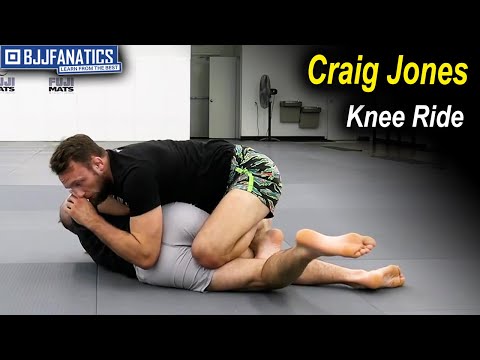

Knee Ride (May 23, 2022) and Rear Ezekiel (May 4, 2022) on BJJ Fanatics. Hit ‘Em With The Hips (May 14, 2022) is the fourth.
3. A free breakdown: Rixty Garami’s “Power Ride Retrospective”
Not Craig, but a 24-minute look at the wrestling controls in Power Ride, two years on. Good if you want the concepts before you pay.

Rixty Garami, September 6, 2024.
Compare to
- Power Ride 2.0 by Craig Jones: $197 The 2026 follow-up: top half guard as a pin, the near side underhook, octopus counters, the quad lemma, plus 51 minutes of live rounds. Buy it second. Our Power Ride 2.0 review has the full breakdown. See it on BJJ Fanatics
- Dagestani Handcuffs, Leg Rides and Mechanical Proficiency by Malachy Friedman & Greg Jackson: $99 The wrestling-first version of the same job, at half the list price. One grappler I came across got more out of it than Power Ride. See it on BJJ Fanatics
- The Complete Wrestling Riding System: Volume 1 by Hudson Taylor: $97 Folkstyle riding from a wrestling coach, for when you want the source Craig borrowed the Turk from. See it on BJJ Fanatics
- Systematically Attacking From Top Pins by Gordon Ryan: $419 bundle The opposite philosophy: the classic past-the-legs pins (mount, side control, north-south) done as well as anyone does them, at more than twice the price. See it on BJJ Fanatics
- Best Craig Jones Instructionals Ranked Where Power Ride sits among Craig’s other courses: the full Craig Jones ranking.
List prices checked on BJJ Fanatics on November 3, 2026.
Questions people ask
Should I buy Power Ride 1 or Power Ride 2.0?
Power Ride 1 first, for almost everyone. It’s the whole toolkit: legs, upper body, turtle, entries and eight finishing chapters, with 4 h 07 of teaching. Power Ride 2.0 covers one position, top half guard, with 2 h 00 of teaching and 51 minutes of live rounds. Both cost $197, and both were $88.65 with BLACKFRIDAY2026 on November 23, 2026 ($165.48 together).
What changed in Power Ride 2.0?
Five big ideas changed. The order flips: Power Ride 1 starts with the legs, 2.0 calls them “mere obstacles” and goes for the upper body grip first. 2.0 treats top half guard as a pin instead of something to pass, makes it the best position instead of the belly-down rear mount, cups the near shoulder instead of reaching to the far armpit for the crossface, and keeps the half guard leg trapped as “an anchor” where Power Ride 1 splits the legs off the leg drag. The leg rides, turtle rides and entries of Power Ride 1 aren’t in 2.0 at all.
Do you need Power Ride 1 to understand Power Ride 2.0?
No, 2.0 stands on its own: it teaches top half guard from the start. But it builds on Power Ride 1 and refers back to it, and it skips the leg rides, the turtle rides and the entries. If you own neither, start with 1.
Power Ride or Power Top?
Different jobs. Power Top, now sold as The B Team Top Game, is Craig’s no-gi passing course: it gets you past the guard. Power Ride holds him down once you are there, and Volume 5 assumes your passing already works. So the two barely overlap: loose riding against tight riding, as I heard someone put it. If you come from wrestling, weigh it differently. Someone who came to it from wrestling and MMA got less out of Power Ride and more out of how Craig explains passing in Top Game. That makes sense: the rides are closer to what a wrestler already does. Our Power Top review compares the two.
How long is Power Ride?
4 hours 9 minutes over six volumes and 49 chapters: 27:44, 30:47, 38:59, 42:40, 44:52 and 1:04:03. Of that, 4 hours 7 minutes is teaching; the rest is a 1:31 trailer. There are no live rounds.
Is Power Ride worth it?
Yes, if you play top. I rate it 10/10 after training it for three months. At the $197 list price it’s $48 per teaching hour; with the code BLACKFRIDAY2026 (tested November 23, 2026) it was $88.65, about $21 per teaching hour. I have seen it called worth full price, and I get why. With a code like that you don’t have to pay it.
Is there a Power Ride flow chart?
The system follows the volumes in five steps: pin the legs (Vol 2), add the upper body (Vol 3), ride the turtle (Vol 4), keep him in the loop (Vol 4 and 5), finish (Vol 6). The flow chart is in the “What’s inside” section of this review.
Is Power Ride free anywhere?
Four chapters are, on the BJJ Fanatics YouTube channel: Spiral Ride (chapter 4.6), Knee Ride, Rear Ezekiel and Hit ‘Em With The Hips, about 15 of the 249 minutes. “Free download” sites offer pirated copies.
Is Power Ride good for beginners?
The ideas are simple, but you need passing that gets you to the legs to reach the rides. Reddit is split on it for lower belts. My advice: blue belt with a working smash pass or leg drag, and it clicks fast.
How long until the rides work in live rolls?
Pins on day one, finishes after weeks: that was my route, in the three phases above. I am one person, though. Others report anything from a week to months. My guess is that the months are mostly the finishes, or a top game that is still new. When the pins themselves do not hold, it is often one of two things: you cannot split the legs, or you put your weight on them, lose your base and get swept. One fix worth trying is a sprawling pressure that stretches him out, which is not the same as leaning your weight on him. And against partners who lie still and wait, go for the Ezekiel: the rear Ezekiel is chapter 6.5.
Does Power Ride work if you are smaller?
Yes: lighter on top is one of the Buy it buckets above. What changes with size is which tools carry it. The leg rides fade as the size gap grows, and the mechanical grips keep working: a 160 lb grappler still gets the wrist ride, the Dagestani handcuff and the Turk on partners over 200 lb, where his weight on their legs no longer does the job. Lighter people, from under 140 to 165 lb, report it working on bigger partners, a purple belt among them on partners up to 60 lb heavier. If you are short, around 5 ft 5, the hard part is keeping weight on the legs while you reach for the upper body: go for both at once and you are light on top and easy to sweep. The wrist ride is detail 07 and the handcuff chapter 3.5, both in Vol 3. The Turk is chapter 2.4, with its Achilles hook in detail 04.
Does Power Ride work in the gi?
It’s taught no-gi, but the leg rides don’t depend on grips. Expect collar grips to change the turtle work. That is why the gi guard player sits under Maybe above. The grips cut both ways. They help you stay on: one gi-only player gets a lot out of it, and another says it almost works better there, with the friction. They also let the man underneath pull you off balance and slow your climb from the hips to the upper body. For the same idea built for the gi, the names that come up are Matt Darcy’s Art of Death Passing and Adam Wardzinski’s Pinning and Pressure Engineering.
Isn’t Power Ride just folkstyle wrestling?
Partly, and Craig says so himself: the Turk is “another move I’ve stolen from another sport, uh, wrestling, folkstyle wrestling”. What he adds is the jiu-jitsu side: entries from BJJ passes and submissions off the rides.
What does Reddit think of Power Ride?
Mostly that it’s Craig’s best, and I agree. The warning that comes with it is fair too: it’s a pinning system, not a passing system, so bring your own passing. Three takes, with my answer, are higher up this page.
Not sure which part of your game needs work first? The free chapters of The BJJ Map answer that before you buy anything. Prices are BJJ Fanatics list prices and the code we tested ourselves; codes rotate, so check the price on the day you buy.
Get the next review like this one
New reviews in this format land in your inbox, with the timestamps and loops. You also get the free BJJMore email course and the instructional-platform discounts I use myself (worth $46).
Email required. Signup includes BJJMore training emails; unsubscribe anytime.
Read next: Power Ride 2.0 review, Best Craig Jones Instructionals, Pinning and top control guide, BJJ Fanatics discount codes.
Stay on the legs
I love this instructional, it’s in my top 5 for best instructionals I ever watched. It might even be #1. If people keep escaping once you get on top, buy this one first. Don’t pay list for it.
$88.65 with code instead of $197. Tested at checkout on Nov 23.