
Home / Reviews / John Danaher / Master The Move: The Shoulder Crunch Series Review
Master The Move: Shoulder Crunch Series Review
Buy it if people keep pulling their arm out of your shoulder crunch: hold them sitting up, lie back only to sweep, and know what to take when the arm comes out anyway.
See today’s price on BJJ Fanatics →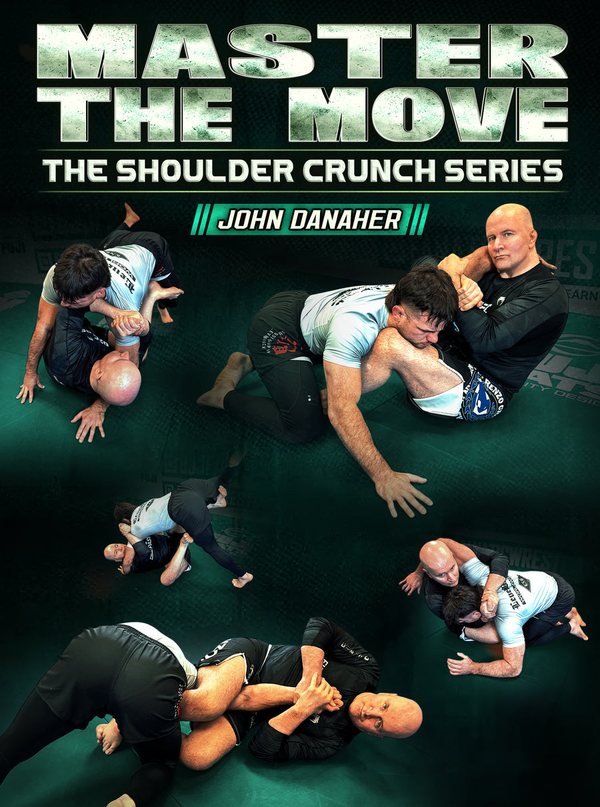
Master The Move: The Shoulder Crunch Series is John Danaher’s no-gi course on one grip from seated guard: an underhook with your hands locked around his shoulder, and the sumi gaeshi sweep that goes with it. Eight volumes: the grip and the sweep, what to do when he defends, and the two grips next to it, the pinch headlock and the high lock.
Yes, if he keeps getting his arm out
You lock your hands over his shoulder, lie back to sweep, and his head comes over yours: the arm is gone. Danaher on why it fails: “they’re supine when they should be seated” (Vol 1 · 4:12). So Danaher holds him sitting up and lies back only to sweep, with the legs. When the arm comes out anyway, two volumes show what to take.
On November 23, 2026 the shop had it at $98.50, and the house code BLACKFRIDAY2026 took that to $44.33 at checkout. That buys 4 h 24 on one underhook: each move shown, then repeated by Danaher’s two partners while he coaches. No free rolling.
11 details that are worth the money
In the order you meet them. First Danaher’s own four steps: sit up to get a grip, go under him, sit up again to hold him, lie back to sweep (Vol 1 · 3:25). Then what your opponent does to stop the sweep. Count how many of the details you already do.
Against anyone good you can’t just reach under his arm: his elbows sit tight to his sides.
So everything starts with getting one of his hands onto the mat. You sit up, take a grip, slide under him and lift. When he posts a hand to save himself, there is room under that arm.
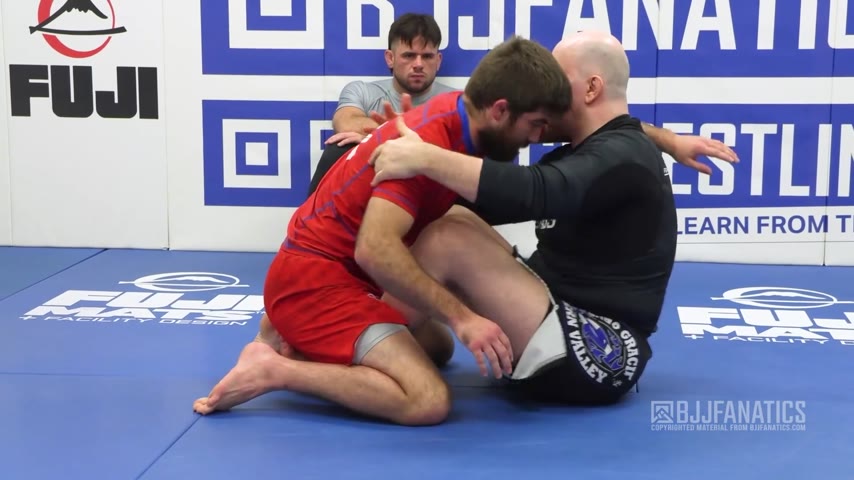
01 Arm drag: wrist deep in his armpit, his shoulder to your shoulder
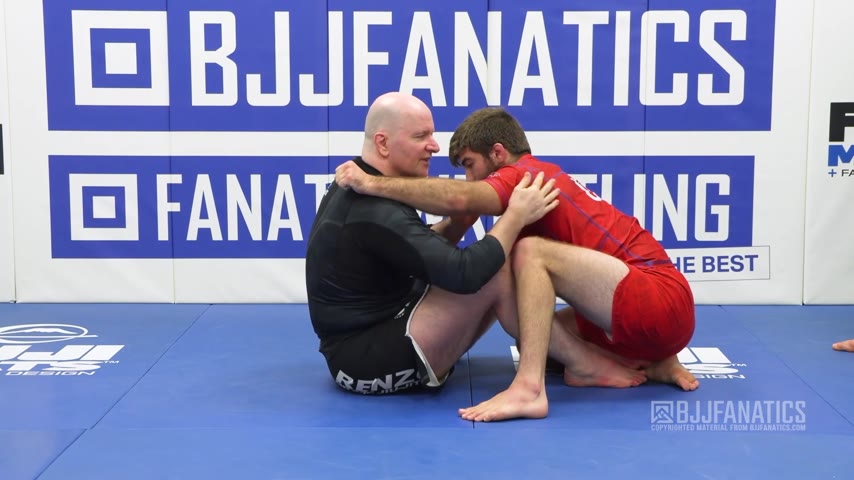
Danaher’s hand goes to his partner’s armpit, not onto the elbow, and he pulls the partner’s shoulder to his own. Pull at the elbow, Danaher says, and only the arm moves: he wants the whole torso to come. The drag only brings him close: the lift that follows is what puts his hand on the mat.
“I want wrist deep when we grip don’t grab the tricep don’t grab the elbow” Vol 4 · 51:50 “I pull his left shoulder to my left shoulder.” Vol 4 · 52:15
Vol 4 · 52:08His hand is on the mat and your arm is under his.
Danaher calls this the weak point of the whole move. Your opponent is above you, so he moves his head across yours and slips his elbow out.
02 The weak point: once his head is over yours, he rips his arm out and comes up free
The top man’s head is already past the bottom man’s head; he pulls his arm out, the bottom man grabs the wrist with both hands, and the top man rips it free and comes up. A shoulder crunch holds his shoulder, not his head. On your back you can’t stop the head from coming across.
“You do not directly control your opponent’s head with a shoulder crunch.” Vol 4 · 9:52
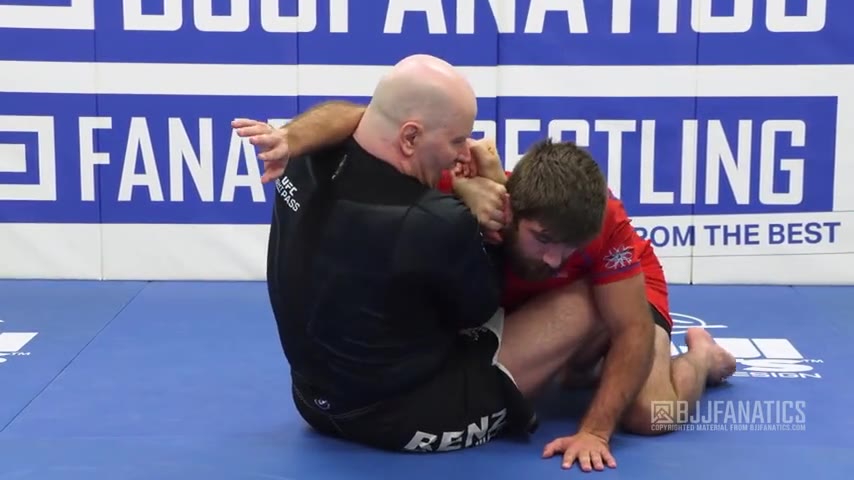
Vol 4 · 9:3903 Pinch headlock: long arm across his neck, short arm straight down, palms together, elbow tight
The fix is a second grip off the same underhook, one that locks his head in with the shoulder: one arm reaches across to the far side of the neck, the other comes down almost vertical, hands palm to palm, and the partner stays held. Danaher’s rule: on your back this is the grip that holds, and you switch to the shoulder crunch once you sit up (Vol 4 · 12:22). Vol 7 then attacks from it sitting up too (detail 10).
“Long arm, short arm, elbow in tight.” Vol 7 · 2:39
Vol 7 · 2:38Switch to the shoulder crunch as you sit up.
Sit up at an angle, along the line his trapped arm points, so his head stays beside yours. Keep your outside elbow higher than his shoulder.
The outside elbow holds. The inside elbow is where it goes wrong.
04 Inside elbow: lift it and his head comes up; keep it down at your ribs and he stays bent over
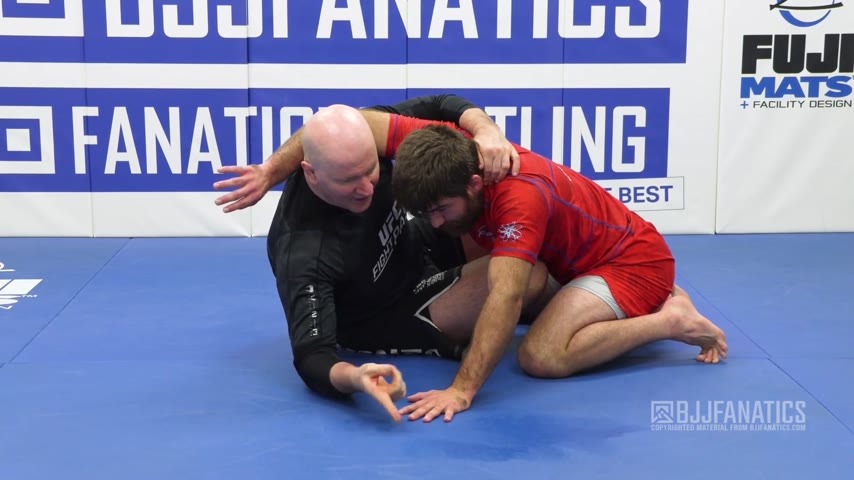
The mistake Danaher calls the biggest one with this grip. It feels as if the inside elbow should help lift. It does the opposite: as soon as it lifts, his head comes up, and Danaher says that is when he pulls free. The outside arm does the holding. The inside elbow only pushes down, to your own ribs.
“If I lift with my elbow that’s when his elbow goes to the center line and he pulls free I want my right elbow to hunker down like I bring it to my own ribs” Vol 2 · 10:47
Vol 2 · 10:49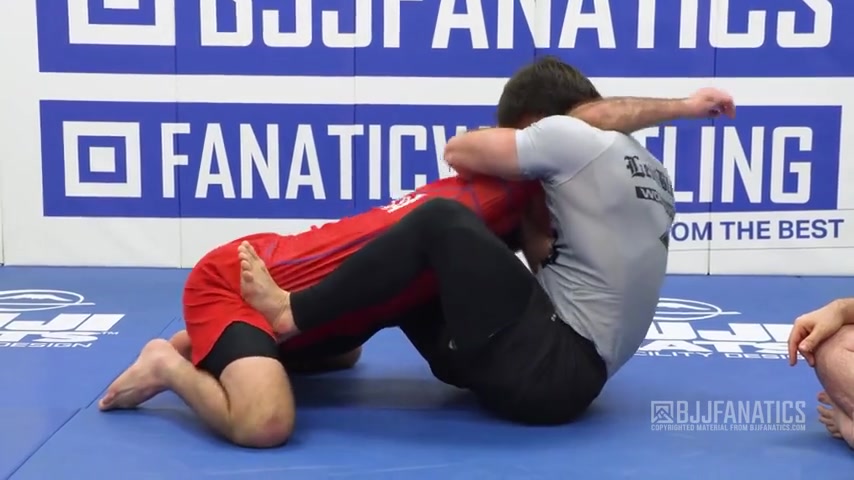 Foot on his hip
05 Foot on the hip: push one foot into his hip like a leg press
A grip on the shoulder is one point, and a man who can move his hips will wriggle out of one point. A foot pushing on his hip is the second: now he is stretched between the two. Danaher says your feet are at least half of the grip.
“Push it into his hip like a leg press” Vol 3 · 16:47 “Now it’s really tough to get away” Vol 3 · 17:08
Vol 3 · 17:05Holding him is not sweeping him.
For that you lie back a second time and lift. The arms only hold: the sweep is your legs. He has two posts left, the hand you are holding and a foot, and the foot matters most.
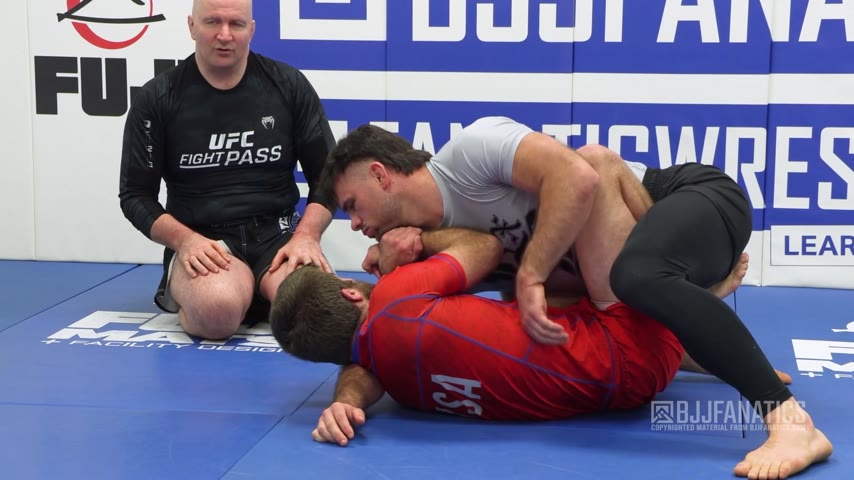
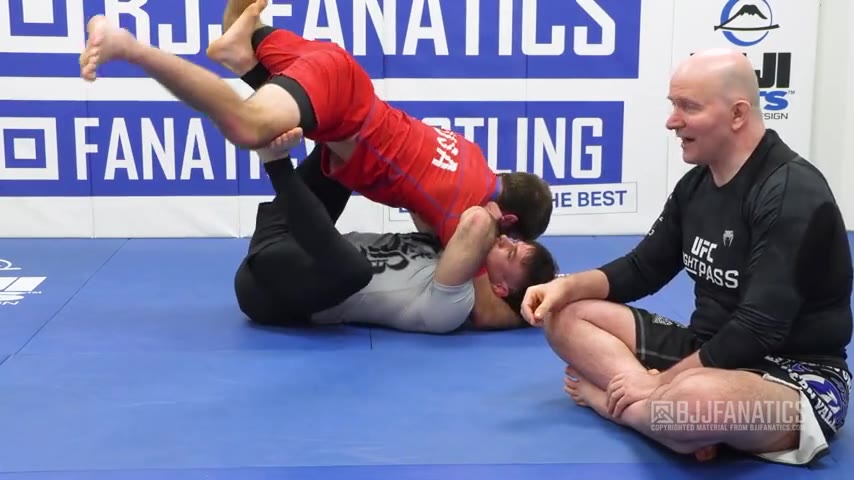
06 Push, don’t pull: both of his feet come off the mat, then he goes over
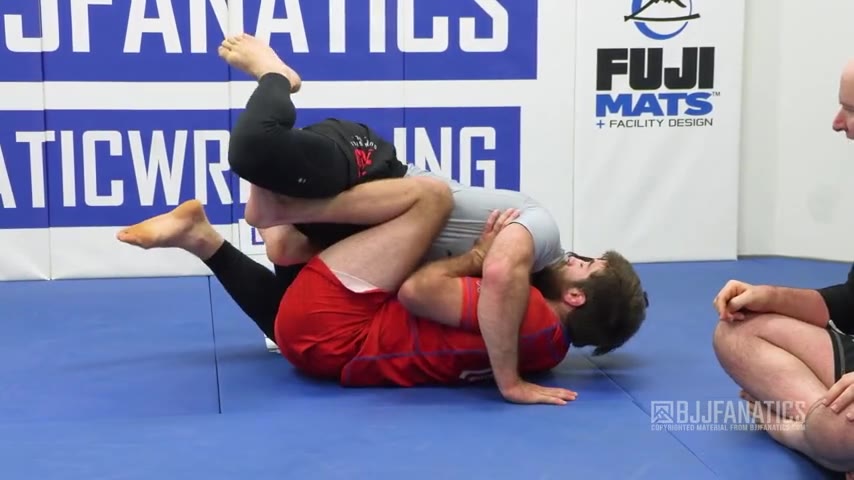
The bottom man lifts the top man until both of his feet leave the mat, then turns him over. Hook his leg from outside and pull, and his toes stay on the mat with his weight on them. Push on his knee and he has nothing left to stand on.
“You literally take his feet off the mat. There’s zero friction with the mat now.” Vol 2 · 22:26
Vol 2 · 22:25The clip at the top of this page is the fast version from Vol 3: push him around in a curve and his legs scissor over.
Danaher calls this the most common way out, and it gets easier late in a round, when you are both slippery.
Danaher does not fight to get the grip back. As the shoulder slips, clamp your elbow over his elbow, put your other hand in his armpit and turn him straight over.
Two things decide if a heavier man goes.
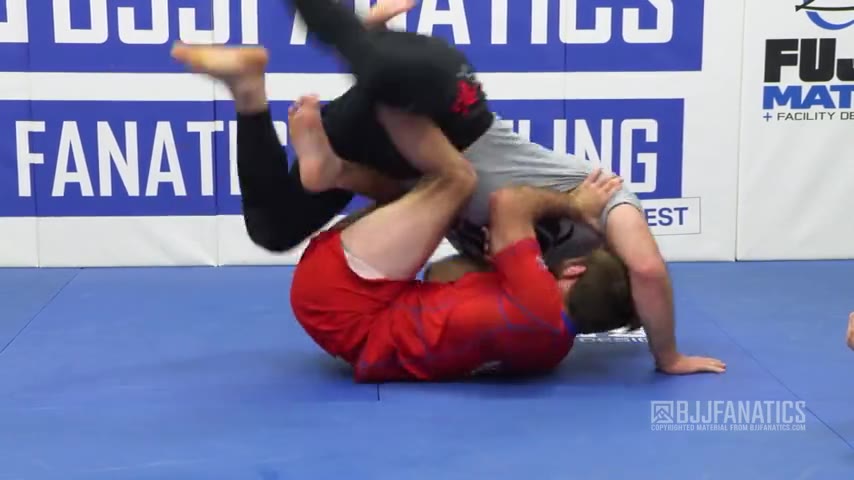
07 Knees to chest: bring your knees in and he goes over you
It is not leg strength. In the course the heavier partner cannot lift the lighter one until his knees come to his chest, and the lighter one moves the heavier one easily the same way. If the lift feels like moving a boulder, your knees are not in yet.
“No, it has nothing to do with the strength of your legs.” Vol 5 · 6:10
Vol 5 · 6:2108 Ear to ear: pull his head down next to yours, then take him over
The cue for when to go. Danaher has the lift tried with the top man’s face over the chest first: “Impossible” (Vol 5 · 6:52). Pull him down until his head is beside yours, on the side you sweep to, and take him over then.
“Bring your opponent ear to ear on the side that you’re sweeping towards.” Vol 5 · 7:10
Vol 5 · 6:59The other way to stop the sweep is to refuse to come forward: he sits back on his heels.
If he stays on two knees, Danaher goes to a triangle, to an arm lock, or pushes his knee out from under him. Against the best people, Danaher says, the more common answer is one foot up on the side of the grip. Then you go to his legs.
09 He posts a leg: your knee behind his knee, rock back, and he comes over with you
Don’t let go to reach for the leg: there is no need, Danaher says. He puts his knee behind the posted knee and rocks back, and the partner comes over with him. Keep the grip until you have rocked back. Only then let go and swing your other foot across his leg.
“It’s tempting to reach for the leg and pull it to you don’t do that” Vol 6 · 1:57
Vol 6 · 2:01The pinch headlock from detail 03 is not only for holding.
It leaves one of his hands free, and that is the hand Danaher sweeps him over. If its elbow touches the mat, his base is too narrow and a normal sumi gaeshi takes him (Vol 7 · 10:08). If he keeps the hand far out, so you can’t bend him down to the elbow, Danaher does this.
10 Pinch headlock: pin his posted wrist to the mat, then roll him over it
Your opponent stops the sweep, Danaher says, by walking that hand forward. So Danaher pins the wrist to the mat, rolls the partner over it and ends on top. You don’t have to pull the hand in. You only have to stop it where it is.
“As long as he can’t advance his hand I can sweep him” Vol 7 · 15:34
Vol 7 · 15:40When you can’t get back to the shoulder crunch, go from one underhook to two, hands locked behind his neck: Danaher calls it the high lock (Vol 8 · 26:10).
If his weight comes forward, it is the sweep from detail 06 with no grip to change. If he pulls back, you stand up with him and take him down with a body lock.
The stand-up is practised alone first.
11 Solo drill: feet far from your butt and you stay down; ankles to your butt and you stand straight up
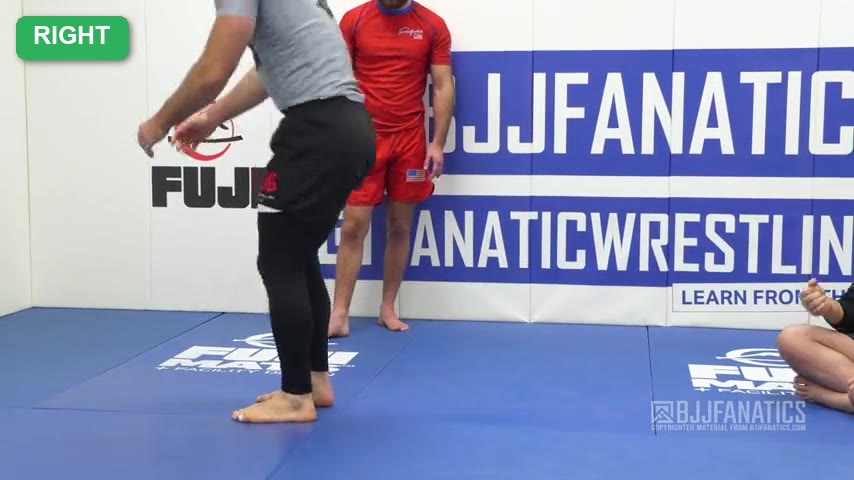
Rock back, snap your ankles to your butt and come straight up into a squat.
“Snap your two ankles right to your butt cheeks and stand up easily” Vol 8 · 6:55
Vol 8 · 6:50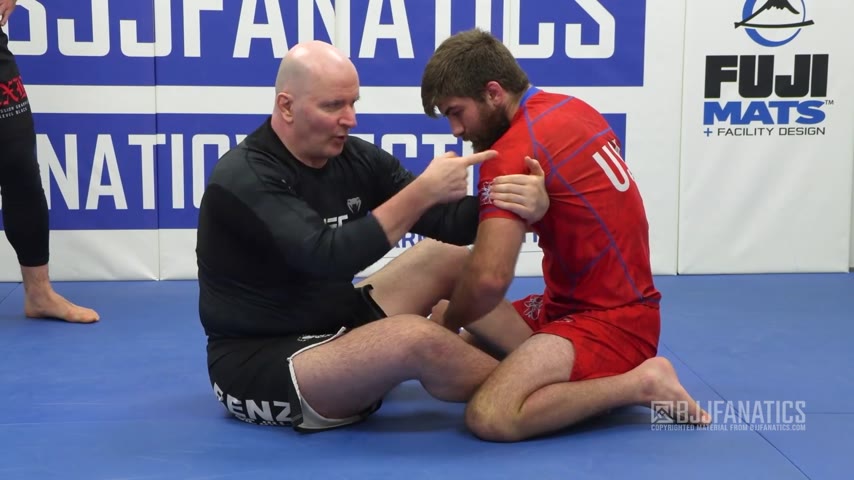 01
 02
 03
 04
 06
 07
 08
 09
 10
 11
How many of these details do you do?
Count the ones you do in a roll, not just in drilling. Each one you don’t do yet is a place where he gets his arm out or stays on top.
- No-gi
- 8 volumes, 4 h 24 min
- 33 chapters
- No free rolling
- Released August 2025
Who should buy Master The Move: The Shoulder Crunch Series
Which one are you?
- He pulls his arm out of your shoulder crunchThat is the course: where to hold him, which elbow does the work, what your feet do, and what to take when the arm goes anyway.
- You sit up into people in no-giSeated or butterfly guard is where all of it starts. One underhook gives you the sweep, arm locks and a way into his legs.
- Your partners are heavierPush his knee until both his feet leave the mat and, Danaher says, his weight is irrelevant (Vol 2 · 23:52). The lighter partner sweeps the heavier one again and again in the course.
- Older, or stiff hipsDanaher teaches it just after a double hip replacement (Vol 3 · 1:00). A BJJ Fanatics reviewer with a torn ACL says it helps him against younger and bigger partners.
- Your butterfly sweep goes forward, into himLying back to sweep can feel foreign, as one long-time butterfly player wrote on Reddit in May 2026 after watching it. The order here is sit up, lie back, sit up, lie back.
- White beltVols 1 to 4 teach the grip and the sweep from zero. Vols 5 and 6 end in triangles, arm locks and heel hooks, easier if you can already finish those.
- You train in the giNo-gi throughout. The locked grips are his answer to having no collar to hold.
 You play flat on your backEverything here starts sitting up. Danaher’s Master The Move: Omoplata fits your guard better.
- You want it shown once, fast4 h 24 on one underhook. Danaher shows a move, then his two partners repeat it while he coaches them, and he talks through almost all of it.
Worth it?
- One idea you can use tonight: hold him sitting up, lie back only to sweep. Ian B., who had struggled with the grip for years, wrote in his BJJ Fanatics review (December 2025) that Danaher showed him “exactly what I was doing wrong” in the first ten minutes
- He shows how the grip fails before he fixes it: the inside elbow that lifts, no foot on the hip, his head over yours. Each one is shown failing on a partner who is trying to get out
- Every way out has an answer: the arm slips, he sits back, he posts a foot or a hand, he pulls back. And when the shoulder crunch is gone, the pinch headlock or the high lock is there
- Details you have not seen elsewhere: a brown belt who owns over 50 BJJ Fanatics courses wrote in his review there (August 2025) that he could not believe how many he had been missing
- Long for one underhook: Danaher shows each move, then both partners repeat it, and the last 18 minutes of Vol 8 are a recap
- The order: getting his hand to the mat, the first thing you need, comes two hours in, at 40:13 of Vol 4. Watch that part right after Vol 1
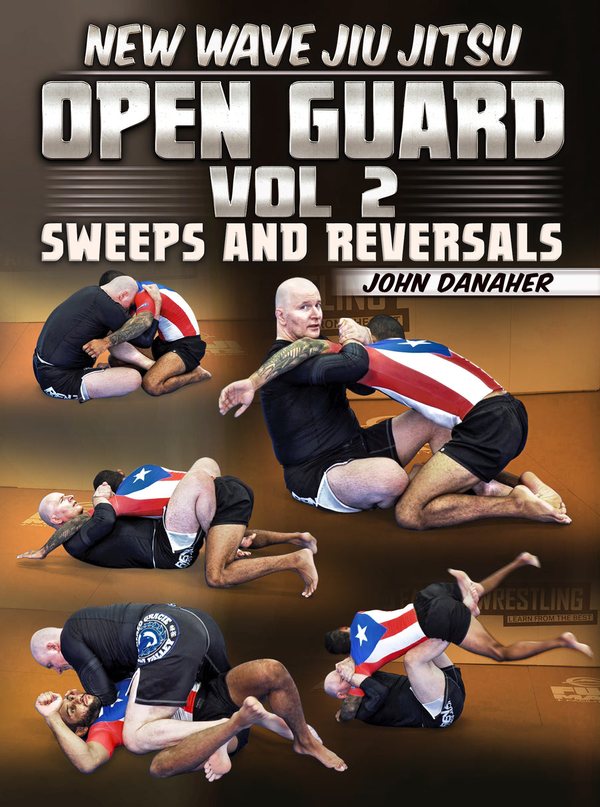
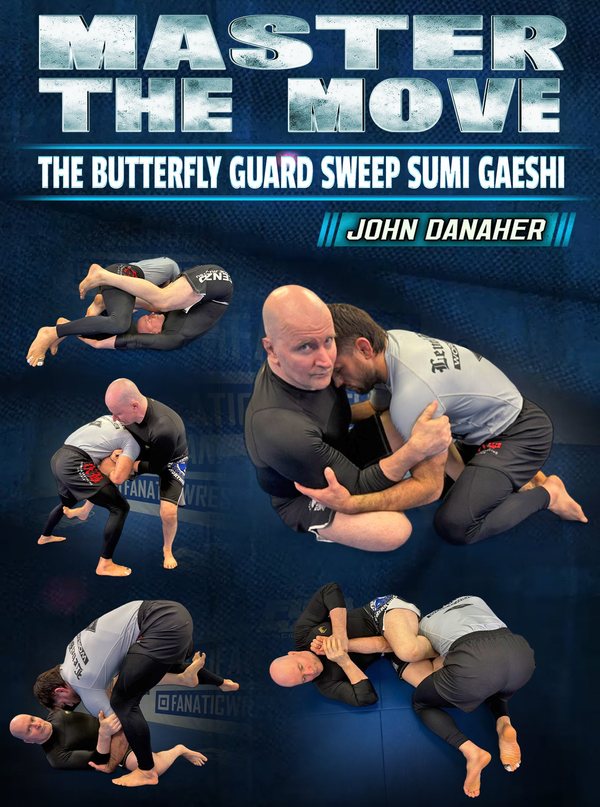
- He teaches this sweep elsewhere too: New Wave Jiu Jitsu: Open Guard Vol 2 (2021) has a shoulder crunch sumi gaeshi chapter, and Master The Move: The Butterfly Guard Sweep Sumi Gaeshi came out two months after this one, in October 2025
- No free rolling and no matches: the resistance is short tests on the move being taught
- Pricey for one underhook. On Reddit, someone who got it on a daily deal with a coupon wrote in October 2025 that it “definitely helped” and was “worth it for just a few details”. In March 2026 he called it a money grab next to Danaher’s older sets. My read: buy it with a code
The sharpest complaint, from a viewer on Reddit in October 2025: “maybe 25 minutes of ACTUAL instruction”.
Fair, if you only count the first showing of each move. The rest is the two partners repeating it while Danaher corrects them.
Learn from watching reps get corrected? That is where the value is. If not, do what Fritz M. advises in his BJJ Fanatics review (October 2025): “watch at 1.5 or 2.0 speed instead of normal”.
All eight volumes, the pinch headlock and high lock series included. House code BLACKFRIDAY2026
What’s inside
Takeaway: half the course is the one sweep from the one grip. Then two volumes on the ways he stops it, and two on the grips you switch to.
Minutes per volume- The shoulder crunch sumi gaeshi (2 h 21)
- His answers when he defends it (56 min)
- The pinch headlock and the high lock (1 h 07)
The rule behind it
“Once you get the hand to the mat, we start digging for underhooks. Of one underhook, you’re going to have three very useful grips. The shoulder crunch, the pinch headlock, and the highlock.”John Danaher, Vol 8 at 32:22
The first two work as a pair: the pinch headlock holds, the shoulder crunch sweeps. Danaher says it was only when he started using the two together that he could sweep the toughest people in his gym (Vol 4 · 14:44). He is honest about the limit too: when a man stands all the way up, the shoulder crunch will not last, and you go to his legs (Vol 6 · 18:11).
The eight volumes
The four steps
Why the grip exists, then the whole move once through: sit up for a grip, go under him so his hand goes to the mat, sit up again to hold him, lie back to sweep. Short, and the map for everything after it.
Vol 1 with timestamps
Introduction (0:00), the four steps from seated guard (2:44).
The grip and the biggest mistake
The grip itself, with your outside elbow higher than his shoulder. Then the biggest mistake with it, the inside elbow that lifts (detail 04), how to take away the hand and the foot he stands on, and why you sit up at an angle.
Vol 2 with timestamps
Key details: high elbow, shoulder to shoulder (0:00), the single biggest mistake with the grip (7:05, detail 04), removing the posts (13:40, detail 06), the forward shift at an angle to prevent pull-outs (26:24).
Off the centre line, and your feet
How to get your foot to his knee without flexibility, how to push on his leg, why your feet are half of the grip, and why you learn this one on both sides: when he pulls one arm out, his other hand is on the mat.
Vol 3 with timestamps
Shifting him off the centre line (0:00), how to push on his leg (6:24, the clip at the top), the crucial use of the feet (13:42, detail 05), switching side to side (23:33).
The weak point and the hand to the mat
The longest volume and the one to watch twice. The weak point of the move and the pinch headlock that fixes it, why you don’t just sweep from the pinch headlock, the high lock, why locked grips replace the collar in no-gi, and at last the ways to get his hand to the mat.
Vol 4 with timestamps
The single biggest weak point and how to overcome it (0:00, detail 02), why not just sweep from the pinch headlock (16:36), the high lock (25:02), the theory of closed grips from guard (33:23), getting the hand to the floor (40:13, detail 01), the two-stage method (55:16).
The elbow slip and the rock back
The two ways out you will meet most. For the elbow slip: the turnover when the arm is already going, with details 07 and 08. For the man who sits back on two knees: a triangle, two arm locks and a second sweep that pushes his knee away.
Vol 5 with timestamps
The elbow slip (0:00, details 07 and 08), the rock back to the triangle (10:42), ude gatame (18:10), juji gatame (22:12), hiza guruma (28:01).
He posts a leg or stands up
When he sits back with a foot up, or stands: into ashi garami, the outside heel hook, kani basami, and the ankle pick to cross ashi. Detail 09 is the way in to all of it.
Vol 6 with timestamps
He posts a leg or stands: ashi garami to the outside heel hook (0:00, detail 09), ashi garami to kani basami (4:58), ashi garami sweep into heel hooks (11:45), ankle pick to cross ashi (18:31).
The pinch headlock series
The pinch headlock as a grip to attack from: the push on his knee, two sumi gaeshi for when his free elbow or hand is on the mat, the straight arm lock, and the way up to his back.
Vol 7 with timestamps
Hiza guruma when he is on two knees (0:00, detail 03), elbow on the floor sumi gaeshi (8:50), hand on the floor classic sumi gaeshi (12:55, detail 10), ude gatame from the pinch headlock (18:29), pinch headlock to tight waist (22:42).
The high lock, then all of it together
The high lock: the same sweep with both arms under his, and the stand-up to a body lock when he pulls back, with detail 11. The last 18 minutes are a recap in another gym that runs through all three grips.
Vol 8 with timestamps
Sumi gaeshi from the high lock (0:00), high lock into a standing body lock (5:27, detail 11), putting it all together (15:06).
Timestamps are volume times, so you can jump straight to the part you want to rewatch.
Free on YouTube: BJJ Fanatics posted three chapters, about 12 minutes or 5% of the course: the two-stage method of getting the hand to the floor (Vol 4), the elbow on the floor pinch headlock sumi gaeshi (Vol 7) and hiza guruma (Vol 5). Watch those first if you are unsure about the Danaher pace.
Compare to
Two more from the same series, and two other courses with this sweep. Every Danaher course I review is in the best John Danaher instructionals.
Master The Move: OmoplataJohn DanaherFor you if you play from your back. Same series, same format: one move from guard, built until it holds.Read my review → Master The Move: The Ankle LockJohn DanaherFor you if he puts a foot up and you would rather finish with the straight ankle lock. Vol 6 here goes into ashi garami, but it finishes with heel hooks.Read my review →
 Systematically Attacking From Open Guard: Seated PositionGordon RyanFor you if you want the whole seated guard: about 10 hours, with the shoulder crunch sumi gaeshi as one of its moves. Danaher’s goes deeper on why this one grip holds and where it fails.Read my review →
 Simplify The System: Sumi GaeshiBrian GlickFor you if you want the sweep wider: 6 h 18 on the sumi gaeshi from butterfly guard, grips at distance and close, with the pinch headlock as one grip of several. Danaher goes deeper on the three locked grips.
Get the next review like this one
New reviews in this format land in your inbox, with the timestamps and clips. You also get the free BJJMore email course and the instructional discounts I find.

BJJMore earns a commission if you buy through these links, at no extra cost to you. Released August 2025; reviewed on all eight volumes.
FAQ
Is Master The Move: The Shoulder Crunch Series worth it?
Yes with the code, if you play seated or butterfly guard in no-gi and people keep pulling their arm out of your shoulder crunch. BLACKFRIDAY2026 took 55% off the $98.50 sale price at checkout on November 23, 2026: $44.33 (list $197), about $10 per hour.
What is the shoulder crunch in BJJ?
An underhook from seated guard with your hands locked around his shoulder: your outside elbow higher than his shoulder, his upper arm jammed against your neck. The sweep that goes with it is the sumi gaeshi. Danaher says he developed the grip in the late 1990s and early 2000s, because the pinch headlock he started from was too tight to attack from (Vol 1 · 0:13).
How long is the Shoulder Crunch Series?
4 hours 24 minutes over 8 volumes and 33 chapters. Vol 4 is the longest at 1 hour 1 minute; Vol 1 is 16 minutes. Vols 1 to 4 (2 hours 21 minutes) are mostly the shoulder crunch sumi gaeshi itself.
Is it the same as Danaher’s other sumi gaeshi courses?
Partly. New Wave Jiu Jitsu: Open Guard Vol 2 (2021) already has a shoulder crunch sumi gaeshi chapter, and Master The Move: The Butterfly Guard Sweep Sumi Gaeshi followed in October 2025. What this set adds: why the shoulder crunch grip holds and where it fails, the answers to the elbow slip and the rock back (Vol 5), the way into his legs when he posts a leg or stands up (Vol 6), and the pinch headlock and high lock series (Vols 7 and 8).
Do you need to be flexible for the shoulder crunch sumi gaeshi?
No. Danaher says he filmed it just after a double hip replacement (Vol 3 · 1:00). The hard part for stiff hips is getting your foot above his knee. His way: use both feet to move the man off your centre line first, so the foot only has to travel a little.
Does it work on bigger, heavier people?
That is what the push is for. Pull on his leg and his foot stays on the mat with his weight on it. Push on his knee until both feet are off the mat and, as Danaher puts it, the weight becomes irrelevant (Vol 2 · 23:52). The lighter partner sweeps the heavier one again and again in the course.
What do I do when he pulls his arm out of the shoulder crunch?
Three answers. Hold him with a pinch headlock while you are on your back and switch to the shoulder crunch only once you sit up (detail 03). If the arm is already slipping, clamp his elbow and turn him over (details 07 and 08). And if the arm is gone, look at his other hand: he needs it on the mat to pull out, so that arm is there to take (Vol 3 · 26:51).
Is it gi or no-gi?
No-gi. The locked grips are Danaher’s answer to having no collar: in the gi the collar controls how far his head is from yours, and without it these grips are one of the few things that do (Vol 4 · 36:47). A gi appears briefly in Vol 4, to show the collar grip they replace.
Does it show live rolling?
No free rolling and no competition matches. What you get is short tests in most volumes, where the partner is told to get out any way he can, and a few unscripted exchanges between the two partners in Vol 8 (13:51).
Is any of it free?
About 12 minutes: BJJ Fanatics posted three chapters on YouTube (the links are under What’s inside). Outside the course, Brian Glick has free shoulder crunch videos on YouTube.
Hold him sitting up, sweep him lying back
If you reach the shoulder crunch and he pulls his arm out or won’t go over, this is the course for it: where the grip holds, how the legs do the sweep, and what to take each time he gets out. Get it with the code.