
Home / Reviews / Takedowns / Mastering No Gi Takedowns Review
Mastering No Gi Takedowns Review (Travis Stevens)
Buy it if your throws stop working when the gi comes off: Stevens rebuilds them on the underhook, the overhook and the Russian tie.
See today’s price on BJJ Fanatics →
Mastering No Gi Takedowns is judo for no-gi from Travis Stevens, Olympic silver medalist in judo and a black belt under John Danaher: four parts, about two hours.
You learn to recreate lapel-sleeve control with clinch ties. Throws are adapted to land in dominant positions. It trades theoretical depth for pace and practical drilling.
Throws that don’t need a jacket
The gi comes off and there is nothing left to pull on.
Stevens swaps the lapel and sleeve for an underhook and moves the man with his shoulder and his torso, not his hands: “I want to be able to keep my feet where they are and then move him.” (Part 2 · 0:45) Then he throws, and he lets go as the man goes over, so he is the one who ends up on top.
$79 at list. No live rounds, no double legs, and it assumes you can already take a fall.
3 details that are worth the money
Without a jacket there is no lapel to pull him off balance with.
Stevens does it with his shoulder. Feet planted, he rolls the shoulder and pulls with his torso until the man’s weight sits on one leg (Part 2 · 0:35), and he comes back to it later in the same part: “the most important thing you could develop from this underhook is your shoulder roll” (Part 2 · 12:28). The three clips below are what happens around that pull, in the order they come up in a no-gi exchange: his hand on your neck, your throw, the landing.
Check which of the three you already do.
- 1He puts a hand behind your necktake the arm (Part 1)
- 2You have the underhook and can’t reach his legsthrow him past your leg (Part 2)
- 3He is going over and you are still holding onlet go (Part 2, Part 3)
He puts a hand behind your neck
Stevens does not fight the hand off. He traps it.
His head and shoulder pinch the wrist, his hand comes up to the forearm, and he rolls the arm off his neck and drags it past his body. He calls the grip he ends in a Russian two-on-one, and says what it is for: “I can be a little bit of a bully” (Part 1 · 13:41). The last part of the course throws from it.
01 Collar tie: pinch his wrist, roll the arm off your neck
His partner’s hand is behind his neck. Stevens pinches that arm between his head and shoulder, lifts the forearm off his neck and pulls the arm across his body. “I pinch it so that I’m in control now.”
Part 1 · 11:55You have the underhook and can’t reach his legs
The Russian is one way to win the grip. The underhook is the one Stevens is happy to stay in: “a hangout position” (Part 1 · 4:18).
From there the wrestling answer is to throw the arm by and go to the legs or the back. A good defender stops that: his head in your neck, his leg back. This is where the judo comes in. “We’re going to throw a little something at him that he’s probably never seen before.” (Part 2 · 6:41) Stevens takes the wrist with his free hand and turns in.
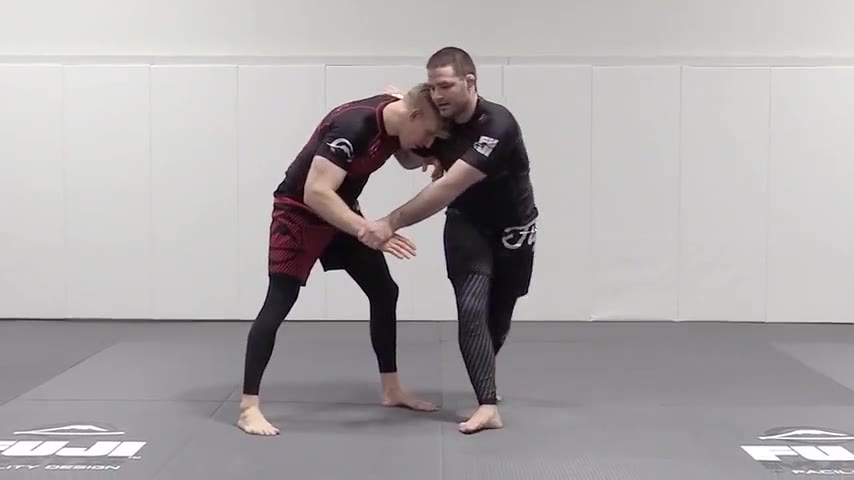
02 Tai otoshi from the underhook: wrist, back step, legs wide
No gi to hold: with the underhook and a hold on the wrist he back steps, spreads his legs wide and pulls his partner past his leg to the mat. His own count: “Back step. Leg goes wide. Big turn.”
Part 2 · 9:09He is going over and you are still holding on
This is the part people skip.
In Part 2 and Part 3 Stevens keeps coming back to one rule for the landing: once the man is going over, let go and put your hands on the mat. “Don’t attach yourself to him. It’ll be too easy for him to roll you through and then he’ll end up with the two points.” (Part 2 · 29:25) Below he does it wrong on purpose.
One throw is the exception, and he says so: on the sumi gaeshi you keep his arm pinned to your chest, or he rolls away (Part 4 · 15:22).
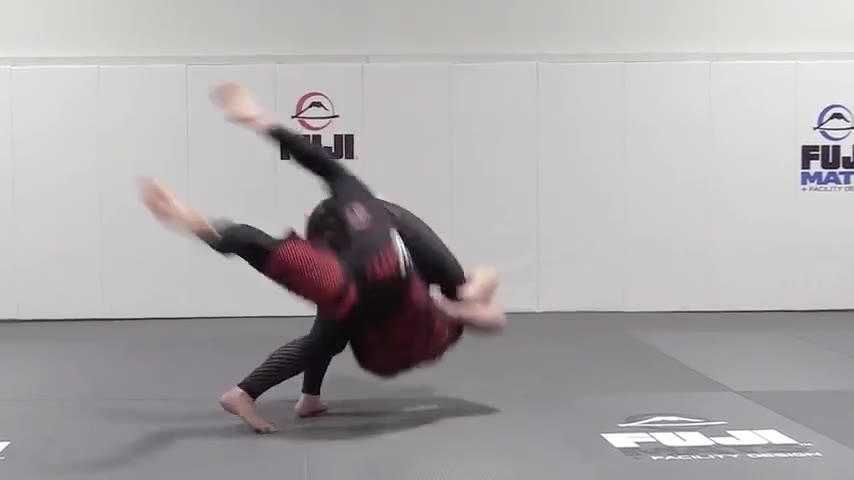
03 The mistake: stay attached and he rolls over you
Stevens throws with an uchi mata and stays attached as they fall. His partner rolls over him and ends up on top. He announces it first: “I’m going to keep my hand in here and keep his wrist and all he’s going to do is roll over.” And after: “I made something that could have been spectacular look really stupid.”
Part 3 · 7:05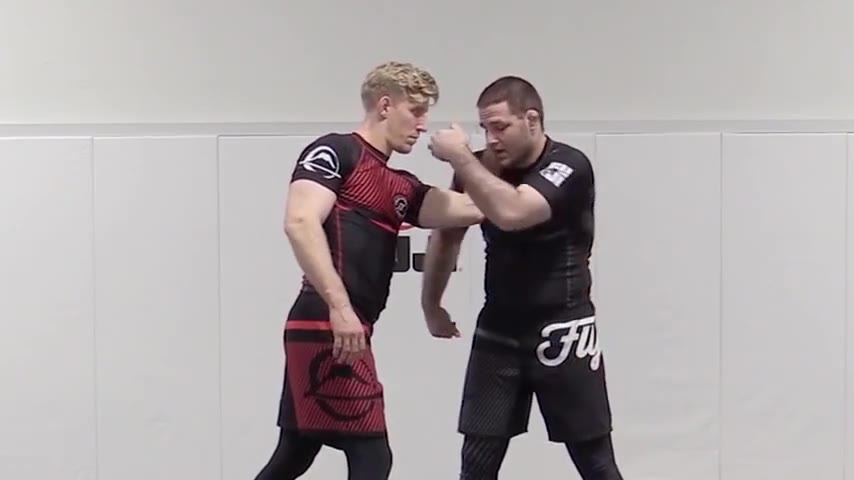 01
 02
 03
Three checks for your next no-gi round
Do you turn his collar tie into your own grip? Do you have a throw for when he blocks your underhook? Do you let go when he goes over? If one answer is no, that is what this course is for.
- No-gi
- 4 parts, 2 h 04
- No live rounds
- One partner, in a studio
- On BJJ Fanatics since April 2020
Who should buy Mastering No Gi Takedowns
Find yourself in a bucket, one reason each.
- You come from judo or the gi and now train no-giThe throws you know (harai goshi, tai otoshi, uchi mata, ouchi gari, kosoto gari, sumi gaeshi), on grips you can get without a jacket.
- You would rather clinch than shootAlmost all of it starts from the over-under clinch or the Russian tie. There is no double leg in the course.
- You keep ending up under his underhookPart 3 is five throws from the overhook, for when he has the underhook and head position. Stevens’ words: “all of these throws are going to come off bad positioning” (Part 3 · 0:49).
- New on the feetPart 1 starts from zero: how to pummel, how to hold a Russian. But nobody teaches you to fall here, and the turn throws need timing. The sweeps-and-trips course under Compare to is an easier start.
- WrestlerThe over-under and the front headlock are home for you. What is new is what Stevens does when the throw-by is blocked.
- Gi onlyThere is not one lapel or sleeve grip in it. The gi course from the same teacher is under Compare to.
- You want wrestling shotsThe leg attacks are few: a single leg off the front headlock, ankle picks and a fireman’s carry. No double leg.
- You want to see it against resistanceOne cooperative partner, no live rounds, no match clips.
Worth it?
- One idea through all four parts: the jacket is gone, so the underhook, the overhook and the Russian tie do its job
- The off-balance comes from a drill you can practise in any clinch: feet planted, roll the shoulder, get his weight onto one leg (Part 2 · 0:35)
- A whole part for when you are losing the clinch: five throws from the overhook (Part 3)
- He teaches the landing as part of the throw, and shows what happens when you hold on (detail 03)
- Built for jiu-jitsu, not for judo scoring: one finish of the kouchi to the ankle is to sit into X guard, “because this is a takedown for jiu-jitsu” (Part 2 · 17:37)
- Honest about what is a setup: foot sweeps are for “setups and distractions for your bigger better throws” (Part 4 · 7:48)
- Short: 2 h 04, and all of it is teaching
- No live rounds and no match clips: you never see it against someone who resists
- No double leg, and little for the legs at all. For shots, see the best takedown instructionals
- Harai goshi and uchi mata are turn throws: you turn your back to him to throw. If that worries you, the sweeps-and-trips course under Compare to is the easier start
- Nobody teaches you to fall. Stevens films on a sprung floor and says so (Part 4 · 7:40)
- Stevens says himself that harai goshi is “a lot less dynamic” without the gi (Part 2 · 3:58)
- The camera sits wide, so the small grips (the wrist, the thumb in the armpit) are easy to miss
Does he use it himself? His Olympic medal is in the gi. We have not found a no-gi match of Stevens to put next to these clips, and the course has no live rounds.
All four parts, about two hours.
What’s inside
Biggest takeaway: Create kuzushi without fabric
That is the whole course in one line. Part 1 gives you the grips that replace the jacket and the front headlock. Parts 2 and 3 are the throws: from the underhook when you are winning the clinch, from the overhook when you are losing it. Part 4 adds foot sweeps and three attacks off the Russian tie.
The four parts
Part 1 · 42:18Grips and the front headlockNo throws yet. First who is winning the clinch: Stevens calls the underhook a place to stay and the overhook a place to leave. Then pummeling with footwork, the Russian two-on-one and the two-on-one. The second half is the front headlock, which he calls one of his favorite positions in no-gi: a way in from the underhook, a way in from the overhook, the snap down to a go-behind, and a single leg.
Part 1 with timestamps: Overhook against underhook (0:12), pummeling (4:53), the Russian two-on-one (9:58, detail 01 is at 11:55), the two-on-one (14:44), underhook to front headlock (19:09), overhook to front headlock (23:09), snap down to a go-behind (29:37), front headlock to a single leg (36:11).
Part 2 · 29:42Five throws from the underhookHarai goshi comes first and with it the shoulder roll. Then tai otoshi (detail 02), a kouchi to an ankle pick with five ways to finish, a deeper kouchi out of the pummel, and knee osoto. Stevens also shows the landing: on his feet after the harai goshi, hands on the mat after the tai otoshi, the deep kouchi and the knee osoto.
Part 2 with timestamps: Harai goshi (0:12), tai otoshi (6:09, detail 02 is at 9:09), kouchi to an ankle pick (12:13), deep kouchi (18:22), knee osoto (23:01).
Part 3 · 31:38Five throws from the overhookHe has the underhook and head position, and you are being stood up. Stevens gives five throws for that: a hopping uchi mata in two versions, kosoto gari with a body lock, ouchi gari, a fireman’s carry and tai otoshi. The tai otoshi comes with a way back to the front headlock for when your arm gets stuck. Detail 03 is from the uchi mata.
Part 3 with timestamps: Hopping uchi mata, two versions (0:12, detail 03 is at 7:05), kosoto gari (8:00), ouchi gari (15:09), fireman’s carry (20:44), tai otoshi (25:11).
Part 4 · 20:44Foot sweeps and the Russian tieThe first eight minutes are foot sweeps: learning to walk in step with a partner, then sweeping on the move. Stevens treats them as setups more than as takedowns. The rest is three attacks off the Russian tie: an uchi mata that takes you to his back, sumi gaeshi, and a kouchi for when the uchi mata does not come off.
Part 4 with timestamps: Foot sweeps, walking and the basic sweep (0:12), a setup with a spin (4:38), uchi mata off the Russian tie (7:56), a sit and twist he says works on jiu-jitsu players (11:32), sumi gaeshi (12:36), kouchi after an uchi mata (16:45).
Compare to
Three courses that sit next to this one. The full lists are in the best takedown instructionals and the best judo instructionals.
- The Takedown Blueprint (Jimmy Pedro and Travis Stevens): The gi course from the same teacher, with his coach. Ten judo throws for the gi, and a third DVD on four kinds of opponent. Take it if the jacket stays on. See it on BJJ Fanatics.
- American Judo System: The Osoto-Gari Encyclopedia (Travis Stevens): Eight parts on one throw, from shadow drills to combinations. This course has one osoto, the knee osoto from the underhook in Part 2. Take the Encyclopedia only if osoto gari is going to be your throw. See it on BJJ Fanatics.
- No-Gi Judo: Foot Sweeps and Trips (Shintaro Higashi): Also judo without a jacket, but built on sweeps and trips, and it starts at first contact: posts, wrists, the head. The easier start if you are new on the feet. See it on BJJ Fanatics.


Get the next review like this one
New reviews in this format land in your inbox, with the details on video. You also get the free BJJMore email course and the instructional-platform discounts I use myself (worth $46).

BJJMore earns a commission if you buy through these links, at no extra cost to you. On BJJ Fanatics since April 2020; reviewed on all four parts.
FAQ
Is Mastering No Gi Takedowns worth it?
If you train no-gi and want throws from the clinch, yes. It lists at $79 for 2 hours 4 minutes, and all of that is teaching. It gives you three grips to replace the jacket, ten throws from the underhook and the overhook, and a rule for landing on top. It is not the course for wrestling shots: there is no double leg in it.
How long is Mastering No Gi Takedowns?
2 hours 4 minutes in four parts: 42 minutes on grips and the front headlock, 30 minutes of throws from the underhook, 32 minutes of throws from the overhook, and 21 minutes on foot sweeps and the Russian tie.
Is it good for beginners?
Partly. Part 1 starts from zero, with how to pummel and how to hold a Russian tie, and every throw is taught from the grip up. But there is no lesson on falling, and throws like harai goshi and uchi mata need timing. Stevens names the blue and purple belt range once, for an easier way to get the wrist (Part 3 · 27:07).
Does it teach double legs or other wrestling shots?
No double leg. The leg attacks are a single leg off the front headlock (Part 1 · 36:11), an ankle pick after a kouchi (Part 2 · 12:13 and Part 4 · 16:45) and a fireman’s carry (Part 3 · 20:44). Most of the course is throws from the clinch.
Do I need a judo background?
It helps. Stevens uses the Japanese names (harai goshi, tai otoshi, uchi mata, kosoto gari, ouchi gari, sumi gaeshi) and does not teach falling. He does teach each throw from the grip, so a jiu-jitsu player who has done some standing work can follow it.
Can I use it in the gi?
The throws are judo throws, so they exist in the gi too, but every grip in this course is a no-gi grip: underhook, overhook, wrist, Russian tie, front headlock. For the gi, Stevens and Jimmy Pedro have The Takedown Blueprint.
Is there a free version?
No. Going by their titles, two short BJJ Fanatics uploads on YouTube are chapters from it: “Ko Uchi To Ankle Pick from Travis Stevens” (3:48) and “Advanced Movement and Feel with Travis Stevens” (3:18). Stevens has more no-gi takedown videos on his own channel, but they are not this course.
Who is Travis Stevens?
An American judoka who won Olympic silver in 2016, and a jiu-jitsu black belt under John Danaher. On BJJ Fanatics he has judo courses for the gi and for single throws as well; this is the one built for no-gi.
Three grips instead of a jacket
Buy it now. I put this top-three because most BJJ gyms spar no-gi weekly, and this course answers the lapel problem cleanly.
It is №3 in our judo ranking. If your throws stop when the gi comes off, this is the short course for that. If you want shots, it is not.
$79 at list on BJJ Fanatics. House codes rotate.