
Home / Mica Galvao / Next Generation Closed Guard Review
Mica Galvao’s Next Generation Closed Guard Review
Buy it if your closed guard goes quiet once he grips your lapel: in this course the grip he takes picks your attack. When he stands up instead, you sweep him.
See the course on BJJ Fanatics →Gi course. Who should buy it ↓
- Gi
- 4 volumes, 3 h 10
- 34 chapters
- Released February 2021
Galvao recorded Next Generation Closed Guard as a 17-year-old brown belt. Three volumes are about the grips the man in your guard takes while he is on his knees; the fourth is for when he stands up.
Stop fighting his grip and use it
You close your guard. He takes your lapel, leans on you and waits, and whatever you try gets stopped. Galvao’s answer: “I don’t need to fight against him” (Vol 1, 49:16). The hand on your lapel is the way to his back, and each way he defends that is your next attack. For the gi player whose guard goes quiet once he grips or stands up. No live rounds.
$79 list, $35.55 with the Black Friday code we tested on November 23, 2026, for 3 h 10.
What he does, and your answer
On his knees first. Then on his feet.
Most people who land in your closed guard take a grip first, and Galvao wants that hand. He calls what follows the cross grip; you may know it as the 2-on-1. Wait until the grip goes light, get it off your lapel, take his arm behind the armpit and pull your knees to your chest until his shoulder lands on your chest (Vol 1, 16:10 to 18:34). From there he goes for the back. He says it is one of his favourites in competition (Vol 1, 15:46).
01 He grips your lapel: cover his gripping hand with yours, then push it off to the side and hold his wrist
Where your hand lands is the detail. Not up on his wrist, he says, but on his fingers: “on the fingers, it hurts a little bit” (Vol 1, 16:46). And he does not want a hard shove: on top first, then to the side (Vol 1, 16:50).
Vol 1 · 20:0502 Then keep one leg high over his back, plant your other foot on the mat and turn onto your side
He rolls over and ends up sitting in front of you, with you behind him. The high leg is there, Galvao says, so the man cannot make space once your guard opens. The foot on the mat is what moves your hips out, and if he does not come on the first try, you do it again (Vol 1, 19:08 to 19:45).
Vol 1 · 23:01The usual defence. You pull his shoulder down, he plants a hand on the mat and puts his weight on you, and the back is gone. Galvao takes that as the opening for the armbar (Vol 1, 23:48). Hug him first, so he cannot sit back up. Then a foot on his hip, slide your hips up, and your legs go over his shoulder (Vol 1, 26:43 to 27:29). If he pulls that arm out, you clamp the arm he left behind and armbar that one (Vol 1, 33:53).
03 He is bent over you with his head down: swing one leg up over his shoulder, bring the other leg up and cross your feet high over his back
His arm is trapped inside your legs. The rule he repeats for this step: “always your head goes to his wrist” (Vol 1, 27:31). And he lets go of no grip before the hug is in, or the man escapes (Vol 1, 29:36).
Vol 1 · 29:01Some people do not post at all. They just lie on you. Galvao says this is where he sees people give up, let go and settle for closed guard again (Vol 1, 36:52). He stops chasing the back, keeps the arm and tips the man off balance (Vol 1, 37:45 to 38:00).
04 He lies heavy on your chest: swing your free leg up so it sits against his armpit, then sweep him over and come up in mount
Not to the side, Galvao says: that way the man does not fall. The inside of your knee goes in behind his armpit (Vol 1, 38:21 to 38:33). He also puts his other foot on the mat right next to the man’s leg, so he cannot step it out and base (Vol 1, 38:06).
Vol 1 · 40:11Everything so far starts from fingers you can reach. Galvao names the limit himself: the 2-on-1 becomes a problem when the grip sits a little lower or a little higher (Vol 2, 0:38). Low on your pants there are no fingers to reach, and high on your collar you cannot push the arm away (Vol 2, 1:18 and 4:20). So you go under the grip. Once it is off, your arm goes inside his, circles it and takes his collar as deep as it will go. He calls that the underhook, and Volume 2 is six attacks from it, again picked by what the man does: room at his neck, the choke; no room, the armbar; he turns his arm, the omoplata.
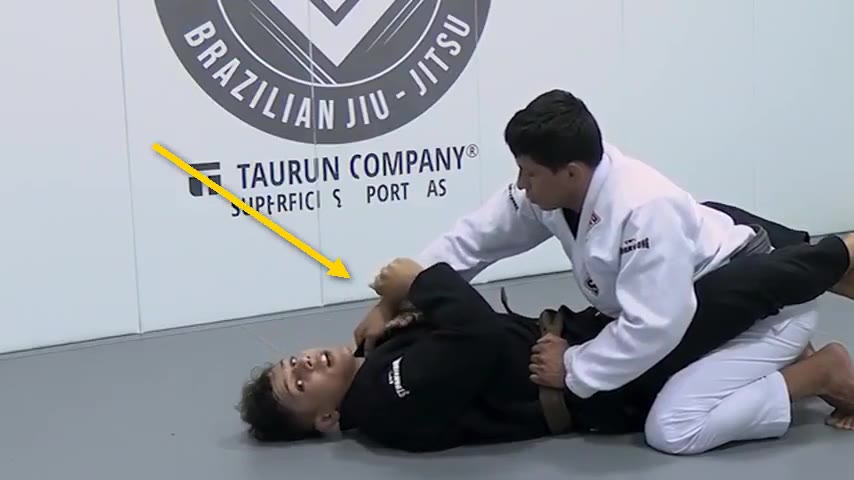
05 He grips your collar high, too high to push away: slide your hand under his grip, lock both hands around his wrist and lift his grip off, up over your head
He calls the two hands a key: “this little key I made on his hand” (Vol 2, 1:56). It has to sit under his hand. On the forearm, he says, the grip is hard to break (Vol 2, 7:49).
Vol 2 · 4:23The last thing he can do is get up. Galvao says most people who know how to open a closed guard do exactly that (Vol 4, 0:29). His first answer is the sweep in the video at the top of this page, and it ends in mount. One thing comes before it, he says: open his knee outward, because with the knee closed he keeps his balance (Vol 4, 2:08). Then the same idea as on the ground. He blocks that sweep: an omoplata takes him forward (Vol 4, 5:47). He stands tall against the omoplata: roll him backward. “Just follow him, don’t waste your energy” (Vol 4, 16:29). He steps his leg out of reach: take the other leg (Vol 4, 17:11).
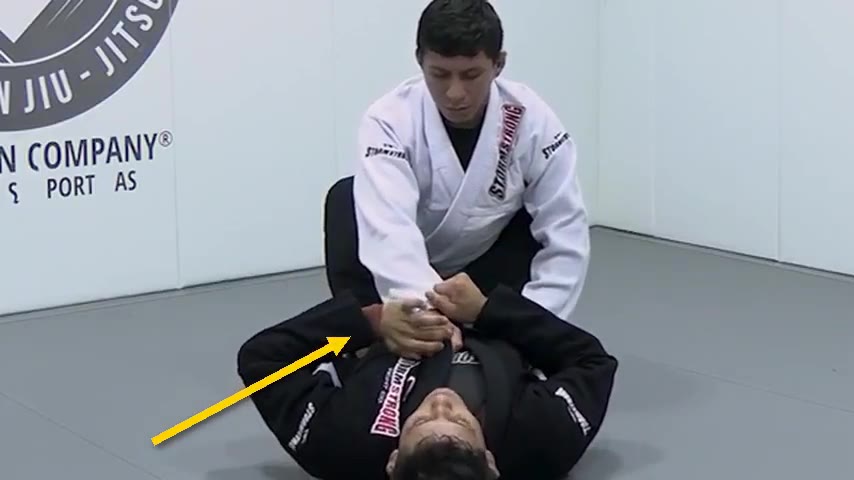 01
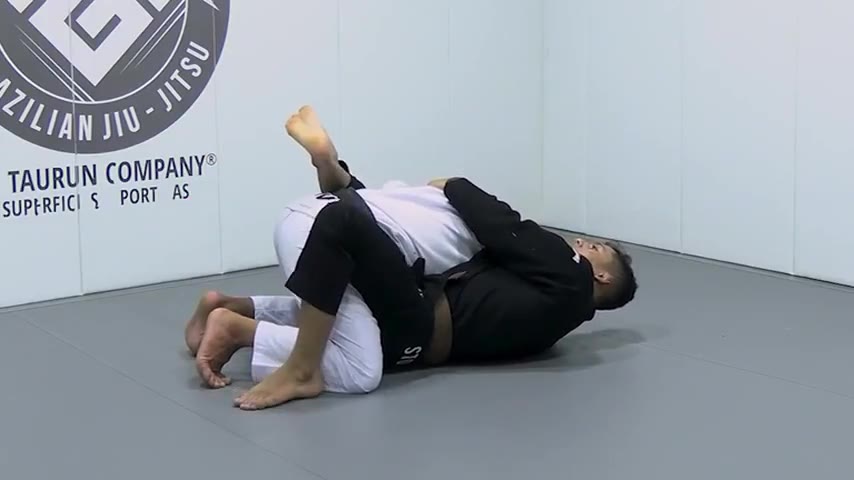 02
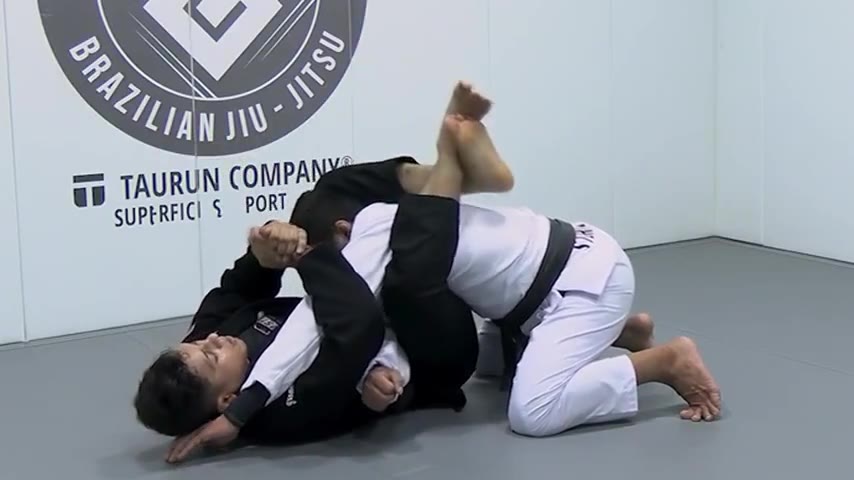 03
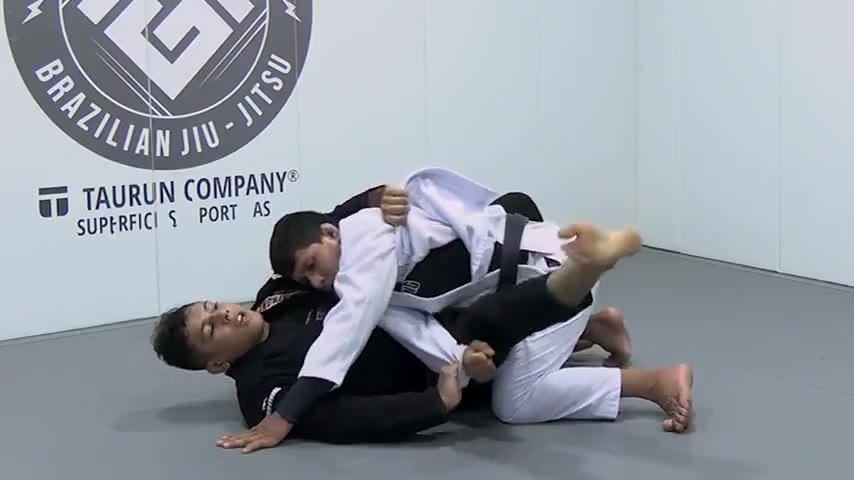 04
 05
Who should buy it
- Your closed guard goes quietHe grips, you hold, nothing happens. This gives you an attack that starts from his grip, and the next one for when he stops it.
- He stands up and your guard pops openAll of Volume 4 is about that. A buyer about a year into training, Marcus B. (January 2022), found those sweeps easy to do.
- White beltGalvao says it works at any belt (Vol 1, 0:46), and the moves are simple. But it assumes you can keep your guard closed long enough to use them.
- Much smaller than your partnersHe says the moves work on any body (Vol 1, 15:52). His partner is lighter than he is, he says (Vol 4, 2:04).
- No-gi onlyCollar, sleeve, pants and belt grips run through all four volumes.
 Your guard gets opened before you can attackDanaher’s Closed Guard: BJJ Fundamentals, Go Further Faster spends its second volume on holding and controlling the guard.
What buyers say about it
Several buyers single out the grip work. Chiang T. (October 2026) says the grip breaks let him go on to many attacks. Stefan M. (June 2026) puts the result well: for the man on top, your closed guard should be “a place to panic”, not a place to rest. Stefan G. (January 2022) names the attacks from the flower sweep as the best part.
Few, and about the delivery, not the content. Xander B. (November 2021) notes “a little bit of a language barrier”. Alan B. (October 2024) says the video quality is below Galvao’s later courses and that it does not hurt the content. Our own worries are in the cons below.
Worth it? The pros and cons
- One idea you can remember in a roll: what he does picks your attack. Nearly every chapter opens with the grip or the defence it answers
- The grip breaks: one for the hand you can peel, one for the grip you cannot
- Eight chapters on the man who stands up, the first four linked by his reactions
- Short chapters made for drilling: most run four to eight minutes, with slow repetitions, a fast one and a recap
 $79 list: $70 less than The Roger Gracie Closed Guard System and about 35 minutes longer
- No chapter on keeping your guard closed or breaking his posture. Danaher’s Closed Guard: BJJ Fundamentals, Go Further Faster ($197 list) spends its second volume on holding and controlling the guard and has four chapters on breaking posture
- No live rounds and no matches: every repetition is on a cooperating partner
 Gi only. Craig Jones’ Closet (Closed) Guard ($149 list) is the no-gi course
- One collar choke, from the underhook. The Roger Gracie Closed Guard System ($149 list) has three chapters of collar and lapel chokes
- His answers to the man who just holds you down are wrist locks, and he says himself that white belts and juveniles get disqualified for them in competition (Vol 3, 38:10)
- A 17-year-old’s first instructional, in rough English, shot from far enough away that finger and wrist details are small on screen
- About 14 minutes of guard pulls come before the first attack from the bottom
An attack for the grip he takes. Another for when he stands up.
What’s inside: four volumes, one grip at a time
On his knees for three volumes, on his feet in the fourth. Tap a volume for what’s in it.
Vol 1 · 54:01Getting to closed guard, then the 2-on-1two guard pulls and a jump guard, the back take, three armbars, a sweep to mount, the other arm
After the intro come about 14 minutes on your feet: two guard pulls and a jump to closed guard that he calls the hardest of the three (10:48). Then the grip break and the roll that puts you behind him, cards 01 and 02 above. The other five chapters are each one thing the man does to stop it: he posts a hand, he pulls his arm out, he drops his weight, he tucks his fingers away, he clamps his elbow to his side. Against the tucked fingers Galvao pulls hard on one arm until the man guards it, then takes the other (44:08). Against the clamped elbow he pushes it further in and takes the armbar (49:15).
Vol 2 · 42:02The underhookgrip break and choke, armbar, omoplata, triangle, pendulum sweep, Mir lock
For the grip you cannot peel: you go under it and lift it off, as shown above. Galvao and the chapter list call the position the underhook. Six attacks follow, and he says the choice depends on the man’s reaction and on what you like (21:55). The triangle is the longest chapter in the course, ten minutes, and the most detailed: your shin in his biceps to make room, your hand on your own shin and not on your foot, both feet pulled up. If he keeps following you with pressure there is a pendulum sweep (32:09). The last chapter is a shoulder lock he calls the Mir lock, the only move he says also works without the gi (37:50).
Vol 3 · 51:43Flower sweep, kimura and bump, wrist locksthree smaller games
Each one is for its own grip. His arm is loose: the flower sweep, holding his elbow where some people hold the sleeve, and the pants on the outside at the knee (1:01 to 2:06). If he posts a hand to stop it, a rolling armbar (7:30); off a cross-sleeve feint, a triangle (13:40). His hands are on your belly: you break them down to the mat, then kimura and bump sweep as a pair. When he defends one, Galvao goes to the other (20:02). He holds you down by your lapel, your arm or your belt: three wrist locks. For the second one he makes the man grip harder on purpose, then uses that grip (42:46).
Vol 4 · 42:14He stands upmuscle sweep, two omoplata sweeps, the other leg, balao, mermaid, one sleeve, double ankle
Eight answers to the man on his feet. The first four are one chain: the sweep at the top of this page, the omoplata forward when he blocks it, the roll backward when he stands tall, and the other leg with an armbar when he steps away. The other four depend on how many of his sleeves you still hold. With both sleeves there is the balao, which he says takes no strength and is a good option against heavy opponents (22:23), and the mermaid. With one sleeve left after he breaks a grip, you sit up and hug his legs (32:53). With no sleeves you take both ankles (37:09). The outro is one minute: he says this was his first time making an instructional (41:37).
Compare to
List prices on BJJ Fanatics in November 2026.
- Closed Guard: BJJ Fundamentals, Go Further Faster (John Danaher, $197 list, 8 volumes, 9 h 37): the part Galvao leaves out. By its chapter list, Volume 2 is built around holding and controlling the guard, Volume 5 has four chapters on breaking posture and Volume 8 is the standing opponent. Your guard gets opened before you can attack: Danaher. You hold it fine and need something to do from there: Galvao, in a third of the time. See it on BJJ Fanatics.
- The Roger Gracie Closed Guard System (Roger Gracie, $149 list, 4 volumes, 2 h 35): built on his own finishes. Its chapter list goes cross collar choke, armlocks, lumberjack sweeps, taking the back. You want the collar choke game: Roger Gracie. You want an answer that starts from the grip he takes, for $70 less: Galvao. See it on BJJ Fanatics.
- Closet (Closed) Guard (Craig Jones, $149 list): a no-gi closed guard course. The pick if you never wear a gi, because Galvao’s grips are collar, sleeve, pants and belt. See it on BJJ Fanatics.
Get the next review like this one
New reviews in this format land in your inbox, with the details on video. You also get the free BJJMore email course and the instructional-platform discounts I use myself (worth $46).

BJJMore earns a commission if you buy through these links, at no extra cost to you. Released by BJJ Fanatics in February 2021; reviewed on all four volumes.
FAQ
Is Next Generation Closed Guard worth it?
Yes, if you play closed guard in the gi and it goes quiet once he grips or stands up. It gives you an attack that starts from his grip, and the next one for when he stops it. It is $79 list for 3 h 10 ($35.55 with the Black Friday code we tested).
Is it gi or no-gi?
Gi. Collar, sleeve, pants and belt grips run through all four volumes. One move, the Mir lock in Volume 2, is the only one he says also works without the gi. For no-gi closed guard, look at Craig Jones’ Closet (Closed) Guard.
How long is it?
3 hours 10 minutes over four volumes and 34 chapters. The volumes run 54, 42, 52 and 42 minutes. Most chapters are four to eight minutes.
Does it cover what to do when he stands up?
Yes. All of Volume 4 is about that, in eight chapters. The first is the sweep to mount in the video at the top of this page. The next three are what to do when he blocks it, stands tall or steps his leg away.
Is it good for white belts?
The moves are simple and Galvao says they work at any belt. One limit: he says himself that white belts cannot use the wrist locks from Volume 3 in competition.
How old was Mica Galvao when he made it?
He says he is 17 and a brown belt in the intro, and in the outro that this was his first time making an instructional. BJJ Fanatics released it in February 2021.
Next Generation Closed Guard or The Roger Gracie Closed Guard System?
Roger Gracie’s course is $149 list for 2 h 35 and is built on his own finishes: cross collar choke, armlocks, lumberjack sweeps and taking the back. Galvao’s is $79 list for 3 h 10 and starts from the grip the other man takes, with a whole volume on the man who stands up. Collar choke game: Roger Gracie. An answer that starts from what he does: Galvao.
Is there a discount code?
On November 23, 2026 the Black Friday code BLACKFRIDAY2026 took 55% off at checkout: $35.55 instead of $79. BJJ Fanatics rotates its codes and sales, so check the price on the day you buy.
Give your closed guard something to do
He takes your lapel and waits, or stands up to open you? This is three hours of answers that start from what he does. Gi only.
Black Friday code BLACKFRIDAY2026, tested at checkout on November 23, 2026: $35.55 instead of $79. BJJ Fanatics rotates these codes.