
Home / Wrestling for BJJ / Closing The Gap Review
Michael Pixley’s Closing The Gap Review
Buy it if your stand-up is two people hanging on each other’s necks until someone pulls guard: start from that tie, push into him, and use his push back or his step. From that same collar tie, duck under and step behind him.
See Closing The Gap →No-gi. Who should buy it ↓
- No-gi
- 4 volumes, 1 h 58
- 40 chapters
- Vol 4: students wrestling live
- Released July 2023
Michael Pixley’s Closing The Gap is a no-gi takedown course for jiu-jitsu players, taught by a man with 18 years of wrestling behind him and hosted by Heath Pedigo of the Daisy Fresh team. Its 1 hour 58 minutes begin where most of our stand-up ends: tied up, head to head.
Yes, if your stand-up stalls in a collar tie
You tie up, pull on each other’s necks for minutes, and when you finally shoot it is from too far and he sprawls on you. Pixley: “I never want to be ear-to-ear. That’s just a stalemate position.” (Vol 1 · 11:20) So he pushes or pulls, and attacks the moment the man pushes back or steps: a snap down, a slide by, or a single leg from an angle.
$98.50 list, $44.33 with the Black Friday code BLACKFRIDAY2026 we tested on November 23, 2026, for 1 h 58. No-gi only. The front headlock chokes are named, not taught.
From the tie to the takedown
Pixley files the course under belts, white to black. The order below is ours: five moments on the feet, tied up first, then the shot. Two cues come back again and again. He pushes back, or he steps.
Pixley’s first takedown lesson is the match everybody has been in: a hand on each other’s neck, both pulling. He says you cannot snap a man down while his arm is bent. You only pull his elbow into your own chest, and people do that for six, seven, eight minutes and then lose a referee’s decision. So he changes two things. His forehead goes on the man’s temple, never ear to ear. And he lays his hand over the man’s arm, little finger at the throat, and pushes until that arm is straight. Then the hand slides to the wrist and he snaps head and wrist down together, not straight down but at a slope, over the man’s own toes. The best moment, he says, is when you feel him push back.
01 Both in a collar tie: push into him, then snap his head down. He lands on his hands and knees in front of you
Snap with your elbows in and your hands going straight down, Pixley says, and move your legs back as he comes down so he cannot grab them.
Vol 1 · 11:59That push back is good for more than a snap down. It is also the moment to step out of his way and let him go past you. Pixley calls that a slide by and teaches three. Two are here; the third, a Russian version, is under What’s inside.
One is the slide by at the top of this page. At full speed you see little more than a duck under and a step behind him. Slowed down, Pixley teaches it like this: same collar tie as the snap down, little finger at his throat again. Step outside his foot, hook his arm above the elbow, point your own elbow at the ceiling, look over your back shoulder and lift his arm past your face. Your other hand stays on his neck the whole way: let go of his head, he says, and there is nothing there. He rates it low risk for a high reward, and Pedigo calls it the move his team has had the most success with.
The other runs on the push itself. He has a hand on your neck. You go over that arm, clamp his head so his ear meets his shoulder, take his wrist with your free hand and push into him. The moment he pushes back, your free hand goes from his wrist to above his elbow, you step in, turn your hips and look behind you. Above the elbow matters: any lower, Pixley says, and he bends his arm and the whole tie is dead. It has a second ending: same tie, same slide, and then you take his foot away.
02 From a tie with your hand on his head: slide him past you, then sweep his foot with yours. He falls on his back
Pixley’s one warning: don’t rush the sweep. Most people kick right after the slide, while all his weight is on that foot, and he goes nowhere. Let him set his feet first.
Vol 2 · 23:43So far you stood head to head with him and waited for his push. Pixley has a tie for when that does not feel safe. If you feel in danger, he says, or the other man is quicker than you, get to a two-on-one: both your hands on one of his arms. He puts a hand on your neck. You grab that wrist and rip it off your head, cup his armpit with your other hand and turn your shoulder down on top of his. From there, Pixley says, he cannot shoot on you, and you can move him where you want.
Then the same cue as before. Thread your hand over his arm and under your own until both thumbs point up, which turns his arm into a lever. Take two steps into him. He either steps off the mat or pushes back, and when he pushes back, his hands go to the mat. If he keeps his arm straight to stop the lock, Pixley kicks the inside of his thigh, which puts all his weight on the other foot, and picks that ankle.
03 From the hand fight, step in on him and drive his hands down to the mat: he drops onto his hands and knees and you come over the top onto his back
Pixley’s picture for what your hands do: shovelling snow.
Vol 1 · 19:48Now the legs, and the second cue: he steps. Pixley teaches single legs. Shots with the head on the outside, like the double leg, he does not rate for jiu-jitsu: too many guillotines and kimuras. And the single starts from a tie like everything else on this page. Circle and pull so the man has to step. Step outside his foot, drop your knee next to his little toe, wrap the leg elbow deep and swing your back leg round until your two legs and his stand in one row. Glue your eyebrows to his ribs, so he cannot push your head away, and drive up.
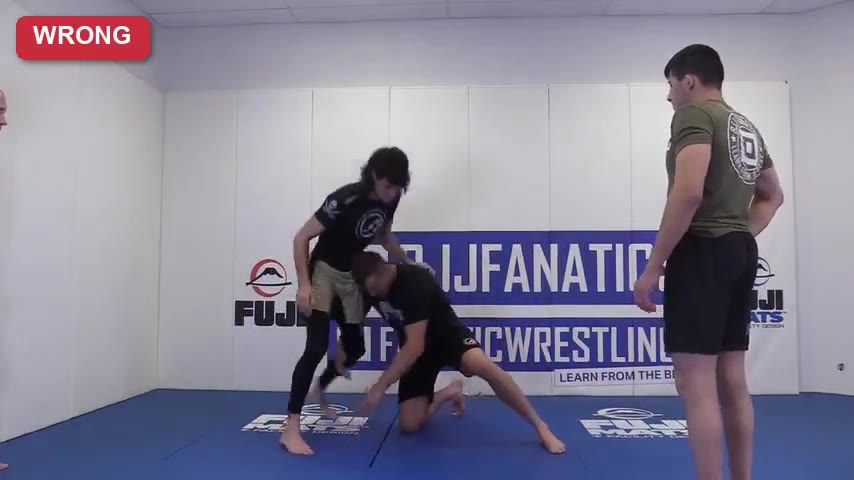
The swing is what beats the sprawl. Shoot straight at him and he just sprawls, Pixley says. Cut the angle and his sprawl misses.
04 Wrong: shoot straight in and he sprawls on you. Right: drop in beside his foot and swing your back leg round. His sprawl misses
His drill for it: start on one knee at the leg, step outside, switch knees and pivot, again and again. Slowly until you have it.
Vol 1 · 37:16You are in on the leg and standing up with it. This is where a jiu-jitsu player gets away: he turns his knee down, lets the leg go limp and slides it out. Pixley says it happened to him for his first two months of jiu-jitsu. Pedigo’s explanation is that no-gi players feel slippery and think they can push your head, turn and run.
Pixley gives the single leg three finishes. The third is for the leg that slips. Close both hands around his ankle like a baseball bat, so the foot has to come out through a very small hole. Most people will not give you their back from there. They turn and face you, and that turn is the cue: a big step, and his leg goes down and then up, like the letter J.
05 On a single leg he turns away to pull his leg free: keep his ankle in both hands, and when he turns back to face you, drop the leg low and swing it up. He falls on his back
Let gravity do the work, Pixley says. You don’t have to hurt your training partner.
Vol 1 · 39:39 01
 02
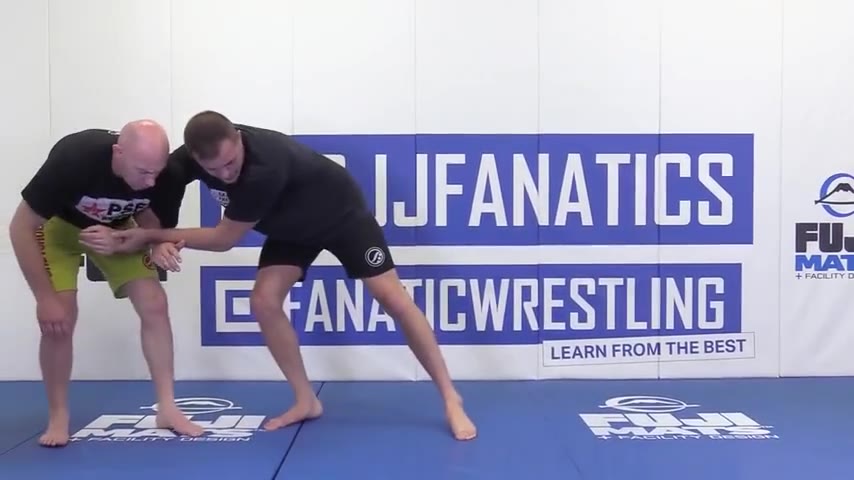 03
 04
 05
How many of these do you do?
Count the ones you already do in a roll, not just in drilling. If most are new to you, this course will change what happens after you tie up.
Black Friday code BLACKFRIDAY2026, tested at checkout on November 23, 2026: $44.33 instead of $98.50. BJJ Fanatics rotates these codes.
Who should buy it
Which one are you?
- Your stand-up stalls in a collar tieThat tie is the first takedown lesson, and the slide bys start from it too.
- Your shots get sprawled on, or he slips his leg outOne single leg, shot from an angle, with three finishes. The third is for the leg that slips out.
- You never wrestled and you train no-giIt starts at how to stand, Pedigo asks the beginner’s questions, and the students in volume 4 make the mistakes you will make.
- You wrestled alreadyVolume 1 opens with stance and a basic single leg. What may be new is the choice of moves for jiu-jitsu: nothing with your head on the outside.
 You want the hand fight itselfStance and first contact get about eight minutes here. Slay The Hand Fight gives that part three hours.
- You train mostly in the giIt is filmed no-gi and no gi grip is shown. The collar tie and the two-on-one exist in the gi too.
- You want to choke from the front headlockThe D’Arce, the anaconda and the high elbow choke are named and never shown. See Compare to.
- Your opponents sit downEvery move starts with two people standing and tied up. There is nothing on a man who pulls guard.
- You want double legs and slamsPixley leaves head-outside shots out on purpose. The only double taught is a last finish from the front headlock.
What buyers and other grapplers say about it
Wubs, a buyer on BJJ Fanatics (September 2023), likes the way it is taught most: Pixley shows the move, Pedigo asks what someone with little or no wrestling would want to ask, and then Pixley coaches a couple of people through it and corrects them.
Matt M. (November 2024) hesitated because he already owned several standing courses. After this one, he writes, he finally feels able to hit a good single leg in jiu-jitsu.
Alonzo (July 2023) had been drilling the slide by for a week when he wrote his review. Christopher H. (October 2024), seven years into training, tells everyone to start with the white belt section, whatever their belt.
David R. (November 2024) keeps it in proportion: it is no Danaher course, he writes, but it is well put together and covers the basics of wrestling.
No buyer review we read complains. Our own complaints are in the cons below.
One more thing, about Pixley’s own game. Someone who went looking in 2024 could not find footage of him shooting for the legs: it was all front headlocks, throw bys and upper body. We have heard his game described the same way since, as built on slide bys and throw bys. That is about his matches, and the course does teach a single leg (details 04 and 05). But it leans the same way: the tie comes first.
Worth it? The pros and cons
- It starts where you get stuck: in the tie. Push, wait for his push back, then snap him down (detail 01), let him go past you (detail 02) or drive his hands to the mat (detail 03). Or go around him from the same collar tie (the clip at the top)
- The moves are picked for jiu-jitsu. No shots with the head outside, and when Pixley does drop to a body lock or run a double from the front headlock, he says how he keeps his neck out of a guillotine
- The single leg gets finished: an entry that beats the sprawl (detail 04) and three finishes, one of them for the leg that slips out (detail 05)
- You see the mistakes. Pedigo asks what a beginner would ask, and guests and students get corrected in every volume
- Defence is included: 18 minutes on stopping his shot and breaking his ties
- $44.33 with the code: $23 per hour

 The front headlock chokes are named and never shown. The Anti-Wrestling Equation teaches the anaconda and the D’Arce, and BJJ Fanatics lists all three in Pixley’s own later front headlock course
- Nothing for the man who sits down or pulls guard. Every move starts with both of you standing and tied up
- Volume 4 is 18 minutes of students wrestling, and there are no match clips. You never see Pixley use any of it against someone who fights back
- Pedigo takes a lot of the time: an introduction to every belt section, questions in the middle of a move, coached tries by guests. Good the first time, slow on a rewatch
- No-gi only, and no gi grip anywhere
- $50 per hour at the $98.50 list price, for under two hours
Push, wait for his push back or his step, and go. Black Friday code BLACKFRIDAY2026
What’s inside the four volumes
40 chapters over four volumes, all no-gi. BJJ Fanatics labels them by belt. Tap a volume for what’s in it.
Vol 1 · 41:46White Beltstance, the snap down, two ties, the single leg
Two minutes of introduction by Pedigo, then eight minutes on stance and first contact: lead with the leg on the side of your strong hand, stay low enough to touch the mat with your back hand, never reach with the front hand, and stop his reaching arm with your thumb in the bend of his arm or in his armpit. Then the snap down from the collar tie (detail 01). Then two ties: the two-on-one with a short drag, the two thumbs up lock (detail 03) and the kick into an ankle pick, and the underhook with a snap to the front headlock, a throw by and a knee tap. The last twelve minutes are the single leg: the entry from an angle (detail 04) and three finishes, the J step last (detail 05).
Vol 2 · 29:44Blue Belthis shot, his ties, three slide bys
The first ten and a half minutes are for when he shoots. Against a single leg: the hip tip, where you tip him over your knee, a stomp that gets your foot back on the mat when he has stood up with your leg, and an ankle roll. Against a double: meet him with your hips first and sprawl after. Then eight minutes on his ties: three ways out of his two-on-one, how to turn his elbow pass back on him, and how to use his underhook to get to your own single leg. The last eleven minutes are the slide bys. One goes over his arm, with the foot sweep as its second ending (detail 02). One starts from the collar tie (the clip at the top). The third is a Russian version, which Pixley calls the best and the hardest of the three.
Vol 3 · 27:36Purple Belt and Brown Beltthe front headlock, more ways into it, two more shots
The first thirteen minutes start where detail 01 ends, with the man on his hands and knees under your front headlock. Put your chest on his back before you circle behind him. Drag him from inside his arm. Pin his arm with your knee and step behind. If he grabs your elbow, he has one hand fewer on the mat: drive him to that side. If he stands up: a cradle, an ankle pick, a cradle on the far leg when he steps back, and last a double leg, run to the far side so your neck stays out of a guillotine. The second half is more ways into the front headlock. The football grip: roll his wrist off your head, club his head, catch his chin, pinch your elbows and sag back. A tap on his foot so that he steps, and the snap while he is on one leg. Entries from the two-on-one and from the underhook. It ends with two more shots: a faked high shot into a low single, which Pixley calls his favourite takedown from college, and a knee pull. The chokes from the front headlock are named several times and not shown.
Vol 4 · 18:29Black Beltcoached live goes
No new techniques. Students wrestle short live goes, most of them with hardly any wrestling behind them by Pedigo’s account, and Pixley corrects them in between. You are shooting from too far, get forehead to forehead first. Stay on the leg. When he has your leg, stomp your foot back to the mat, don’t wait. About half the time nobody talks.
Compare to
- Slay The Hand Fight (Nick Rodriguez, $194 list, 4 volumes, 3 h 10): the part Pixley gives eight minutes. Rodriguez spends a whole course on who touches first, who gets which grip and how to make the man push, and he stops at the shot: no takedown finish is taught. Closing The Gap is the other split, a little hand fighting and then the snap down, the slide bys and a single leg with three finishes. No takedown you trust yet: Pixley first. A shot you can’t get to: Rodriguez. See it on BJJ Fanatics. Or read our review.
- The Anti-Wrestling Equation (Craig Jones, $197 list, $98.50 on November 13, 2026; 8 volumes, 7 hours): what to do once the snap down has worked. Pixley gives the front headlock itself about thirteen minutes and names the chokes without showing them. Craig Jones stays in that position for a whole course: how to keep the man down, the anaconda, the D’Arce and the guillotine as threats, and the ways to his back that they open. See it on BJJ Fanatics. Or read our review.
- Michael Pixley’s Complete Front Headlock System (Pixley and Pedigo, $98.50 list, 3 volumes): the same two men a year later, on the front headlock alone. BJJ Fanatics lists chapters on the D’Arce, the anaconda and the high elbow guillotine in its third volume, the three chokes this course only names. We have not reviewed it yet. See it on BJJ Fanatics.
Train in the gi, or want the whole field? Our best wrestling instructionals for BJJ has a pick for the gi. Prices are BJJ Fanatics prices on November 13, 2026.
Get the next review like this one
New reviews in this format land in your inbox, with the details on video. You also get the free BJJMore email course and the instructional-platform discounts I use myself (worth $46).

BJJMore earns a commission if you buy through these links, at no extra cost to you. Released by BJJ Fanatics in July 2023; reviewed on all four volumes.
FAQ
Is Closing The Gap worth it?
Yes, if your stand-up stalls in a collar tie or your shots get sprawled on, and you train no-gi. It is $98.50 list ($44.33 with the Black Friday code we tested on November 23, 2026) for under two hours. Skip it if you want chokes from the front headlock: they are named, not taught.
How long is Closing The Gap?
1 hour 58 minutes over four volumes: 41:46, 29:44, 27:36 and 18:29, in 40 chapters. The fourth volume is coached live goes between students, so the teaching itself is about 1 hour 39.
Do I need a wrestling background?
No. It starts at how to stand. Pixley opens by saying that everybody wants singles, doubles and big slams, and that he will start at white belt level. Pedigo asks the questions a beginner would ask, and says his team uses the slide bys at every belt from white to black. The belt names on the volumes are labels more than levels: in our view the brown belt part is not harder than the purple.
Is it gi or no-gi?
No-gi. Nobody wears a gi and no gi grip is shown. The ties it is built on, the collar tie, the two-on-one and the underhook, exist in the gi as well, and Pedigo says the collar tie stalemate happens in both. For takedowns built on gi grips, see the gi pick in our wrestling ranking.
Does it teach the double leg?
Not as a shot. Pixley says he does not think takedowns with the head on the outside, like the double or the high crotch, work well in jiu-jitsu, because of guillotines and kimuras. He teaches a single leg, a low single and a knee pull. A double shows up twice: as a last finish from the front headlock, run to the far side to keep your neck safe, and when he corrects a student’s double in volume 4. The BJJ Fanatics text lists doubles among the takedowns. Don’t buy it for those.
Does it teach front headlock chokes?
No. In volume 3 Pixley names the D’Arce, the anaconda and the high elbow choke several times and moves on. At one point he says he is only showing how to get the man into the front headlock. What you do get from there: ways to his back, a tip over when he grabs your elbow, two cradles, an ankle pick and a double. For the chokes, see Compare to.
Closing The Gap or Slay The Hand Fight?
Two halves of the same fight. Rodriguez gives the hand fight three hours and stops at the shot. Pixley gives it about eight minutes and then teaches the snap down, the slide bys, the front headlock and a single leg with three finishes. No takedown you trust yet: Pixley. A shot you can’t get to: Rodriguez.
Can I watch any of it for free?
BJJ Fanatics has a free sample on the product page, and three short videos on its YouTube channel carry the names of chapters from this course: Knee Tap, Ankle Roll Defense and Near Side Cradle. Daisy Fresh has a five-minute slide by lesson from Pixley on its own channel. The slide by is the part you can see most of for free.
Is there a discount code?
On November 23, 2026 the Black Friday code BLACKFRIDAY2026 took 55% off at checkout: $44.33 instead of $98.50. BJJ Fanatics rotates its codes and sales, so check the price on the day you buy.
Get out of the collar tie
Stuck head to head, or sprawled on every time you shoot? Start from the tie you are already in: push, wait for his push back or his step, and snap him down, slide by or shoot from an angle. No-gi, under two hours.
Black Friday code BLACKFRIDAY2026, tested at checkout on November 23, 2026: $44.33 instead of $98.50. BJJ Fanatics rotates these codes.