
Home / Lachlan Giles / The Body Lock Pass Review
Lachlan Giles’s The Body Lock Pass Review
You drive in to pass and his knee comes up with you. Giles does the opposite: keep your weight back until you have stepped over his knee, and only then put your weight on him and pass.
See The Body Lock Pass →No-gi. Who should buy it ↓
- No-gi
- 6 volumes, 7 h 6 min
- About 1 h 30 of narrated rolling
- Released September 2019
Lachlan Giles’s The Body Lock Pass is seven hours on one no-gi pass: hands locked low around his hips, through his half guard, to side control or mount. Much of it goes to what he will do to stop you, one answer at a time.
Yes, if you pass no‑gi and stall at his knee
You reach his half guard or butterfly and his knee is between you. You drive in, and the knee comes up with you. Giles locks his hands low around the hips, so there is no space for him to make, and has one rule for the rest: “don’t drive more forward, it’s gonna actually make it harder for you.” (Vol 3 · 10:45) Weight back until you are over his knee. Then on him.
$99 list, $44.55 with the Black Friday code BLACKFRIDAY2026 we tested on November 23, 2026, for 7 h 6 min. On the mat it costs you your hands: locked together they cannot post, and Giles tells you to expect to get swept a lot at first.
From the first grip to the pass
Giles splits the pass into five stages: get his back off the mat, lock your hands, get over his knee, free your knee, free your foot. The details below follow those stages, with closed guard at the end as a problem of its own. The clip at the top is the first half of the rule that holds them together: weight back until you are over his knee. Then on him.
Your hands won’t meet behind him
The lock needs his back off the mat, and a man with his knees to his chest gives you nothing to reach around. So Giles does not reach. He traps one of the man’s legs between his own, pulls the knees away from the chest and squares him up, circling backwards the whole time. A man stretched out like that wants to sit up, and he sits up into your hands.
01 He sits up into you
Your head and chest stay down on him with your hips high, and his far leg comes up off the mat. He rolls up and sits up into you, and you end with your arm wrapped around his waist.
On the way there it takes both directions, Giles says. Go only backwards and he stays on his side and attacks. Go only sideways and you are in his butterfly guard with no lock.
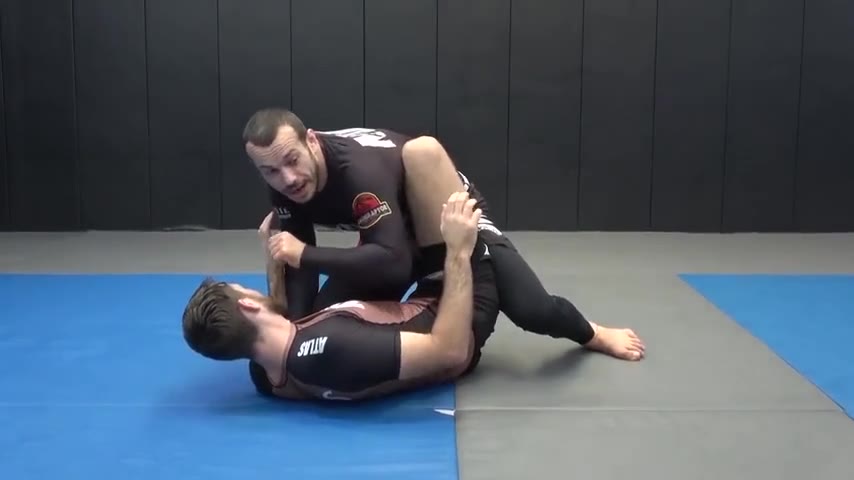
Vol 2 · 42:46A man flat on his back with his knees in is the harder case, by Giles’s own word. There he starts from headquarters, gets his shoulder past the knee, puts his own knee down and moves back.
02 Shoulder past his knee, and he sits up
From headquarters you slide your shoulder down past his raised knee and stay low with a hand on the mat. When he sits up into you, you sprawl your legs back and end with your head pinned against his chest.
Two things Giles does not let slide: your shoulder stays lower than his, and you don’t start any of this while his feet are outside your hips.
Vol 2 · 29:51Your hands are locked and his leg still comes back
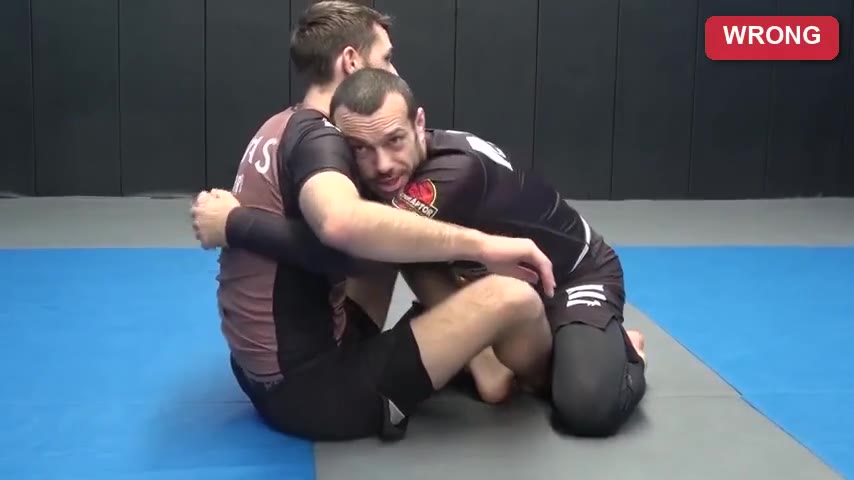
He sat up and your hands met. Now he pulls his knee to his chest, slips his foot outside your hip, and on that side the lock is worth nothing. Giles calls the cause the most common mistake there is: hands too high. Around the upper back they do nothing to his leg. He links his fingers as far around the far hip as they go, low, so that his elbow sits by the knee and blocks it. He half jokes that it should be called the hip lock pass.
03 Low around his hips, not high on his back
Wrong: arms locked high around his upper back. Right: drop your head to his hip and wrap your arms low around his hips.
Your outside leg does the other half: stepped forward and a little wide, so there is no gap between your elbow and your knee for his leg to come through.
Vol 1 · 19:35If his leg gets past your hip anyway, let go and catch it again. It is one of three moments when Giles lets go of the lock. The other two: you are about to be swept, or his foot is in front of your face.
His butterfly hook lifts you
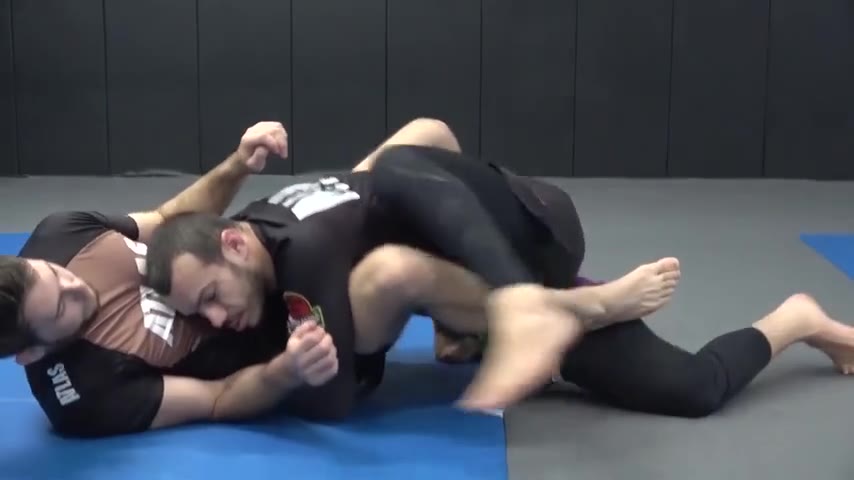
Locked hands have a price: you cannot post. So the hook under your thigh comes first, before you try to get over his knee, and Giles handles it the way he got the lock, by going back. Weight low on his hips, none of it driving into him. With him on one hip, reach your leg back, sprawl, and slide down and across the mat until the hook has nothing left to lift. Then step. While he is still square to you, Giles says, you will not get over.
04 Legs back, then down and across
Against his butterfly guard before you are past his knee: stretch your legs back and slide down and across until his legs go flat, then bring your knee over his thigh and settle on top.
When the hook already has real lift, Giles frees one arm, pushes that knee across into a smash pass and locks his hands again from there.
Vol 3 · 15:31His knee is in the way
The hook is dead, or was never there. His knee is still between you, pulled tight to his chest, and often his hand is on your leg as well. This is the clip at the top of the page. Driving forward feels like the obvious thing, and it is the wrong half of that clip: go forward and his knee rides up with you, and the step gets higher than your balance allows. Giles blocks with his head, lets his weight sag back, and the thigh drops toward the mat. The flatter the thigh, the smaller the step.
↑ Watch it again: the clip at the top
Two things make it easier. Tilt him onto his side and then square him back a little, so his hand cannot reach your knee. And use your other leg to drag his foot away, which straightens the leg. Hip flexibility helps here too, and Giles shows a stretch for it.
In the last volume Giles calls this the step people have the most trouble with. And if he tips you the moment your head goes across, that is the John Wayne sweep: detail 10, under the route.
You are over his knee and he still has your leg
Once your knee is past his, the rule flips. Now your weight goes forward, through your shoulder, onto him, and your head goes across to his far side. He will be holding your leg in a half guard or with a butterfly hook, Giles says, and the two need different answers.
Half guard: head on the mat, one foot out wide for balance, knees pinched. Walk your hips up until your shin lies over his thigh, step your other foot onto the back of his calf, and your heel comes out. If he bridges, take mount. If he hip escapes, side control. Lean on him, don’t squeeze him: holding on tight, Giles says, makes it easier for him to roll you.
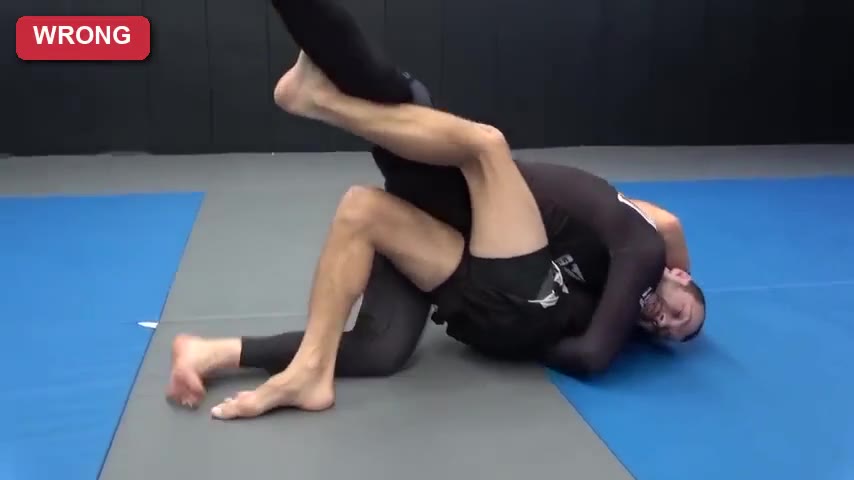
A butterfly hook: don’t kick yet. With his foot behind your knee he follows the kick. Put your leg against his thigh and walk sideways until his knee points away from you, step up his shin until you are near the knee, then kick. Below is the kick alone, at the wrong moment and at the right one.
05 Don’t kick while his foot is behind your knee
His butterfly hook is still in after you pass his knee. Wrong: you kick your leg off while his foot is hooked behind your knee, and his leg rises with yours. Right: the kick clears his leg and you land chest down on top of him.
And it is not a back step, Giles adds: the leg goes up, the hips stay facing the mat.
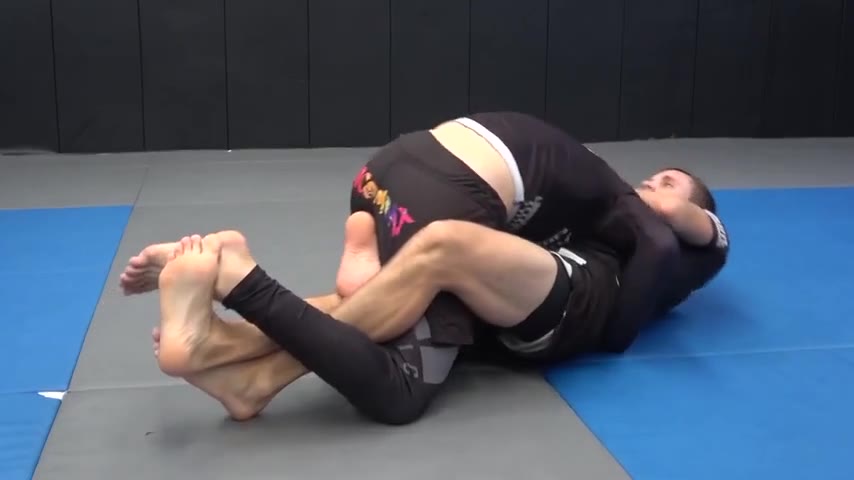
Vol 4 · 18:21 and 16:44A lockdown is a half guard with its own answer. Driving from the far side gets you stuck. Head back to the near side, your free foot over his thigh, lift the trapped heel and step it out.
06 Lift your foot out of the lockdown
His legs are crossed around your lower leg (lockdown). You lift that foot up out of his legs and plant it on the mat outside them.
In the last volume Giles does this in a live round, on a student who switches to a lockdown, and ends in side control.
Vol 4 · 29:40He turns into you
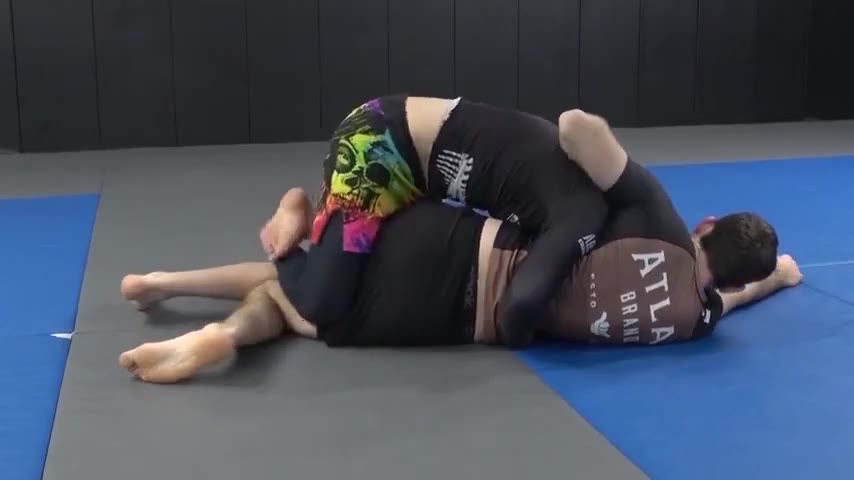
That pressure only works on a man who is flat. When he gets up on an elbow or turns onto his side toward you, driving forward opens your own knee and lets his leg out. So your head comes back to the near side, under his chin if you can get it there, and the pass changes: your knee comes through on the near side, then across. When he turns in so far that his top leg folds inward, Giles waits for exactly that, lays his shin over the leg and goes behind it. Try to go behind while that knee still points up and you land back in his guard.
07 Leg onto his hip, then over his legs
When he lies on his side: bring your leg down onto his hip, then swing your leg out over his legs and turn your hips. You end high on top of his hips.
Giles’s rule of thumb: head across, free your knee and go to mount or side control. Head on the near side, knee through.
Vol 4 · 53:23He closes his guard
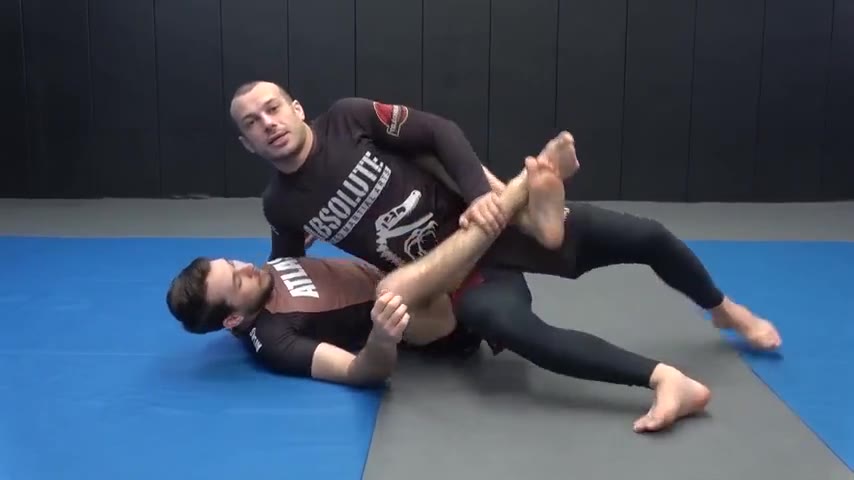
Everything above starts with one of his legs trapped between yours. In closed guard both his legs are wrapped around you, and standing up to open it puts his feet in front of you again. Volume 5 is Giles’s way around that: the Sao Paulo guard open, done without standing, straight into half guard with the lock one step away. Grip his ankle with your elbow tight to your ribs, switch out to the side, move your hips back, step over his feet and pry them apart.
08 Grab his ankle, swing your leg over
In his closed guard, post a hand on the mat, reach back and grab his ankle, sprawl out to the side and swing your leg over his legs. You end on your hip beside him with his leg trapped.
Giles rates this open as harder to learn than the pass itself, and says that getting good at it makes the pass easier.
Vol 5 · 3:32His first words in that volume are a warning: it is a very dangerous way to open a guard. Elsewhere he says it took him a long time to make it work.
Two counters he will try on the way
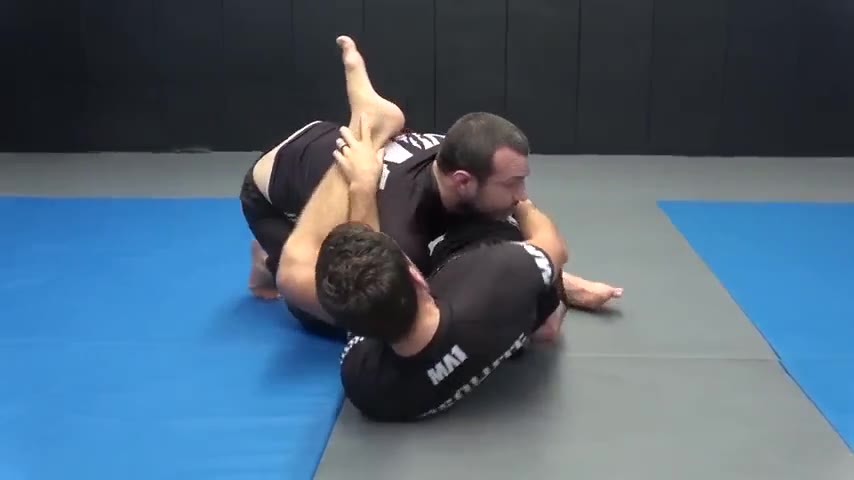
His leg comes over your shoulder. Flexible guard players hunt an omoplata or try to bring a foot in front of your neck. Giles draws a hard line: once the foot is in front of your neck, let go and get out. Before that, step over his knee and walk sideways. That turns his hips and takes the foot away from your head. In one of his own rounds Giles holds the lock too long and says so.
09 His leg is over your shoulder
His leg is over your shoulder and he holds his own foot. As you work around him the leg ends up pointing straight up off your shoulder, he lets go and you settle chest to chest on top.
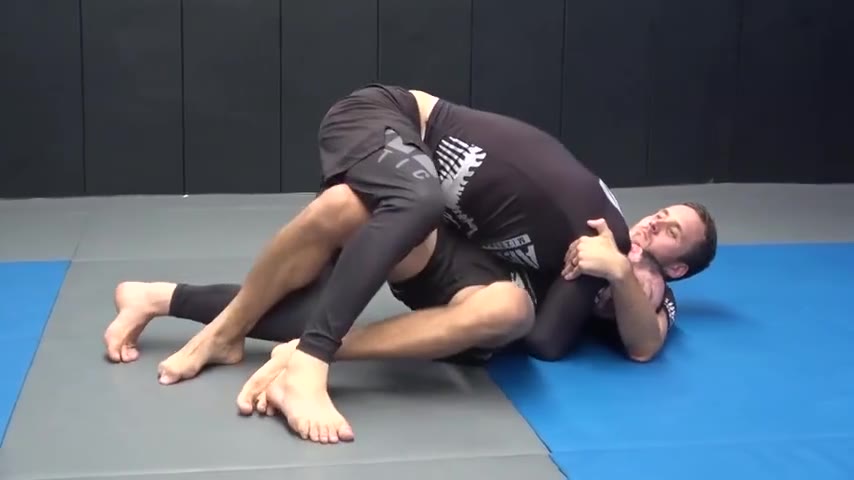
Vol 3 · 54:10He tips you just as you get over his knee. This is the John Wayne sweep, and it comes at the moment your head goes across and your weight comes forward. Giles’s first advice is plain: be ready to let go and post, because staying on top matters more than the lock. When he sees it coming he rolls his hips until his knee points at the ceiling and steps out wide, so his leg is his base and not his arm.
10 Knee up, then step out wide
With your head across on his far side, lift your hips so your knee points up, then step that leg out wide and plant the foot. You stay on top, based on your leg.
Vol 3 · 1:08:03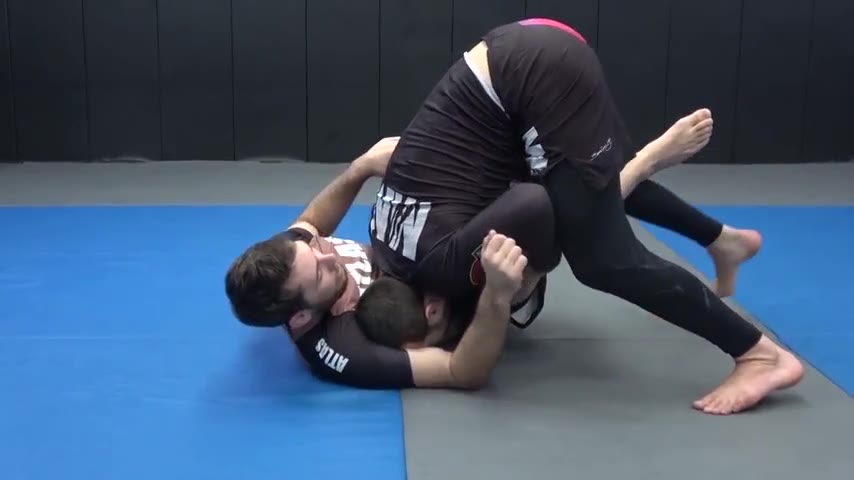 01
 02
 03
 04
 05
 06
 07
 08
 09
 10
How many of these do you do?
Count the ones you already do in a roll, not just in drilling. If most are new to you, this course will change how you get past his knee.
Black Friday code BLACKFRIDAY2026, tested at checkout on November 23, 2026: $44.55 instead of $99. BJJ Fanatics rotates these codes.
Who should buy it
Which one are you?
- You pass no-gi and stall at his kneeVolume 3 is 1 h 19 on that one step and on everything he does to stop it.
- His butterfly hook keeps lifting youYou get one answer for before you are over his knee and one for after (details 04 and 05). In both, driving into him is what lets the hook lift you.
- You are not long-limbedGiles isn’t either, and he says which options work better with longer legs or arms than his.
- Closed guard is where your passing stopsVolume 5 opens it without standing up, if you accept the risk he describes.
- You train mostly in the giEvery rep is no-gi and no gi grip is shown. One buyer, Christopher P. (September 2022), writes that he finds it works in the gi too. The warning that keeps coming back from gi players is loop and collar chokes (see the FAQ).
- You are new to passingGiles assumes you can already get past his feet. The course starts after that.
 You own Giles’s Guard Passing Anthology: Half GuardThis one starts earlier, in butterfly, headquarters and the knee cut, and holds one grip all the way through.
- You want takedowns into the lockNo entry is taught against a standing man. The lessons start with him sitting or on his back.
- You want leg lock defence while you passIn the rounds his partners pull him toward leg entanglements and he steps out without teaching it.
- You want every kind of body lockThis is one lock, mostly to one side. See Compare to.
What buyers and other grapplers say
Chris J. (January 2020) bought it as his first instructional and writes that it made him harder to sweep, from butterfly above all. David P. (March 2024) writes that it helped him shut down butterfly and seated guards at his level, and gave higher belts trouble too. jdomask (September 2021), an older grappler and bigger in size by his own description, got his first body lock pass with technique after two volumes and names the grips and the head position as what helped.
 Joe W. (April 2020) calls it a tricky pass in practice, one you fix by going back to the troubleshooting. Roland D. (February 2022) says it will not be for everyone: it is a study of the body lock itself, not of one position like some of Giles’s other courses. He got a lot out of it, and counts it in its favour that it costs less than Gordon Ryan’s body lock course.
Elijah (January 2024) had never been good at opening closed guard and now uses the Sao Paulo open regularly.
Away from the shop, the praise gets more specific. One grappler calls it the instructional he uses most, even on the days he never gets the lock: controlling the hips, stepping over the knee line and taking his head to the far shoulder. Read that as: the course pays off before the lock does. Another calls the Sao Paulo part the best teaching of that pass he has seen, a hidden gem at the end of the course, and it is now the closed guard pass that works best for him.
Not everyone got it working. Someone who watched it could not make the pass work and found Gordon Ryan’s course clearer. He adds that this is an early course of Giles’s and that he knew less jiu-jitsu himself back then, so weigh it that way. The report worth your time comes from a gym that drilled the standard version of the pass for years without steady success against good frames, until they pinned the man flat before clearing the legs. The writer still rates this course above Gordon Ryan’s and John Danaher’s takes on the pass, and says it hardly mentions the pin. It is in there: Giles teaches pinning him flat with shoulder pressure once you are past the knee, in Volume 4. Watch that part twice.
Worth it? The pros and cons
- One rule you can check in the middle of a round: weight back until you are over his knee (the clip at the top), then on him
- An answer for each thing he does, and Giles lists them up front: butterfly hook, guillotine, omoplata, kimura, a hand on your knee, a grab on your leg, the John Wayne sweep
- He tells you when to let go. Three moments in Volume 1, and a hard line for the omoplata in Volume 3
- He shows it failing in his own narrated rounds: he bails late from an omoplata (Volume 6) and nearly gives up his back on a Sao Paulo open (Volume 5)
- About an hour and a half of narrated rolling against his training partners, most of it in the last volume
- A way to learn it: one problem at a time with a partner, and start from the finish and work backwards
- $44.55 with the code is about $6 per hour. Gordon Ryan’s Body Lock Study was $174.50 on sale on November 23, 2026, the day we tested the code
- One lock, mostly to one side. Giles says his other side is weaker. Gordon Ryan’s Body Lock Study covers front and side body locks, tight waists and over-under in 10 volumes
- No-gi only, and nothing from standing against a standing man
 Leg locks while you pass are not covered. Gordon Ryan’s The Pillars of Defense: Leg Locks to Guard Passing ($349 list on November 13, 2026) is built on that problem
- The four teaching volumes have almost no rolling: four short inserts in Volume 2, a short silent clip in Volume 3, none in Volumes 1 and 4
- The last volume is uneven: ten minutes of questions from a class, and 34 minutes on the training videos of one blue belt viewer
- No competition matches are shown. He describes two and suggests you look one up
Weight back until you are over it, then on him. Black Friday code BLACKFRIDAY2026
What’s inside the six volumes
Six volumes, one file each, all no-gi. The first four teach the pass in order, the fifth opens closed guard, the sixth is rolling. Tap a volume for what’s in it.
Vol 1 · 41:47The idea and the gripfive stages, the grip, when to let go, common mistakes
No rolling here, only the plan. Giles explains why locked hands work (to break them he has to beat your whole grip, not one arm) and what they cost you: no hands to post. He gives the five stages, then walks through one full pass from butterfly to side control. Then the grip, low on the hips (detail 03): fingers linked deep on the far side, one palm up and one down. Then the three moments to let go, where your head goes at each stage, and how to stop his leg coming back. The volume ends with the most common mistakes (a grip that is too high, and driving forward) and with how to practise: one problem at a time, and from the finish backwards.
Vol 2 · 59:40Getting your hands lockedseated, butterfly, headquarters, knee shields
Every entry starts with one of his legs trapped between yours and ends with him sitting up into you (detail 01). Against a seated man Giles compares it to shooting a double leg: win the inside of the hand fight, get your shoulder lower than his, then one hand deep and one shallow on his thigh. In butterfly he keeps his hips low and back and posts a hand on the mat to stop being pulled forward. Lose the head fight and he grips under the calf and pulls his own hips down. Against a man on his back he goes to headquarters and slides his shoulder past the knee (detail 02). Then the knee shields, shallow, deep and high, plus reverse De La Riva and a thumb in the armpit to beat an underhook. He says plainly that the shin flick is not his best move and that floating over the legs suits taller people. Four short inserts show the posting and the wrist control in live rounds.
Vol 3 · 1:19:15Getting over his kneesag back, butterfly hook, guillotine, omoplata, John Wayne sweep
The longest teaching volume. It opens with the list of what the bottom man will try. Then what makes the step easier: tilt him and square him a little, drag his foot away, and sag back instead of driving (the clip at the top). After that it is one counter at a time. The butterfly hook (detail 04) and the smash pass when the hook is too strong. The guillotine. Z guard. His foot on your far hip, which Giles reads as a sign you went too far sideways. A hand pushing your head. The leg over your shoulder (detail 09). A stiff arm. The John Wayne sweep (detail 10). A grab on your leg, where the rule is head under his chin or let go. The last six minutes repeat all of it in one run.
Vol 4 · 58:32Past his kneehalf guard, late butterfly hook, lockdown, kimura, when he turns in
Now the weight goes on him. Two jobs are left, freeing your knee and freeing your foot, and where your head is decides the pass. The half guard comes first: shoulder pressure, head on the mat, shin over his thigh, a foot on the back of his calf. Giles spends two minutes on not getting bridged over, and his point is to lean, not squeeze. Then the late butterfly hook (detail 05), the lockdown (detail 06), the kimura grip, the man who gets up on an elbow or sits up, and the man who turns in (detail 07). No rolling, but long runs of reps from several angles with no talking, and a short recap at the end.
Vol 5 · 1:13:30Closed guardthe Sao Paulo guard open, its four stages, its risks
A separate skill that ends where the pass begins (detail 08). Two versions, head low with a grip around the waist or head up with a hand posted, which is the one Giles uses more. Four stages: the ankle grip with your elbow locked to your ribs, trapping both feet, getting them uncrossed, then his knee and the lock. Then what he will attack you with: triangle, choke, flower sweep, omoplata, an underhook. The last half hour is narrated rounds against three partners, including the one where his back is nearly taken.
Vol 6 · 1:52:57Rollingnarrated rounds, students’ mistakes, a blue belt viewer’s videos
The first 55 minutes are narrated rounds against six of his training partners, and Giles says why they matter: you see which reactions come up most. He pauses and rewinds as he talks. You see the smash against a strong butterfly hook, the walk and the kick off, the lockdown answer, and an omoplata he gets out of too late. Then ten minutes of questions from a class, 14 minutes on students trying the pass on each other, and 34 minutes on the training videos of a viewer, a blue belt from another gym. That last part is where the driving mistake from the top of this page is shown best, next to Giles doing it right. Giles found that viewer through a call on r/bjj in June 2019: one viewer would get the course before release, film himself trying it in his rolls, and get Giles’s notes on the footage.
Free sample: BJJ Fanatics has a YouTube video on the product page.
Compare to
- Systematically Attacking the Guard: Body Lock Study (Gordon Ryan, $349 list, $174.50 on November 13, 2026, 10 volumes): the wide version. Front body locks, side body locks, tight waists and over-under, with his own gym rounds broken down. Giles teaches one lock, mostly to one side, in six volumes, and tells you where it fails. Want one pass with one rule to start on this week: Giles. Want the whole family of body locks: Gordon Ryan. Ask around and people split the same way: Gordon Ryan’s is the more detailed one, Giles’s the better organised and the easier to take in. A sensible order, and one that has worked on the mat: start with Giles, and go to Gordon Ryan’s for details when you hit a snag. Read our review of it. See it on BJJ Fanatics.
- The Guard Passing Anthology: Half Guard (Lachlan Giles): the broad course next to this narrow one, and the comparison is Giles’s own. That one covers many kinds of half guard and lets you pick your path through them. This one is a single grip that he sets up before half guard, from butterfly, headquarters or a knee cut, and keeps until he is past. He points back to it in Volume 4, for the trick of turning your trapped foot so it slides out. See it on BJJ Fanatics.
- Body Lock the World (Shawn Williams, 8 volumes, no-gi): another name that comes up next to Giles and Gordon Ryan. It is wider than a pure body lock course, with near side underhooks, smash passing and half guard around it. So take it as a supplement, not as a second body lock course. Someone who owns both calls the two complementary, from different angles. Read our review.

Want the whole field? This course is in our best body lock passing instructionals, in our best pressure passing instructionals and in our list of every Lachlan Giles instructional. Prices on BJJ Fanatics, November 13, 2026.
Get the next review like this one
New reviews in this format land in your inbox, with the details on video. You also get the free BJJMore email course and the instructional-platform discounts I use myself (worth $46).

BJJMore earns a commission if you buy through these links, at no extra cost to you. Released by BJJ Fanatics in September 2019; reviewed on all six volumes.
FAQ
Is The Body Lock Pass by Lachlan Giles worth it?
Yes, if you pass no-gi and stall at his knee or get lifted by his butterfly hook. It is $99 list ($44.55 with the Black Friday code we tested on November 23, 2026) for 7 h 6 min on one pass. Skip it if you train only in the gi or want several kinds of body lock in one course.
What is the main idea?
Lock your hands low around his hips, keep your weight back until you have stepped over his knee, and only then put your weight on him. Giles comes back to the first half of that again and again, because driving forward is a mistake he calls really common.
How long is it?
7 hours 6 minutes over six volumes: 41:47, 59:40, 1:19:15, 58:32, 1:13:30 and 1:52:57. The BJJ Fanatics page says over 8 hours; the six files add up to 7 h 6 min.
Is it gi or no-gi?
No-gi. Every rep and every round is no-gi, and Giles describes the problem as a no-gi one: one underhook is often easy to counter. The idea of keeping your weight back carries over to the gi; the grips are not shown there. People who took it into the gi report two things. It works, but the lock is harder to get around a jacket and the gi slows you down. And the risk that keeps coming back is collar and loop chokes. Someone who says he is the blue belt Giles corrects in Volume 6 trained mostly in the gi and found it less useful there for that reason. Not everyone runs into it: keep your head in the right place and the chokes should not be a problem, one gi player says.
Is there live rolling?
About an hour and a half of narrated rolling, but not in every volume. It sits in Volume 6 (55 minutes against six training partners) and Volume 5 (about half an hour of the Sao Paulo open), with four short inserts in Volume 2. Volumes 1 and 4 have none, and Volume 3 has under two minutes of silent gym clips.
Will I get swept while I learn it?
Yes, and Giles says so. With your hands locked you cannot post, so your legs and your head have to balance you. He tells you to expect to get swept a lot at first and names the moments to let go.
Do I need to be flexible or strong?
Hip flexibility helps you step over his knee, and Giles shows a stretch for it. On strength: locked hands mean he has to beat your whole grip, not one arm, and once Giles is past the knee he leans on the man rather than squeezing him.
What is the Sao Paulo guard open?
A way to open closed guard without standing up: you grip his ankle, switch out to the side, step over his feet and pry them apart, and you are in half guard with the lock close. Giles gives it a whole volume and calls it a very dangerous way to open a guard.
Giles or Gordon Ryan’s Body Lock Study?
Giles is one lock in six volumes with one rule to hold on to. Gordon Ryan’s course is 10 volumes on front and side body locks, tight waists and over-under, at $349 list and $174.50 on sale, both on November 13, 2026. Start with Giles if the body lock is new to you.
Is it the same as Giles’s low body lock course on Submeta?
Not the same course, but by Giles’s own account close to it. In 2023 he put out a newer course on the low body lock on Submeta. When someone asked him about it on r/bjj, Giles wrote that there is probably not a big difference between how he does the pass now and then. He explains some things differently now, he says, hopefully better. His advice: if you have this course, do not subscribe to Submeta just for the new one. We reviewed this course only.
Is there a discount code?
On November 23, 2026 the Black Friday code BLACKFRIDAY2026 took 55% off at checkout: $44.55 instead of $99. BJJ Fanatics rotates its codes and sales, so check the price on the day you buy. A $139 version adds a flow chart and visual notes; we reviewed the videos only.
Weight back, then on him
If you pass no-gi and stall at his knee, this is seven hours on that one problem: make him sit up into your hands, lock them low, keep your weight back until you are over his knee, and only then put your weight on him. No-gi, six volumes, an hour and a half of it narrated rolling.
Black Friday code BLACKFRIDAY2026, tested at checkout on November 23, 2026: $44.55 instead of $99. BJJ Fanatics rotates these codes.