
BJJ Guard Passing
How to Pass Guard: 14 BJJ Guard Passes and the Guards They Beat
Once you can see all the passes, you stop forcing the one you know and start taking what your opponent gives you. Here are 14 BJJ guard passes, which guard each one beats, and a video for every one.

Some links on this page are affiliate links: BJJMore earns a commission if you buy through them, at no extra cost to you.
Want a course for it? Our guide to the best guard passing instructionals ranks 10 passing courses, from body lock to pressure passing. The five courses that teach the passes on this page are at the bottom.

What is a guard pass?
A guard pass gets you beyond your opponent’s guard into top control. Under IBJJF rules, passing guard or half guard and holding side control or north-south for 3 seconds scores 3 points. A continuous pass-to-mount sequence can score 7 points (3 for the pass plus 4 for mount) under the cumulative-scoring rule, provided the control requirements are met. You must actually pass a guard; simply landing beyond the legs does not automatically score a guard pass. Other formats, including submission-only events, use different scoring rules.
How to pass guard in 2 Simple steps
There are two steps to guard passing in BJJ:
- Get free of his guard. Break grips, strip hooks and get your legs out of guards like closed guard, worm guard, single leg X or a locked half guard.
- Do the pass, such as a knee slice or a leg drag.
Sometimes both happen at once, and sometimes you can skip the first step, which is ideal. But very often you first need to get free, and only then can you pass.
Step 1: get your legs free
 From John Danaher’s guard passing course: if his legs lock above your knee, he has you. Hook your shoelaces over his knee and shake the knee free. Once he only has your ankle, you are winning. Vol 7 · 25:04 Our full review →
 From Jozef Chen’s Tripod Passing: in a locked half guard his foot is behind your knee. Grab his top ankle and straighten your leg to split his feet. Vol 3 · 19:10 Our full review →
Step 2: the pass
From John Danaher’s guard passing course, the Gordon Ryan special: camp with your head on him, run your feet around his legs and drop your knees into a north-south pin. Vol 2 · 10:07 Our full review →How to master guard passing in BJJ
To become truly good at guard passing, you need to develop 3 separate skills:
- Escaping guards by breaking grips and disentangling hooks
- Avoiding sweeps and submissions by having great balance and solid position at all times
- Attacking and combining guard passes
Begin with attacking and combining guard passes, so you put pressure on your opponents. You don’t need to learn every pass right away: two or three that chain together are enough to start. Our guide to guard passing instructionals helps you pick a passing style that fits your game.
Balance, the second skill, from Jozef Chen’s Tripod Passing: kneel on his butterfly hooks and he lifts you. Put your weight on your head and the same hooks can’t move you. Vol 1 · 6:21 Our full review →Which guard pass works against which guard?
You can pass almost any guard with any guard pass. The combinations are endless, especially if you go through intermediate positions (like the headquarters position) or if you disentangle all the grips first.
Nevertheless, some guard passes work naturally against some guard positions. Here’s an overview of such combinations:
| Guard | Passes that work well against it |
|---|---|
| Open guard | Toreando, Leg drag, Leg weave, Throw by, Double under, Cross grip, Cartwheel |
| Closed guard (once it is open) | Knee slice, Near side knee through, Double under |
| Half guard | Knee slice, Smash pass, Leg weave, Over/under, Double under, Body lock |
| Butterfly guard | Smash pass, Cartwheel, Body lock |
| De la Riva guard | Knee slice, Near side knee through, Smash pass, Leg drag |
| Reverse de la Riva guard | Knee slice, Long step, X pass, Leg drag |
| Single leg X guard | Back step, Knee slice, Long step |
| X guard | Back step, Long step |
| Spider guard | Throw by |
| Lasso guard | Toreando, Knee slice, Throw by |
Also read: All Guards in BJJ: an exhaustive list
1. Toreando / Toreada / Bull fighter pass
Works against: open guard
One of the most versatile and widely used guard passes is the Toreando or bull fighter pass. It’s called the bull fighter pass because a common variation is that you push your opponent’s legs towards him, and when he pushes back, you step to the side with perfect timing like a bull fighter against a bull.
There are many variations of the Toreando, each suited to different grips and postures. The most common grips are pants at the knee or ankle, and some no-gi players use shin-on-shin control instead. What all Toreandos share is that you control your opponent’s legs and pass around them. A common mistake is bending at the waist instead of driving with your legs, which kills your speed and lets your opponent recover guard.
2. Knee slide / Knee slice / Knee cut / Knee through pass
Works against: half guard, reverse de la riva, de la riva
The knee slide (also called the knee cut or knee through pass) is a guard pass that is often used at the highest levels of BJJ competition. It’s usually initiated from a position in which one of the opponent’s legs is trapped in between the passer’s legs, such as reverse de la riva or half guard.
Knee slides are very versatile: you can run them fast with a collar grip to blow through the guard, or slow and heavy with an underhook and crossface to grind past half guard. The key detail most beginners miss is the angle of the sliding knee – it should slice diagonally across your opponent’s thigh, not push straight down. You see it at every level: at ADCC 2024, Gordon Ryan got double underhooks on Yuri Simoes, switched his head to the near side and knee cut into three-quarter mount.
 Course: Systematically Attacking The Guard by Gordon Ryan (no-gi). Knee slides against the knee shield, split squat passing and body locks, chained into one system.
3. Near side knee through
Works against: de la riva, headquarters position, closed guard
The near side knee through pass is similar to the knee slide, but the difference is that in the knee slide you pass to the opposite side of the leg you’re using, and in the near side knee through you pass to the side of the leg you’re pushing through the guard. An advantage of the near side knee through compared to the knee slide is that you don’t necessarily need to step over one of your opponent’s legs first.
4. Leg drag
Works against: open guard, de la riva guard
In the leg drag you grab your opponent’s ankle or pants and pull that leg across your body, pinning it to your hip. Your inside knee drops to the mat next to their hip to block guard recovery. The leg drag is a staple of modern open guard passing because it chains naturally with the Toreando and X pass. Competitors like the Mendes brothers built their passing game around the leg drag. A common mistake is not controlling the far-side collar or underhook after the drag, which lets your opponent turn into you and reguard.
5. Smash pass
Works against: half guard, headquarters, butterfly guard
The smash pass is a pressure pass in which you flatten your opponent’s legs together using your body weight. You typically drop your hip or chest onto both of their thighs, pinching their knees together so they can’t create any frames or hooks. The key is keeping your hips low and heavy while walking your feet around to complete the pass. If you do it right, your opponent literally cannot move their legs, giving you a free path to side control or mount. Bernardo Faria and Lucas Lepri are two of the best examples of high-level smash passers.
6. Leg weave pass
Works against: open guard, half guard
The leg weave pass is similar to the smash pass, but instead of using your hips or belly to smash your opponent’s legs to the floor, you use your shoulder. The advantage of this is that your legs are free to move around your opponent, and the drawback is that you naturally have less pressure.
7. Throw by pass
Works against: spider guard, spider lasso guard, open guard
For the throw by, grab one of your opponent’s pant legs and throw that leg explosively past your body. The difference with the leg drag is that you stand up straight, so all your deadlift muscles throw the leg past you. You can also do the throw by and then drop down to settle in a leg drag position.
8. Over/under pass
Works against: half guard
The over/under guard pass gets its name from the grip configuration: one arm threads under your opponent’s leg, the other controls over the top leg. This gives you a powerful clamp that pins both legs in place.
The over/under is a classic pressure pass and is usually initiated from half guard. Bernardo Faria, a five-time black belt world champion, is famous for it. The trick is driving your shoulder forward into your opponent’s hip while walking your legs around. A common mistake is lifting your head, which relieves the pressure and lets your opponent create space to reguard.
 Course: Pressure Passing Encyclopedia by Bernardo Faria (gi). Built around the over/under, with entries from the knees, the lasso, spider and half guard.
9. Double under pass
Works against: open guard, half guard, closed guard (after you break it open)
For the double under pass you pass both your arms under your opponent’s legs, and then you usually try to stack him. From the stacked position, you get a thumb-in cross collar grip and use that to push your opponent’s legs out of the way.
Alternatively, you can use the double under to set up the stack position and then pass in some other way, such as with a leg drag.
10. Long step
Works against: single x guard, headquarters, reverse de la riva
The long step is an explosive guard pass that requires good hip mobility and timing. To execute it, you switch your hips 180 degrees to launch your trapped leg far behind you, clearing your opponent’s guard entirely. You need to land immediately with strong upper body pressure – a tight crossface and your shoulder driving into their jaw. The timing is everything: if you’re too slow, your opponent will follow your hips and reguard. The long step takes time to learn, so drill the hip switch on its own before you try it in a roll.
11. Cross grip / Crazy dog pass
Works against: open guard
The cross grip pass is a gi pass built on one grip: as soon as you hold your opponent’s pants with a cross grip, it becomes hard for him to set up a good guard.
Its close cousin is the crazy dog pass, where you wrap his leg with your arm instead of holding it out straight. Both finish the same way: take the collar on the same side with your other hand and circle past the leg.
12. X pass / High step pass
Works against: headquarters position
The X pass is one of the best passes to learn early on. You start from the headquarters position (standing with one leg between your opponent’s legs). To execute it, you mule kick your lead leg backward to free it, then immediately use your hands to push your opponent’s legs to the mat while stepping around. I had a lot of success with this pass as a blue belt, and it remains effective at every level because it’s fast and hard to predict. The key mistake beginners make is not pushing the legs down firmly enough before stepping around, which lets the opponent re-hook.
13. Cartwheel pass
Works against: butterfly guard, open guard
The cartwheel pass works best against butterfly guard, where your opponent is sitting up with hooks in. As they go for a butterfly sweep, you cartwheel over their legs in the direction of the sweep, using their momentum against them. You can also use it against open guard to create movement and scrambles, but it’s harder to finish the pass cleanly from open guard because you leave a lot of space for your opponent to recover.
14. Body lock pass
Works against: butterfly guard, half butterfly, half guard
In the body lock pass you lock your hands around your opponent’s waist and sprawl your hips back. That splits his butterfly hooks and puts your weight on his hips, where his legs can’t lift it. From there you finish with a knee cut or by walking around his legs. You need no grips on the clothes, which is why the body lock became one of the main passes in no-gi. If your body lock keeps failing, try John Danaher’s fix: put your temple on his top shoulder.
ADCC 2017, Romulo Barral vs Gordon Ryan (FloGrappling): Gordon locks his hands around Romulo’s waist, sprawls to split the butterfly hooks and finishes with a cross knee cut. Starts at 0:52.
Best guard passing instructionals for these passes
Five courses that teach the passes on this page. Start with the one that fixes the spot where you get stuck now.

Start here · No-gi · 2024 · 7 h 31 min
The Fastest Way: Effective Guard PasserJohn Danaher
For when you spend whole rounds stuck in people’s guard and want a clear plan to get past their legs. Danaher teaches the passes in one order: camp and angle, toreando, hand block and leg drag, body lock, knee cut and tripod, then half guard.

Butterfly hooks · No-gi · 2024
Tripod Passing: Beating Inside PositionJozef Chen
For when butterfly hooks keep lifting you off as you try to pass. Chen puts your weight where his hooks can’t carry it, then beats one hook at a time. Not an easy pass: expect to get swept while you learn it.
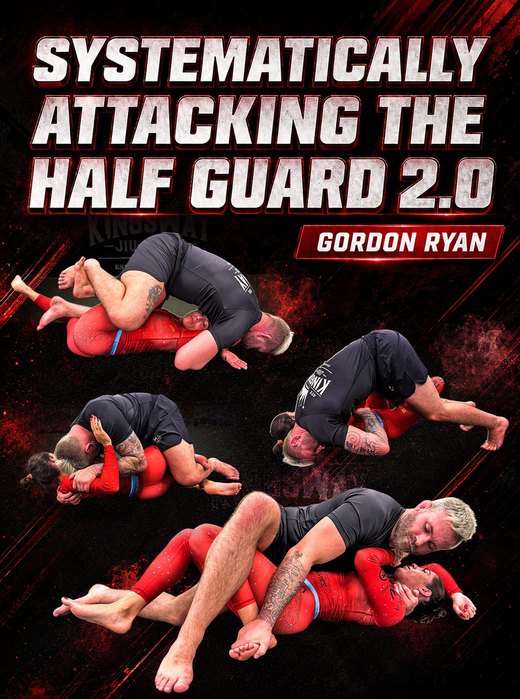
Half guard on top · No-gi · 2026 · Intermediate and up
Systematically Attacking The Half Guard 2.0Gordon Ryan
For when you get on top in half guard, try to pass and get rolled over. Gordon’s rule: stay low while your opponent can post on your hip, pass to the far side first, and knee cut with a misdirection. Not a first half guard passing course.
Knee shields · No-gi · 2019 · 8 volumes
Systematically Attacking The GuardGordon Ryan
Gordon’s 2019 passing system: split squat, knee shield, half butterfly and half guard, with body lock and under/over passes. It also has live rounds that Gordon talks you through afterwards.
For the gi · 2018 · 4 volumes
Pressure Passing EncyclopediaBernardo Faria
The gi pick of the five. Built around the over/under: entries from the knees, the lasso, spider and half guard, plus stack passes, knee cuts and butterfly passing.
Want to compare more courses? These guides rank them in detail:
- Best Guard Passing Instructionals – 10 passing courses ranked, from body lock to pressure passing
- Best Pressure Passing Instructionals – For smash pass and over/under specialists
- Best Jozef Chen Instructionals – Three passing courses, each for a different spot where your pass gets stuck
- Best BJJ Instructionals Overall – Top picks across all positions
- Best Instructionals for Beginners – If you are just starting out