
Guards are essential positions in BJJ. BJJ’s focus on guards is also the main differentiator from other grappling arts.
Here is an exhaustive list of all BJJ guards. If you want to become good at BJJ, you’ll need to get good at all these guards (at least to some degree).
Updated November 2026: every guard now has a short explanation, what it is good for and, where we have one, a link to our ranking or review. Passing instead? See the guard passes that beat each guard.
What is a guard in BJJ?
Before we can give an exhaustive list of all guards in BJJ, we need to define what a guard is. We’ll use the following definition:
Definition: A guard is any position in which you use your legs to manage the distance between you and your opponent.
For example, you could be using your feet on your opponent’s biceps to manage the distance, and we call that spider guard. But you could also be using your inner thighs to clamp down on someone’s ankle to prevent him from knee sliding you; we still count that as a form of half guard (albeit a very disadvantageous one).
Some notable exceptions to this definition are various leg entanglements. For example, in 50/50 you are technically using your legs to manage the distance between you and your opponent, but we don’t typically call that ’50/50 guard’. (I think this is because in leg entanglements your opponent is also managing the distance with his legs, which doesn’t concord with the more traditional picture of your guard being your defense against an advancing opponent.)
Of course, no definition is ever perfect, but we’ll use this one as a working definition to make up our list of all guards in BJJ.
All BJJ Guards: an exhaustive list
Here is a list of all (major) guards in BJJ:
That makes 24 guards in 6 families. Each one below says what your legs and grips do, what the guard is good for and, where it has them, the attacks it is known for.
Closed guards
Closed guard
Your legs wrap around his waist with your ankles crossed behind his back. He can’t pass until he opens your legs, so you have time to break his posture and attack. The classic attacks are the scissor sweep, the hip bump sweep, the armbar, the triangle and the kimura; in the gi add the cross collar choke.
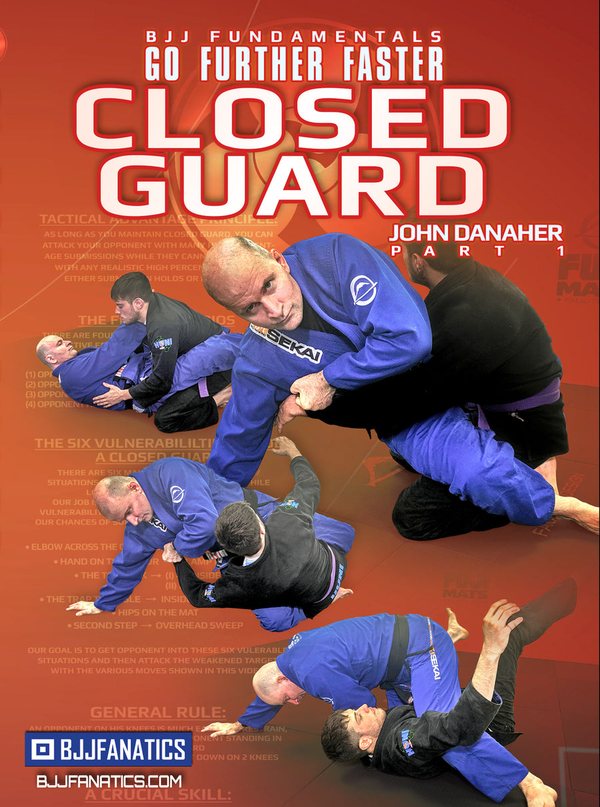 Review Danaher’s Closed Guard (Go Further Faster)
 Review Mica Galvao’s Next Generation Closed Guard
High guard and rubber guard
A closed guard with your legs climbed high on his back, so his posture stays broken. In the rubber guard (Eddie Bravo’s 10th Planet system) you bring one leg over his shoulder and hold your own shin, which keeps his head down. It sets up the omoplata, the triangle and the gogoplata, and it asks for flexible hips.
Half guard and its variants
Half guard
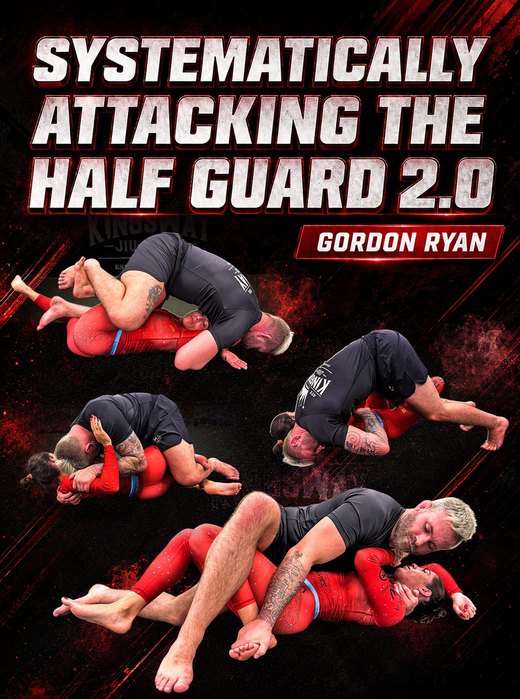
You trap one of his legs between yours. Half guard works when you are on your side with the underhook or a knee shield, not flat on your back with his crossface on. From the underhook you get the old school sweep, come up on a single leg (the dogfight) or take his back. If he gets double underhooks, Gordon Ryan’s answer is to lift him over your shoulder until he has to let go with a hand:
Z guard (knee shield half guard)
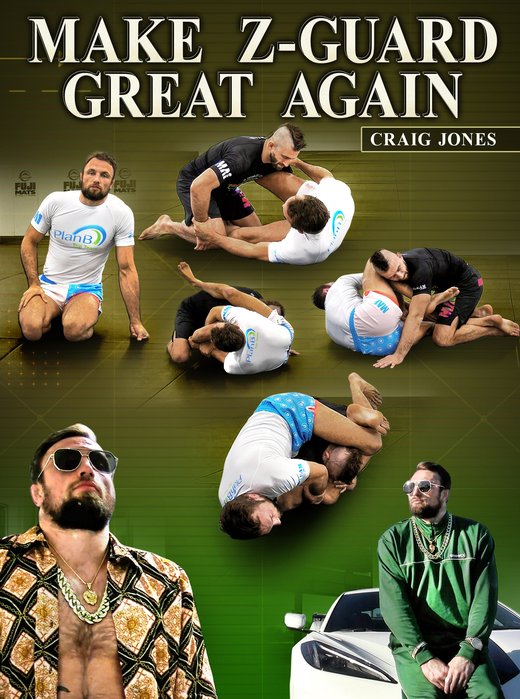
Half guard with your top knee across his chest or hip as a frame, so he can’t flatten you or crossface you. Craig Jones made it famous in no-gi: from the knee shield you attack the arm (kimura, armbar, triangle, omoplata), go to the legs with single leg X, or come up to the underhook and the dogfight.
Deep half guard
You go all the way under him, your head near his hips and both legs locked around one of his legs. He is on top but has no base on that side. The best known sweep is the waiter sweep, where you lift his free leg like a tray and tip him over.
Half butterfly guard
Half guard and butterfly guard mixed: you are on your side with one butterfly hook inside his thigh, usually with an underhook. The hook lifts his weight, so you can sweep him over instead of getting flattened.

Reverse half guard
You still hold one of his legs between yours, but one of you has turned so you face his feet, often because he is halfway through a pass. Most people use it to get back to a normal guard before he finishes the pass, but Jake Mackenzie plays it on purpose in the gi, with sweeps and back takes.
Octopus guard
You get your head out to his side and reach your arm over his back, so you end up beside him instead of under him. From there you take his back or come up on top. Eduardo Telles made it known; Craig Jones’ newer course plays it mostly from bottom side control rather than from half guard.
Quarter guard (a.k.a. 3 quarter mount)
You only hold his foot or ankle between your legs and he is one step from mount. This is where you fight to get back to half guard (frames on his hips and shoulder, a knee back in), not where you attack.
Quarter guard 2 (a.k.a. deep knee slide bottom)
He has knee sliding almost through and your thighs clamp his trailing ankle. Same job as quarter guard: frame, keep the ankle, and get a knee back in before he frees his foot.
Butterfly guard
Butterfly guard
You sit up with both feet hooked inside his thighs, chest close, usually with an underhook or an arm grip. The hooks lift his weight, which is why smaller people sweep bigger ones from here. The main moves are the butterfly (hook) sweep, the arm drag to the back, the guillotine, and the switch to X guard or single leg X.
 Review Adam Wardzinski’s Butterfly Guard Rediscovered 3.0
Open guards (gi)
Double sleeve guard
You hold both of his sleeves with your feet on his hips or biceps. With both arms controlled he can’t grip you, and you can sweep, go to the triangle or the omoplata, or move on to De la Riva or spider guard.
Collar sleeve guard
One hand on his collar, the other on a sleeve, a foot on that biceps and your other foot on his hip or hooked behind his knee. It is one of the first open guards people learn in the gi: the triangle, the omoplata and the overhead (tomoe nage) sweep all come from here.
Spider guard
You grip both sleeves and push your feet into his biceps, so your legs steer his arms and his posture. Triangles, omoplatas and spider sweeps come from it. It needs sleeves, so it is a gi guard.
Lasso guard
Your leg wraps around his arm from the outside, your foot ends under his armpit (in the deep lasso, across his back), and you hold that sleeve. The lasso is hard to strip and slows a passer down; it leads to the omoplata, the triangle and sweeps.

De la Riva guard
Your outside leg hooks his lead leg from the outside, the foot behind his thigh, while you hold that ankle and a sleeve or collar. It is the start of the berimbolo, of back takes and of many sweeps, and an easy way into X guard.

Reverse de la Riva guard
Your leg hooks his lead leg from the inside instead. It is a standard answer to the knee cut, and it leads to the kiss of the dragon, berimbolo and crab ride back takes, and leg entanglements.
Worm guard (and Mantis guard, Reverse de la worm guard)
Lapel guards: you feed his own lapel around his leg and grip it, which ties that leg to you. Keenan Cornelius made the worm guard famous; the reverse de la worm uses the same lapel wrap from a reverse de la Riva hook.
Open guards (no-gi and both)
X guard
You are under him, holding one of his legs: one foot hooks behind that knee and the other foot pushes on the front of his hip, so your legs cross in an X. His leg is pried away from his base, which makes it a sweeping guard; the technical stand up sweep is the classic. Marcelo Garcia built much of his game on it.
Single leg X guard
You hold one of his legs, your inside leg goes between his legs and your outside foot sits on his hip. In the gi it is a sweeping guard (the tilt sweep, the technical stand up); in no-gi it is also a main leg lock position, with the straight ankle lock and, where legal, heel hooks.
K guard
You lie on your side and hold one of his legs, with your inside leg across his hip and the shin across his body like a knee shield, so he can’t pass while you work that leg. It works against a kneeling or a standing passer, and it is a way to get under him: into the matrix, the backside 50/50 and heel hooks in no-gi, or to his back in the gi.

Shin to shin guard
Your shin goes against the inside of his shin while you hold that ankle, sitting or lying. It is the doorway to single leg X, X guard and coming up on a single leg.
Seated and supine guards
Seated guard
You sit up facing him, feet on his knees or hips or hooks in, hands fighting his grips. A lot of modern no-gi guard play starts here: you wrestle up with ankle picks and single legs, sweep off a collar tie or two hands on one arm, or go to butterfly and the leg entanglements.

Supine open guard and guard retention
Lying on your back with your feet on his hips, knees or biceps. Its first job is to stop the pass and get back to a guard you can attack from: keep your knees between you and him, keep one leg high and one low, and bring a leg back across when he steps around.
 Review Lachlan Giles’ Guard Retention Anthology
 Review Gordon Ryan’s They Shall Not Pass
 Review Danaher’s Fastest Way To Develop An Unpassable Guard
 Review Mikey Musumeci’s Power Switch Guard Retention
Questions about BJJ guards
How many guards are there in BJJ?
There is no official number. With the definition on this page (any position where you use your legs to manage the distance), we count 24 major guards in six families. Each of them has named variations of its own.
What is the best guard for beginners?
Closed guard and half guard. Most gyms teach them first, and what you learn there (breaking posture, the scissor sweep, the armbar and triangle, fighting for the underhook) carries over to every other guard. Add butterfly guard once you can sit up and stay square to your opponent.
What is the difference between closed guard and open guard?
In closed guard your ankles are locked behind his back, so he has to open your legs before he can pass. In an open guard your legs are not locked: you control him with your feet, hooks and grips. That gives you more sweeps and more ways to move, and him more ways to pass.
Is 50/50 a guard?
Not on this list. In 50/50 you do use your legs to manage the distance, but your opponent does the same with his legs, so we count it as a leg entanglement rather than a guard (see the definition above).