
Home / John Danaher / Closed Guard: Go Further Faster Review
Danaher’s Closed Guard, Go Further Faster (Gi): Worth It?
Buy it if you train in the gi and your closed guard only holds people: you get a move for when he kneels up, gives you an elbow, posts a hand or stands up.
See the course →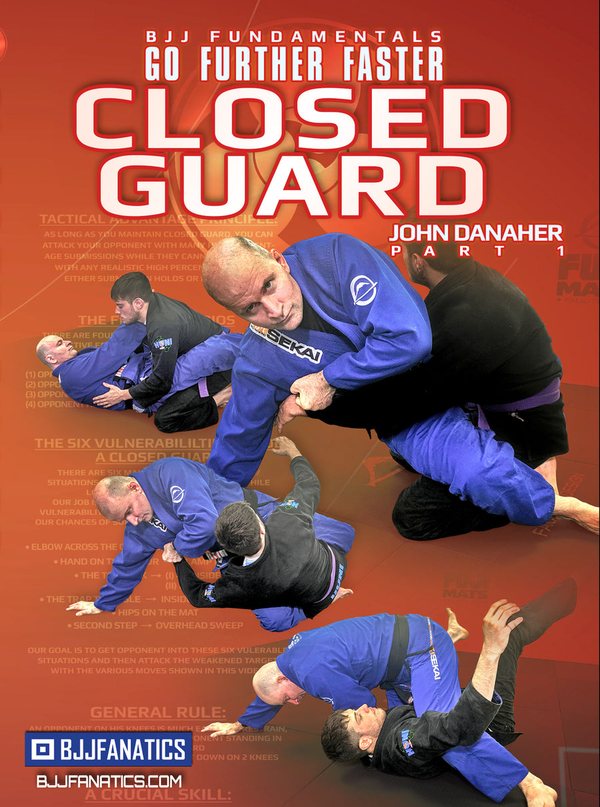
- Gi only
- 8 volumes, 9 h 37
- About $10 an hour with the code
- Released November 2019
It shows you when to attack from closed guard
You close your guard, he sets his hands on your chest, and you both wait until he stands up. The armbar is not the problem: “there’s a million people out there that can teach you an armbar from guard.” (Vol 1 · 34:02) Danaher teaches the moment before it, when an elbow, a hand, his head or a foot gives you the opening. Worth it for a white or blue belt in the gi whose guard only holds.
With the code it comes to about $10 an hour. Gi only, and slow: 9 h 37 over eight volumes.
14 details, sorted by what he does
Five stops with him on his knees, then the moment he stands up.
- 1He kneels up straight→ the knee pull, Vol 2
- 2His elbow crosses your centre line→ the side scissor, Vols 2 and 3
- 3You are out at his side→ his back, or a sweep, Vol 3
- 4He keeps his elbow back→ the top lock, Vol 4
- 5He puts a hand on the mat→ the clamp, then the trap triangle, Vol 7
- 6He stands up→ a sweep for each step of the way, Vols 5 to 7
This is where it starts. Until he bends forward you have nothing: “Start by breaking your opponent’s posture and balance.” (Vol 2 · 1:10:24) You do it with your legs.
01 Pull with your knees up in his armpits, not down by his hips
With your knees down by his hips he just arches away. Bring them up toward his armpits and pull up and forward first, then down: “that’s when you break people’s posture very easily.”
Vol 2 · 38:11In a real match: Jacob Couch v Manny Morales, ADCC East Coast Trials 2023 ↓02 Head over his hips? Sit up at him. When his head comes forward to stop you, knee pull him down
The knee pull works while his head is in front of his hips. Head right over his hips? Sit up and threaten to take him backwards. “His only response to this is gonna have to be to bring his head forward,” and then the pull is on again.
Vol 2 · 48:03Next, Danaher wants one first move from you: his arm across your middle and your hips out to his side. He calls it the side scissor, and it is the clip at the top of this page.
03 Pin his wrist by your shoulder, then push it to his hip
Past your centre line the pull runs out, because your back is on the mat. Switch: hand under his wrist, push it toward his hip, and let your legs do the pulling. “Initially, the pull is to my shoulder, then we switch to a push to his hip.”
Vol 3 · 27:30Out here at his side, Danaher says, “you can win matches” (Vol 3 · 3:53). What you do next hangs on one question: “Is my head higher than his head?” (Vol 3 · 41:20)
04 Get your head higher than his: up on your elbow, then take his back
If the answer is yes, “go for your opponent’s back every single time.” Come up on your elbow so your head is above his, bring your top leg over his back and climb on.
Vol 3 · 40:5305 He drives into you so you can’t come up on your elbow: post on your shoulder, head on the mat
People who know the back take is coming drive into you, and the elbow feels impossible. Don’t fight for it: lift your hips and work from your shoulder, “just the shoulder alone,” then build up to your hand, get a hook in and take his back.
Vol 3 · 1:37:5606 He gets his head over yours: stop chasing the back, flower sweep him
And when the answer is no? The back is gone, but “he has no capacity to base out in this direction because his arm is still trapped across the chest.” Swing your straight leg up and over and he goes over onto his back.
Vol 3 · 1:13:36A good opponent sees the side scissor coming and keeps his elbow back. Danaher asks for less: “if I can’t get the elbow across the center line, I can at the very least bring it closer to the center line” (Vol 4 · 1:56).
07 His elbow won’t cross? Inside your hip is enough: leg over his shoulder, lock
He does not have to lose the fight for his elbow. “Just so long as [his] elbows are inside my hip, that is enough” to swing a leg over that shoulder and lock your feet: the top lock.
Vol 4 · 5:11In a real match: Mica Galvão v Pedro Maia, Worlds 2024 semifinal ↓08 Lock your feet behind his neck, not on his lower back: now he can’t sit up
Why lock that high: his spine is a lever. Feet on his lower back hold the short end, so he sits up easily. Feet crossed behind his neck hold the long end, “a very, very strong leverage position,” and the same push goes nowhere.
Vol 4 · 3:33So far you went after his elbow. His hands are the other target. Pull him forward with your legs until one comes down to catch him: “Hands on the mat is a tremendous vulnerability inside a closed guard.” (Vol 7 · 12:29)
09 His hand touches the mat: swing your hips out and clamp your knees around his head and one arm
“The second the hand hits the ground,” stop holding the closed guard: hips out to the side, knees around his head and one arm. That is the clamp, and the triangle and the omoplata start there.
Vol 7 · 5:0210 He lifts his head to posture up: swing your leg through and lock your legs around his head and one arm
Broken down like this, he wants his posture back, and lifting his head is how he tries. That is the moment your leg passes through and locks around his head and arm. “Trap triangle is even stronger than a top lock.”
Vol 7 · 39:24Sooner or later he stands up, because that is how he opens your guard. It takes him two steps, and the details follow him up and back down.
11 He starts to stand up: scissor sweep him toward the knee that is still on the mat
Let him get both feet under him and you are late: “Now is not the time for scissor sweeps.” Go while one knee is still down, and sweep toward that knee. The other way runs “right into my opponent’s base of support” (Vol 6 · 24:00).
Vol 6 · 26:0212 On his second step up, lift him on your shins and extend your legs: he goes over your head into mount
Danaher calls this “the vulnerable second step”: “the big side-to-side movement of their head makes it relatively easy to off-balance them for that critical moment” (Vol 7 · 51:36). Knees in front of his chest, extend your legs, and he goes over your head. You land in mount.
Vol 7 · 59:3913 He stands up in your guard: scoop inside his ankle and sit him on his hip
He made it to his feet. A standing man you can no longer pull forward gets put on his hip instead: scoop “inside of our training partner’s leg” (Vol 5 · 51:42), bring your hips up and turn them out, and down he sits.
Vol 5 · 51:5914 His hip touches the mat: sit up, chest down, and hip sweep him
The scoop leaves him here, on his hip with a hand on the mat. Danaher’s golden rule: put his hand, elbow, shoulder or hip on the mat and “you can knock anybody in the world over with a hip sweep” (Vol 5 · 37:16). Sit up, arm over his, chest down, then take his hand off the mat.
Vol 5 · 52:41Does it work in real matches?
The volumes are studio demos with a partner who lets it happen. Here are three of these moves in high-level matches.
Jacob Couch’s knees come up beside Manny Morales’ arms, the pull comes, and Morales folds onto his hands
The same mechanic in a no-gi match: knees high first, then the pull, and he is down in under a second. ↑ Back to detail 01
Mica Galvão keeps Pedro Maia’s arm across and turns out to his side
 Worlds 2024 semifinal · gi
In the gi, and slower than the swing at the top: the arm is already across, and Mica turns his hips out over about ten seconds.
Mica Galvão locks high over Pedro Maia’s shoulder, and Maia stays folded over for about 12 seconds
 Worlds 2024 semifinal · gi
Later in the same match: the high lock over his shoulder, and he stays folded over. ↑ Back to detail 07
Who should buy it
Which one are you?
- White or blue belt in the giYour closed guard holds people, then nothing happens. This gives you something to do each time he moves.
- You want the reason for every moveEvery move comes with why it works, so you can fix it when it fails.
- Purple belt and upFew moves will be new, but the timing for each one might be. That tidies up a guard you already play.
 Owns Ageless Bottom Game GiThat is a whole bottom game. This is one position, in depth.
 No-gi onlyThe grips are gi grips. Get New Wave Closed Guard instead.
 No patience for long lecturesIt is slow and repeats itself. Roger Gracie’s four parts cost less at list.
What other people say about it
“Just learning the side scissor is worth the price alone.” Patrick G., a buyer on BJJ Fanatics (2022).
“This has become my go-to sequence now and it really works.” A four-stripe white belt who tried it in sparring (2021), about the side scissor. The back take rarely worked in those rounds; the sweep after it often did. The course expects that: his head over yours means sweep, not back (detail 06).
“I got 4 submissions from my closed guard at this last tournament!” Chase M., a white belt buyer (2024).
“He tends to repeat himself a lot in GFF and you might want to watch at 1.25x speed, but the knowledge is gold.” And that is a fan talking (2022).
“The first two hours was kind of a let down and was super repetitive, the last 15min summed it all up.” Jordan H., a buyer (2019).
Nobody says the techniques are wrong. Most complaints are about the pace, and for that there is a short route under What’s inside.
Worth it? The pros and cons
- For each thing he does there is one attack: he kneels up, gives you an elbow, posts a hand or stands up
- The side scissor in real depth: a whole volume of 2 h 04, with the back take and what to do when he drives into you or gets his head over yours (detail 04, detail 05, detail 06)
- Small fixes that change a lot: knees in his armpits, not by his hips (detail 01); feet behind his neck, not on his lower back (detail 08)
- It is slow and repeats itself: the hip sweep and its setups take an hour of volume 5. The Roger Gracie Closed Guard System teaches Roger’s own gi closed guard in four parts for $149 (list, November 10, 2026)
- No collar chokes from the guard: the finishes are the armbar, the triangle, the omoplata and the kimura. Roger’s course has the cross collar choke, the finish he is famous for
- Gi only, built on collar, sleeve and cuff grips. Danaher’s New Wave Closed Guard (2022) is the no-gi course and adds the double underhooks this one barely touches
Black Friday code BLACKFRIDAY2026
Which closed guard course: gi, no-gi or Roger Gracie?
- New Wave Jiu Jitsu: Closed Guard (Danaher, 2022, no-gi). Train no-gi only? Take this one. It starts from the same first move, the side scissor, drops the gi grips and adds the double underhooks. See it on BJJ Fanatics
- The Roger Gracie Closed Guard System (2021, gi). The gi rival, from the man Danaher credits for the side scissor. Roger teaches his own finishes (cross collar choke, armlocks, lumberjack sweep, back take) in four parts, cheaper at list. People who prefer Roger’s teaching give the reason you would expect: a handful of techniques, explained well, and he does not “repeat things over and over again.” New to closed guard: Danaher. Already play it and want Roger’s finishes: Roger. See it on BJJ Fanatics
- Ageless Jiu Jitsu: Bottom Game Gi (Danaher, 2023). A whole bottom game for an older body, where this is one position in depth. Want both? This one first. “GFF is much more in depth regarding technique. It is a great base for Ageless,” says someone who did all of Go Further Faster at 57 and the four Ageless courses after it. See it on BJJ Fanatics · our review
Also in the series:  our Pin Escapes & Turtle Escapes review. More options in the best closed guard instructionals and every John Danaher instructional ranked.
What’s inside the eight volumes
Eight volumes, 9 h 37 and 71 chapters: Danaher in the gi with a partner, no live rounds. How to get through it:
- Short on time: volume 1 from 32:54, where he shows the six vulnerabilities in 33 minutes, then volume 2 for the knee pull (detail 01, detail 02).
- Then: the volume for what the people you roll with do most. Volume 3 ends with a 10-minute overview of the side scissor, volume 5 with a 4-minute recap of the hip sweep.
Every chapter group, volume by volume
- Vol 1 · 1:06:10, The six vulnerabilities. Why the closed guard is a place to attack from (your hips are on top of his), then, from 32:54, the six moments the man is weak. The first 11 minutes are a trailer.
- Vol 2 · 1:18:25, Holding and breaking posture. The knee pull (detail 01), reading his head against his hips (detail 02), the cross collar grip, and his first move for each way the man can kneel or stand (the clip at the top of this review).
- Vol 3 · 2:04:19, The side scissor. Getting the elbow across (detail 03), the back take when your head is higher (detail 04, detail 05) and the sweeps when his is (detail 06).
- Vol 4 · 54:33, The top lock. For the man who keeps his elbow back: the lock (detail 07, detail 08), the grips that get you there, and the armbar from it.
- Vol 5 · 1:12:04, Flower and hip sweep. One chapter on the flower sweep, then an hour on the hip sweep and on putting his hand or hip on the mat first (detail 13, detail 14).
- Vol 6 · 1:10:57, Scissor and pendulum sweep. The scissor sweep, also on a man with one foot up (detail 11), and the pendulum sweep.
- Vol 7 · 1:00:07, Clamp, trap triangle, overhead sweep. His hand on the mat and the clamp (detail 09), the trap triangle (detail 10), and the overhead sweep on his second step (detail 12).
- Vol 8 · 50:25, The standing opponent. The man who is up on his feet: the scoop again, then the handstand, leg trap, omoplata and double ankle sweeps. None of the 14 details is from here.
Get the next review like this one
New reviews in this format land in your inbox, with the timestamps and clips. You also get the free BJJMore email course and the instructional-platform discounts (worth $46).

This review covers the whole course: all eight volumes (released November 4, 2019).
FAQ
Is Danaher’s Closed Guard: Go Further Faster worth it?
Yes, if you train in the gi and your closed guard holds people but rarely sweeps or submits them. It teaches the moment for each attack. Two caveats: it is slow, and it is gi only.
Is it good for beginners?
Yes. It starts from holding the guard and breaking posture. A black belt who loved this course still told a white belt to “wait at least blue belt level,” but that was a point about learning from video that early, not about this course. White and blue belts get the most new material; purple belts and up mostly get the timing and the reasons.
Gi or no-gi: Go Further Faster or New Wave Closed Guard?
Gi, built on collar, sleeve and cuff grips (2019). Danaher’s no-gi closed guard is New Wave Jiu Jitsu: Closed Guard (2022), which adds the double underhooks. Pick by uniform.
Danaher or Roger Gracie for closed guard?
New to closed guard: Danaher, who builds it step by step and credits Roger for the side scissor. Already play it and want Roger’s finishes, like the cross collar choke: Roger’s four parts, $149 (list, November 10, 2026).
What are the six vulnerabilities?
Danaher’s name for six moments when a man in your closed guard is easy to attack: his elbow across your centre line (the side scissor), his elbow inside your hip (the top lock), your grip inside his wrist (the trap triangle), his hand on the mat (the clamp), his second step when he stands up (the overhead sweep) and his hip or knee on the mat (the hip, scissor, flower and pendulum sweeps).
Can I watch it for free?
Only about 13 of the 577 minutes, on BJJ Fanatics’ YouTube channel: the 2-on-1 grip scissor sweep from volume 6 and the armbar from the top lock from volume 4.
Is there a discount code?
Yes. $197 list; 55% off at checkout with code BLACKFRIDAY2026 (tested on this course on November 23, 2026), $88.65. BJJ Fanatics rotates these codes and sales, so check the price on the day you buy.
Make your closed guard the place you attack from
If people sit in your guard and you wait, start here: knees in his armpits to break his posture, then his elbow across your middle and your hips out to his side.
Black Friday code BLACKFRIDAY2026