
Home / Mount / Danaher 4×4 Mount System Review
Danaher 4×4 Mount System Review: New Wave Mounted Pin Attacks
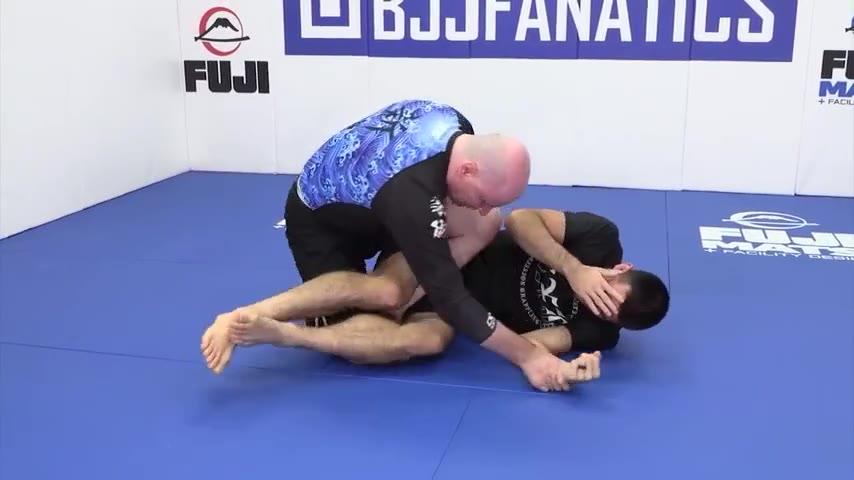
Buy it if you get mount and he just keeps his elbows in. Danaher shows the order that gets his elbow up, ending with your chest on his face and this finish.
See The 4×4 Mount System →No-gi course. Who should buy it ↓
- No-gi
- 8 volumes, 11 h 09
- 72 chapters
- No live rounds
- Released March 2022
The 4×4 Mount System is John Danaher’s no-gi course for the man on top: 11 hours over eight volumes on getting to mount and finishing from it.
Yes, if you get mount and nothing happens
You get mount on someone good and nothing happens. His elbows stay on his ribs, and when you reach for an arm he bridges or gets a knee back in. Danaher’s answer is an order: “Beat your opponent at the elbow first and then beat the opponent.” (Vol 2 · 1:43:10) Four steps: a hand under his elbow, the elbow up over his shoulder, a grip that keeps it there, and the finish that grip gives you.
$197 list, $88.65 with the Black Friday code, for 11 h 09. No-gi, no live rounds, and the four steps start three hours in.
Not sure it is this one? Which mount course for whom ↓
From elbows in to the finish
Danaher teaches it as four steps, in this order, with four finishes at the end. That is the 4×4. Every step takes one defence away from the man under you, and the grip you end up with tells you which finish is there. When a step fails, you leave the mount on purpose.
This is where mount stalls. With the elbows at the sides, Danaher shows, a whole person can be lifted off the floor before an elbow moves. So step one is small: get your wrist between his elbow and his ribs, an underhook. Danaher’s favourite way in is a cross grip, your right hand on his right wrist: lean on it until his arm goes out to the side, away from his body, and when the arm comes back your hand is already under it.
01 Seated in mount: take one wrist in both hands, lean your weight over it to drive the arm out to the side until it is on the mat, and bring your head down next to it to pin it
This is the push, here with both hands on the one wrist. The underhook comes when his arm comes back to his body.
Vol 3 · 6:37While you fight for that first hand, he works on his escape, and it starts at your foot. Danaher’s rule: “I don’t care if my opponent gets my feet. I care if they get my knees.” (Vol 2 · 1:22:45) So when nothing else gets a hand under his elbow, give him the foot. Danaher compares it to handing over five dollars to get a hundred back: as he turns to finish the escape, four fingers go in on the inside of his arm. Then your knee goes to his belly button so he cannot stuff it between his legs, and you cross to the side and climb back to mount, this time with the underhook.
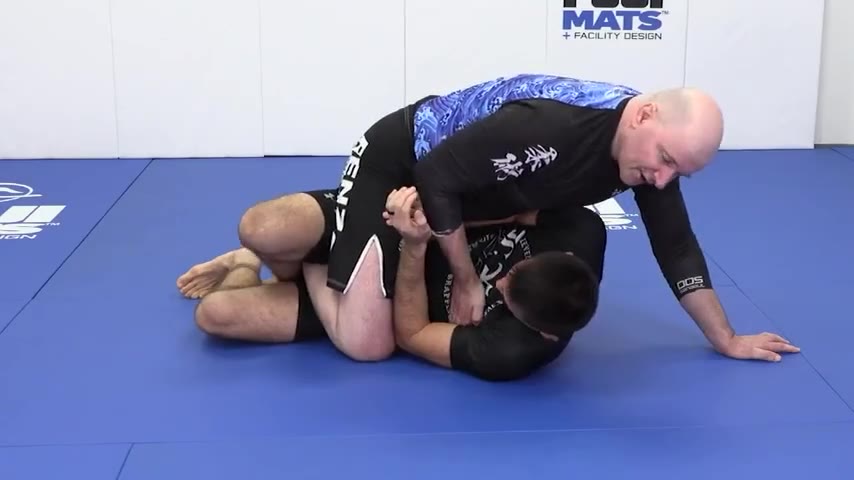
02 Mounted and leaning forward on both hands: push your hand in on the inside of his arm. As he turns onto his side, his elbow comes up off his ribs and his arm ends up straight along your shoulder
You have given the foot before this clip starts. Watch the hand go in and his elbow come up as he turns.
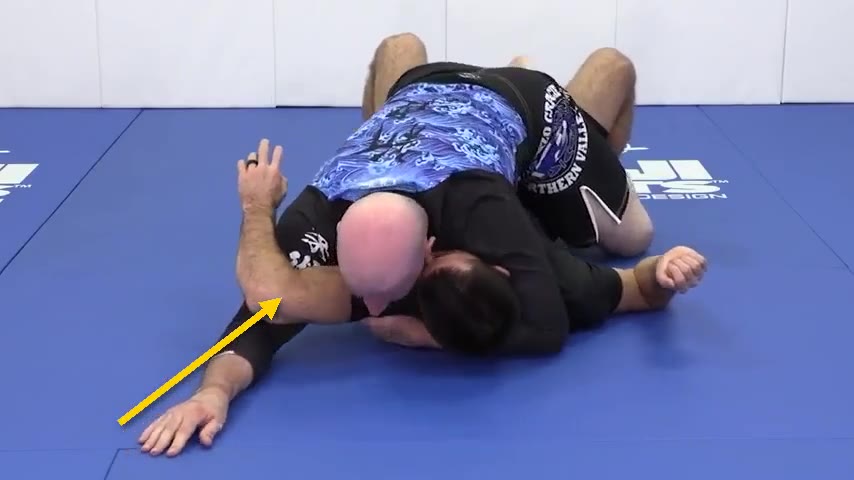
Vol 3 · 32:15An underhook finishes nobody. Low on his ribs, his elbow sits on your elbow, and from there he can swim his arm back under yours, or wrap over it and roll you. So step two takes his elbow up his body until it is as high as the top of his head. Fingers do not move a strong arm, your whole body does: chin to his shoulder, elbow off the mat, steal a few inches, and let your hand on the mat hold what you won. Danaher calls it the ratchet, because it only goes one way, and names the point where the fight is over: “When you get it to the shoulder, you’ve won the battle.” (Vol 3 · 1:03:15)
03 Where the ratchet ends: his elbow on your shoulder, right by your head. Then bring your posted arm in and wrap it around his head
Vol 3 · 1:05:51Now you could go for a finish, and Danaher says that is where people end up disappointed: the man still has too much room to move. So step three is a grip that keeps his arm up there, the single chest wrap. One hand on his lat, the other on your own upper arm, then a shrug that takes his arm from behind your neck to in front of your jaw and puts your chest over his nose and mouth. Mount is the only pin where you can get in the way of his breathing, Danaher says, and a man who is looking for his next breath stops working on his escape. It is one of four grips Danaher teaches, and each one points to its own finish.
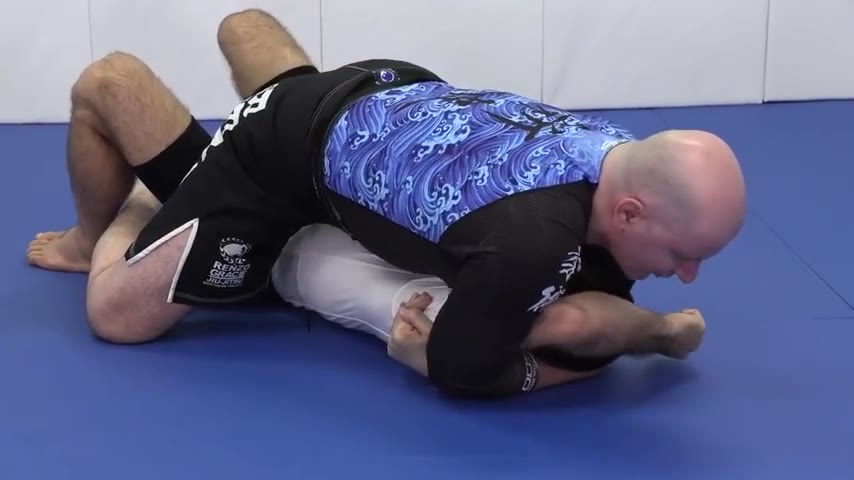
04 With his arm trapped straight up beside his head: shrug that arm forward across his face and settle your chest down over his head
Watch the arm go across his face. The full lesson on this grip is in Volume 3.
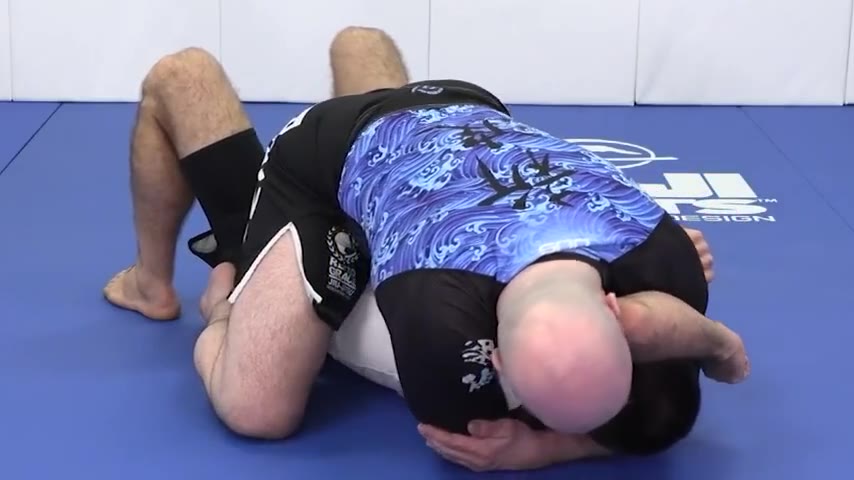
Vol 1 · 1:09:32One arm up and your chest on his face: the first finish is the arm triangle, kata gatame in the course. Start with it every time, Danaher says: it asks for the least movement, and if it fails you are still on top. The risky moment is the change of grip, because once you let go of the wrap his arm is gone. So your head has to hold that arm before your hand comes out. Danaher recommends that you leave the mount to finish. That is the clip at the top of this page: step off to the side and sprawl, head down next to his.
05 From on top with your arm under his head: drop your head onto his arm, then pull your arm out, cup his chin and slide it back around his head. His arm stays trapped the whole time
Danaher’s order, head first and hands second: “Only now do I take my arm out because when he tries to move his arm, my jaw holds it in place.” (Vol 4 · 6:59)
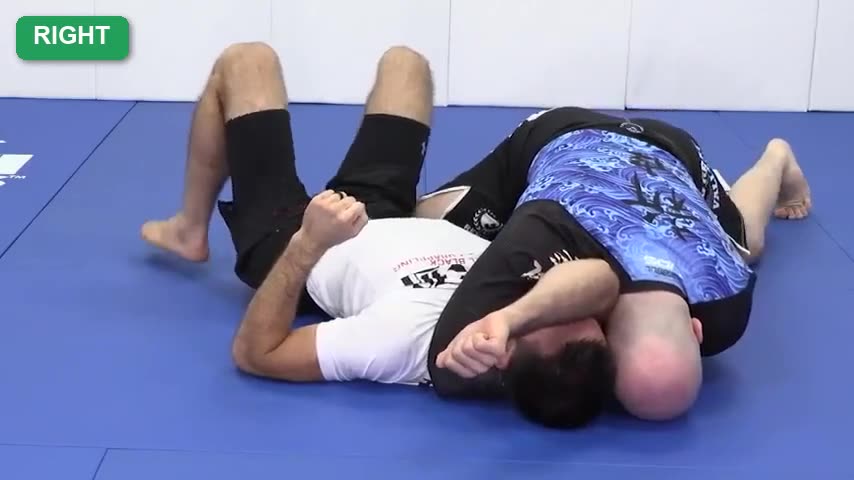
Vol 4 · 6:5606 Wrong: your head is up, he turns into you and frees his arm. Right: your head is on the mat tight against his, and he stays flat
Danaher’s warning: “If your forehead is not touching his forehead, I don’t care how low you get your sprawl, one hard bridge and he’s out.” (Vol 4 · 26:59)
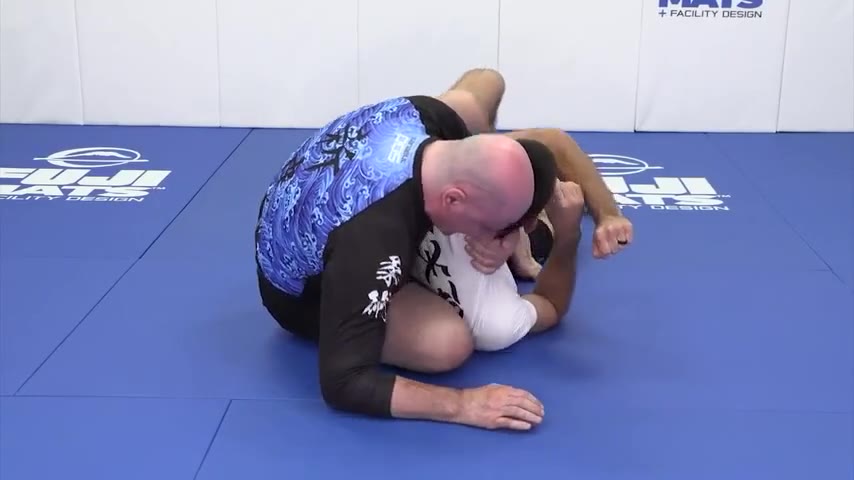
Vol 4 · 27:06One way he resists that choke is to turn away from you, and Danaher has the back waiting. The two strangles are a pair: he turns away and it is the back, he turns back and it is the arm triangle again. The grip that starts it is for when the shrug is not there and his hand stays behind your neck. Take the wrap off, hold the far side of his neck and roll your shoulder across his upper arm until your chest is behind it: the far trap. When he bridges forward to get his elbow back, put your chest behind him and your head down next to his, and sit back with him.
07 With your head down by his and your chest on his back: sit back and pull him up with you. You end sitting behind him with his back against your chest
Keep your head down: with your head up he can put his back on the floor again. Your legs lock around him after this.
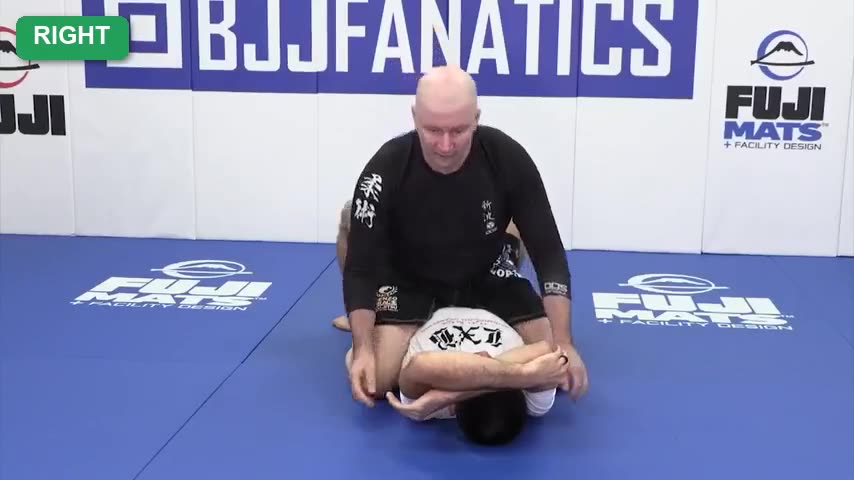
Vol 5 · 4:21While he fights the far trap, his other arm is often there for the taking, and it goes up easier than the first: same ratchet, other side. Both arms over his head is the double chest wrap, the grip for the armbar, and the moment Danaher wants you to go for one. The armbar you learned as a white belt, off a push on your chest, almost never works on someone good, because low elbows slip back inside as soon as you turn. Danaher’s rule: “If you can’t see your opponent’s triceps, don’t bother going for juji gatame.” (Vol 5 · 1:18:26) Juji gatame is the armbar, and it has a price: you finish it sitting on the floor with two hands on his arm, so this finish costs you the mount.
08 Wrong: his elbows are down at his chest. You lean over to turn the corner and he turns into you. Right: both his arms are over his head, and you get your knee by his head
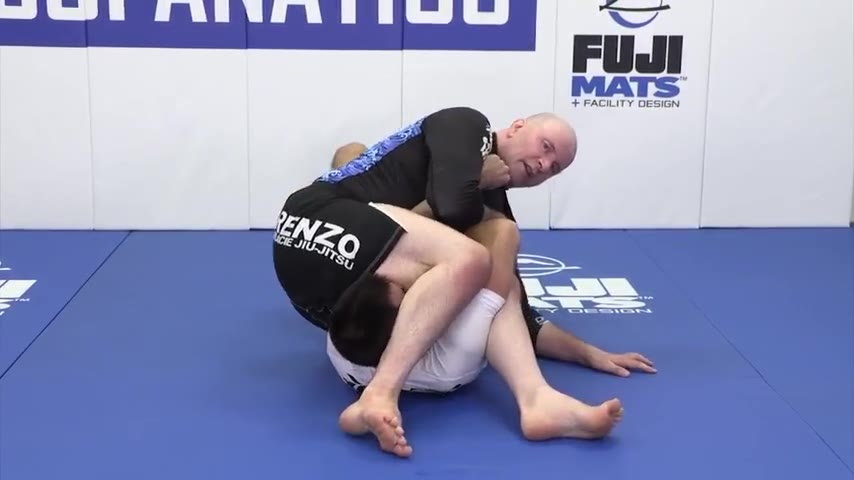
Vol 5 · 1:19:2309 Perched high on his chest with your ear down toward his knees: step your leg over his head and sit back to the floor into the armbar
If your ear does not go down, Danaher says, the leg is hard to get over.
Vol 5 · 1:29:41The armbar puts you on the floor. The last finish, the triangle from mount, can put you on your back, and Danaher calls that a hard sell: you were mounted. It starts from the single chest wrap again, one of the man’s arms inside your legs and one outside, with a knee sliding over his shoulder where most people step over the arm, because that is tighter. The usual knee slide ends with a drop to your shoulder. Your back is on the mat before your legs are locked, which is why it is not Danaher’s favourite.
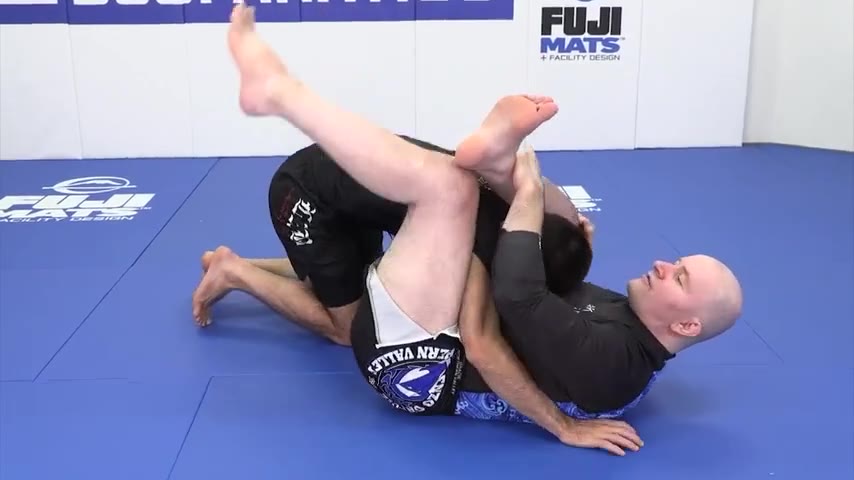
10 On your back, legs over his head and shoulder, one of his arms inside: swing your top leg over his neck and lock your foot in the crook of your other knee
This is the version that drops to your shoulder, picked up once your back is on the mat. The good news, Danaher says, is that you already have his head and his arm.
Vol 7 · 49:33Danaher’s favourite version pivots where that one drops, so you stay on top. On the way you pass a position of its own, kneeling around his head and one arm. Up there his hips cannot reach you, and you barely feel his bridge.
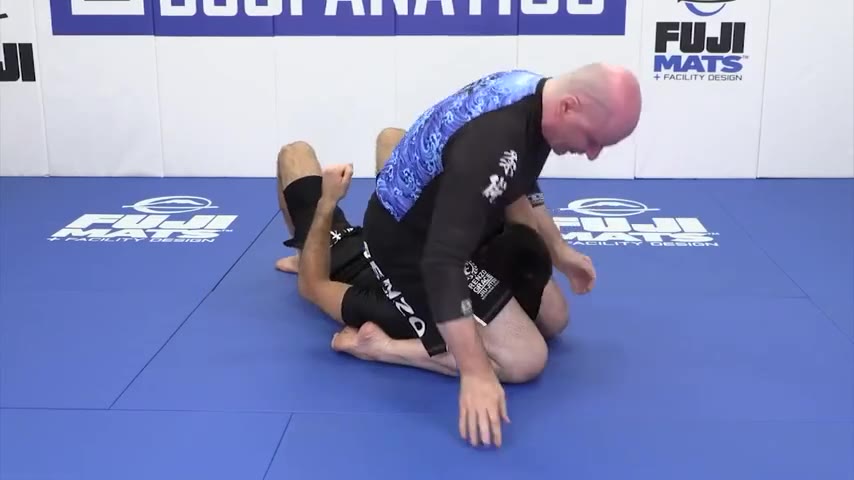
11 From mount, slide your knee across and come up sitting tall on your knees astride his head and shoulder. When he kicks his legs up to bridge, you stay where you are
Danaher on this position: “It’s like the ultimate mount.” (Vol 7 · 1:07:31)
Vol 7 · 1:13:13The system can stall at either of the first two steps, and each time Danaher’s answer is to leave the mount on purpose. You have the underhook and his elbow will not go up: usually, Danaher says, he is a lot stronger than you, and if you stay he pulls your arm in and rolls you. Put your head on the floor as a base, step off to the far side with the arm, drop your knees to the mat, come up on them with his arm hugged to your chest, and finish with a kimura. You cannot get a hand under at all: give it two or three minutes, not ten seconds, then give him your foot again, walk your knee across his belly and step back into his legs for a leg lock.
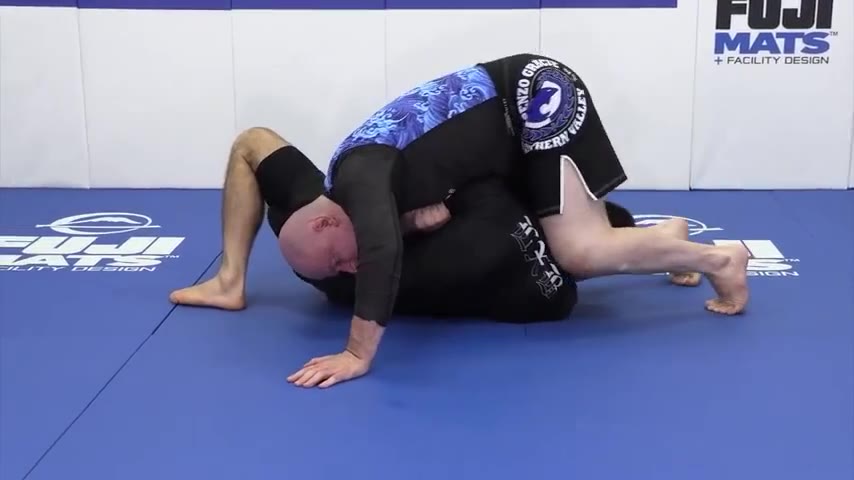
12 With your hips high on your toes and one hand posted: drop your knees to the mat, sit up and hug his arm to your chest
From here Danaher locks a figure four on the arm and takes the hand behind the man’s back.
Vol 8 · 6:3413 Standing across his body: back-step one leg over and drop into his legs, then grab behind his knee and his ankle
The finish taught from here is an inside heel hook, so it is for rule sets that allow one.
Vol 8 · 18:01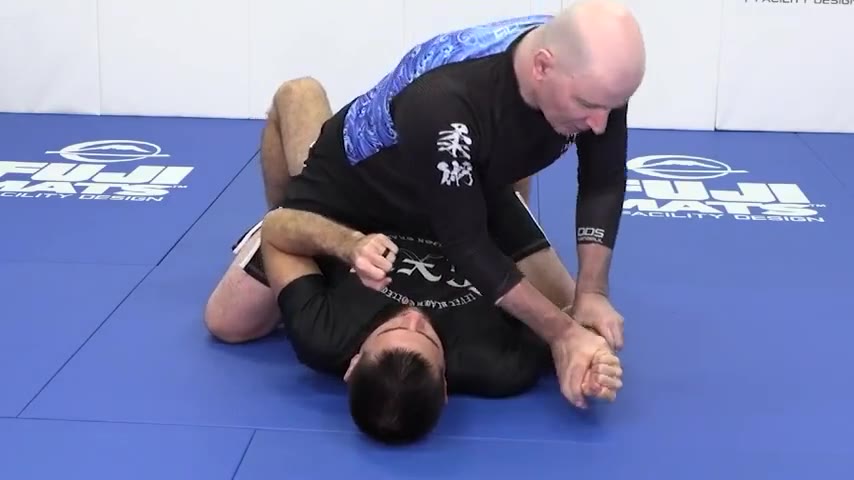 01
 02
 03
 04
 05
 06
 07
 08
 09
 10
 11
 12
 13
How many of these do you do?
Count the ones you already do in a roll, not just in drilling. If most are new to you, this course will change what happens after you get to mount.
Five more: getting to mount, two more grips, and saving a failed finish
With your head and hands posted and your hips high: step your leg over close to his hip. The foot lands up at his hip line, and only then does the knee come down into mount
An elbow escape needs your foot below his hip line, Danaher says. So it never lands there.
Vol 2 · 33:14Lying across him near his head: bring your forearm up across his face and slide your head around to the far side of his head. His head ends up wrapped between your arm and your head
For when he turns back toward you. From here Danaher steps across and drops into the strangle from the clip at the top.
Vol 5 · 1:13:58Bring his second arm up over his head too, so both his arms are crossed above his face. Then slide up and put your head down to the mat with both arms trapped under you
The double chest wrap, the grip for the armbar.
Vol 5 · 1:28:08Up on your toes with your head down on the mat by his: lift your far leg high behind you, bring it back down and drop your hips onto your knees, still on top of him
The arm triangle did not finish. Danaher’s line on it: you lost the choke, not the position.
Vol 4 · 54:30When he comes up on top and stacks you in the armbar: float him up and over, put him back down on his back and end sitting up in the armbar again
Danaher’s point with this drill: once you are in the armbar, top or bottom stops mattering much.
Vol 6 · 33:42Who should buy it
Which one are you?
- You get mount on good people and nothing happensThat is the course. Every method in it is built for an opponent who keeps his elbows in and knows his escapes. Wout W., a buyer on BJJ Fanatics (May 2026), used to prefer side control because it felt stable and now looks to attack from mount far more often.
- You coachFour steps, four finishes, and a rule for which grip leads to which finish. The overview in Volume 8 runs 12 minutes and works as a lesson plan.


 You own Danaher’s back, armbar or triangle coursesAbout an hour of Volume 5 is back and armbar teaching in short form, and Danaher says so. Anthony T., a buyer (March 2025), valued the lessons on control more than the submissions, since Danaher’s armbar and triangle courses already covered the finishing details.
- You are a white beltEvery method here assumes an opponent who knows his escapes, and buyers are split. Conor M. (October 2022), who calls himself a very bad white belt, went from losing mount at once to tapping people from it. Ian M. (January 2023) found it way above his level.
- You want it shortThis is 11 hours.
 Roger Gracie’s mount course is 1 h 38 and
 Pedro Sauer’s is 1 h 36.
- Gi only, and you want collar chokesNone here. Roger Gracie’s course has the Ezekiel and the cross collar choke.
- You want to see it against resistanceOne partner who helps on every rep, and no live rounds.
 Gordon Ryan’s Top Pins: Mount has them.
- You want to stay mounted through the finishThe arm triangle is finished from the side and the armbar from the floor. Only the triangle done Danaher’s favourite way keeps you on top.
Which mount course for whom
- The 4×4 Mount System (John Danaher, $197 list, 8 volumes, 11 h 09, no-gi)
For you if: you get mount and he gives you nothing. You want one order and the reason for every step, and you will sit through 77 minutes of theory, with one first showing of the chest wrap, before the teaching starts. - Systematically Attacking From Top Pins: Mount (Gordon Ryan, $349 list, 8 volumes, no-gi)
For you if: you want the same family of attacks and you want to see them in live rounds. Danaher says the method taught in the 4×4 is the one Gordon Ryan uses, and Gordon’s chapter list has the same four finishes. The last two volumes are five rolls, then the same five with commentary, and one volume is about keeping the mount. It costs $152 more. See it on BJJ Fanatics. Or read our review. - The Roger Gracie Mount System (Roger Gracie, $149 list, 3 volumes, 1 h 38, gi)
For you if: you train in the gi, you hold mount, and you lose it when you attack. Roger’s order is hold him low, climb high, then finish with the armlock, the Ezekiel or the cross collar choke. Every chapter starts with you already in mount. See it on BJJ Fanatics. Or read our review. - Unlocking The Secrets Of The Mount Position (Pedro Sauer, $149 list, 3 volumes, 1 h 36, gi)
For you if: he escapes before you can attack. Sauer spends the whole first volume on the elbow escape. Sauer and Danaher share one idea: let the escape start on purpose. Sauer does it to make sure the escape never finishes, Danaher to win the underhook. See it on BJJ Fanatics. Or read our review. - Cheaper in the gi: The Mount Attack Encyclopedia (Bernardo Faria, $79 list, 4 volumes).

Want the whole field? This course is one of eight in our best mount instructionals. List prices on BJJ Fanatics, checked 13 and 17 November 2026.
What buyers and other grapplers say
Buyers on BJJ Fanatics and people who train it praise the same thing: a simple system for a position where most people have none. Brent P., a buyer (November 2024), wrote that the explanation of the ratchet alone was worth the price. As we heard someone put it: the moment you get mount you feel far more confident, because there is a system to lean on. Another finishes the arm triangle or the armbar, or takes the back, so often that the mounted triangle rarely comes up. That fits the course, where the arm triangle goes first.
The complaints are about the watching. Elijah K., a buyer (June 2023), titled his review “Brilliant, essential, magical, boring”: the same technique shown over and over, and it worked on the mat at once. Another buyer, df (May 2022), thinks the system would fit in six or seven volumes.
One real doubt from the mat. A lighter grappler kept losing mount while leaning in for the cross wrist push. The answer he got from someone who finds the system hard himself: it can be done the way the course explains it, but the angle takes drilling. Get it wrong and you pin the arm to the man’s body when you meant to take it away. So the doubt is about the reps, not about the method. The course has its own answers, and they are in the first two sections of the details above.
Worth it? The pros and cons
- One order from the first grip to the finish, and Danaher gives the reason for every step
- Each grip names its finish: one arm up for the arm triangle or the triangle, both arms up for the armbar, the far trap for the back (details 04 to 11)
- The arm triangle goes first because a failed one leaves you on top, and it works as a pair with the back: turn away from one and you turn into the other
- It says what to do when it stalls: step off to the side when his elbow will not go up, go to the legs when you never get a hand under (details 12 and 13)
- Volume 2 opens with 48 minutes on getting to mount, then 33 on keeping it, before the four steps start
- 11 h 09 for four steps and four finishes, and many chapters run the first three steps again before the new part. Roger Gracie’s mount course takes 1 h 38
- Volume 1 is 77 minutes of theory with one first showing of the chest wrap, and the four steps start three hours in. Roger Gracie talks for two and a half minutes before his first technique
- No live rounds, and no match shown or named: one partner, Placido, who Danaher says is the lighter and smaller of the two. Gordon Ryan’s Top Pins: Mount ends with five rolls and a volume of commentary
- About an hour of Volume 5 is back and armbar teaching that Danaher says has been covered before, and the first 37 minutes of Volume 6 are more armbar finishing. Enter The System: Arm Bars has 94 chapters on that one lock
- Every finish but one takes you off the mount: the arm triangle to the side, the armbar to the floor, the back behind him. Only the triangle done Danaher’s favourite way stays on top
His elbows first. Then him.
What’s inside the eight volumes
72 chapters over eight volumes, all no-gi, all taught on one partner. Tap a volume for what’s in it.
Eleven hours is a lot. This route is about 1 h 50 and gives you the system:
- Volume 8 from 22:16, 12 minutes. The final overview: the whole system shown once, start to finish. Yes, begin at the end.
- Volume 1 from 1:02:58, 9 minutes. Why mount at all, and the first showing of the chest wrap.
- Volume 3 from the start, 9 minutes, then from 55:11, 28 minutes. The cross wrist push, the ratchet and the single chest wrap.
- Volume 4 from the start, 11 minutes, then from 28:04, 2 minutes. Why the arm triangle goes first, the entry, and the whole choke in one go.
- Volume 2 from 1:21:21, 17 minutes. Feet, knees and keeping the mount.
- Volume 8 from the start, 22 minutes. The two fallbacks.
After that, when those work: Volume 5 from 1:07:23 for the two strangles as a pair and from 1:17:00 for the armbar, then Volume 7 from 59:02 for the triangle the way Danaher likes it.
What can wait: Volume 1 from 6:59 to 40:38 is pinning in general. And if you own Danaher’s back course, Volume 5 from 17:47 to 1:07:23 is a short form of it.
Vol 1 · 1:17:10The problemwhy mount stalls without strikes, the elbow, the breath
Almost nothing to drill here, only a first showing of the chest wrap (detail 04). This volume is the argument for the rest. Without strikes, Danaher says, a good opponent keeps his posture and the submission does not follow the position, so many people settle for the points. From 6:59 to 40:38 the subject is pinning in general: the five pins, which of them score, why wedges beat weight and why moving beats holding still. The course proper starts at 40:38 with the idea that carries it: the way from a pin to a submission goes through the man’s elbows. The last twenty minutes are about mount itself: why people give up on it, and why Danaher sends students there anyway.
Vol 2 · 1:43:49Getting to mount and keeping itknee drive, step over, double underhooks, the mounts, your foot and your knee
The first 48 minutes are three ways into mount on a man who keeps his elbow and knee together: Danaher’s favourite, a knee drive from side control, then a step over with the hips facing down (in the fold under the details), and double underhooks from half guard. Then comes the longest chapter of the course, 33 minutes on keeping the mount. Danaher announces ten variations of the mount as tools for different jobs. We count nine shown by name, and so did a buyer. The 17 minutes after that matter most for what follows: the man will get your foot, so keep your knee (detail 02 builds on it). The volume closes with six minutes that set up the four steps.
Vol 3 · 1:39:24The first three stepsunderhook, ratchet, the four grips
This is the volume the course is named for. 55 minutes go to the underhook, in eight chapters: the cross wrist push (detail 01) and the grip for it, bringing the underhook with you from half guard or taking it as you mount, giving a foot to get it (detail 02 shows the hand part), two misdirections, and a wrist against elbow method that Danaher says is harder than the rest. Then 15 minutes on the ratchet (detail 03 shows where it ends), with the two ways the man fights it and the answer to each. The last half hour is the four grips: the single chest wrap (detail 04), the far trap for when the shrug fails, the double chest wrap, and an arm wrap.
Vol 4 · 1:05:26The arm triangleentry, mechanics, his defences, failure, when to step off
One choke for a whole volume. Three minutes on why it goes first, then the entry from the chest wrap, head on his arm before your hand comes out (detail 05), then 19 minutes of mechanics: elbow deep behind the neck, thumb on the shoulder, temple to temple (detail 06), shoulder under the chin, and a choke that pulls where most people push. By Danaher’s account here, the students open with this choke in competition. No match is named. After that: lifting the man’s head to get the arm deeper, getting through his defences, what to do when the choke fails (in the fold under the details), and when to step off the mount (temple to temple, head on the floor). The step off itself is the clip at the top.
Vol 5 · 1:54:36The back and the armbarfar trap to the back, back control, the two strangles as a pair, the armbar from two arms up
Two finishes in the longest volume. The first 18 minutes take you from the far trap to his back (detail 07). The next 50 minutes are back control and strangles in general: leg positions for long and short legs, the fight for the hands, a strangle with the legs. Danaher says this has been covered in earlier courses and keeps it brief. At 1:07:23 come the ten minutes that tie the first two finishes together. The armbar starts at 1:17:00: why the white belt version fails (detail 08), both arms up (in the fold under the details), the entry (detail 09). The last 17 minutes are a summary of Danaher’s armbar teaching.
Vol 6 · 59:49Armbar finishes, then the triangle beginsbreaking power, leg positions, rolling him through, why the triangle
The first 37 minutes stay with the armbar: two ways to add breaking power, five leg positions, and the drill that answers the fear of leaving the mount (in the fold under the details). In the middle sits the best story of the course. Three of Danaher’s students kept working on a shoulder lock with the legs after being told to drop it, and went on to submit world champions with it. Danaher’s own verdict: the students were right. From 37:06 the mounted triangle begins: six minutes on why it is worth the risk, then the choice between stepping over the arm and sliding the knee over the shoulder.
Vol 7 · 1:48:22The triangle from mountfour keys, five ways in, the mount around head and arm, short legs
Four keys first: use a hand to help close your legs, lean forward and never back, lift his head off the mat twice, and the rules for when your back may touch the mat. Then five ways in: two step overs, the knee slide with the drop to a shoulder (detail 10), the pivot Danaher likes best, and one from the arm wrap. Seventeen minutes go to the mount around the head and arm (detail 11). In a chapter called Placido’s Revenge the partner, Placido, who had only ever used step overs, learns the knee slide on camera in about three minutes. The last ten minutes are for short legs: an armbar with crossed ankles in place of the triangle.
Vol 8 · 40:27When it fails, and the summarytwo fallbacks, the overview, the idea
Twenty-two minutes on the two fallbacks (details 12 and 13), then a 12-minute overview that runs the whole system once and says which grip leads to which finish. The last six minutes put the idea in Danaher’s own terms: position first, then break the man’s posture, and only then the submission.
Free on YouTube: three short excerpts from this course on the BJJ Fanatics channel (the misdirectional underhook, the lat grip and forward bias, about ten minutes together), and a 23-minute talk from February 2022 in which Danaher explains the idea to Bernardo Faria.
Get the next review like this one
New reviews in this format land in your inbox, with the details on video. You also get the free BJJMore email course and the instructional-platform discounts I use myself (worth $46).

BJJMore earns a commission if you buy through these links, at no extra cost to you. Released by BJJ Fanatics in March 2022; reviewed on all eight volumes.
FAQ
Is the 4×4 Mount System worth it?
Yes, if you train no-gi, you get mount on people who defend well, and nothing happens once you are there. It gives you one order to drill: a hand under his elbow, the elbow up, your chest over his face, then the finish. The system is short, four steps and four finishes. The teaching is not: 11 h 09 over eight volumes, a first volume that is almost all theory, and no live rounds. Ask people who train for Danaher’s best course and this one keeps coming up, sometimes as his most concise. We take that as praise for the system, not for the running time.
Does it work in the gi?
It is a no-gi course and Danaher says so. Nothing in the four steps or the four finishes needs cloth. Someone who uses it in both says it changed how he plays mount in the gi too. What a gi player does not get: collar chokes. And the last fallback is a heel hook, so check your rule set.
Is it for beginners?
Not as a first course. Danaher builds every method for an opponent who knows his escapes. The system itself is easy to remember, and if you cannot hold mount yet, Volume 2 is where to start.
Danaher’s 4×4 or Gordon Ryan’s Top Pins: Mount?
Same family. Danaher says the method taught in the 4×4 is the one Gordon Ryan uses, and Gordon’s chapter list has the same finishes. Gordon’s costs $349 and ends with five rolls and a volume of commentary. Danaher’s costs $197, has no rolls, and gives the reason for every step. Where we saw this exact question asked, most answers leaned to Gordon’s, as easier to watch or to apply. Much of that is taste in teachers. On content, the split we would pass on: Danaher for getting to mount and for the triangle, Gordon for keeping the mount.
What is the ratchet method?
Step two: taking his elbow from his ribs to above his shoulder once you have the underhook. Chin to his shoulder, elbow off the mat, move your whole body forward a few inches, then let your hand on the mat hold what you won. It only goes one way, hence the name. Detail 03 above shows where it ends: his elbow on your shoulder.
Does Danaher really tell you to go for the legs from mount?
Yes, as a last resort. If two or three minutes pass and you cannot get a hand under either elbow, give him a foot, walk across his body and step back into his legs for an inside heel hook (detail 13). If you have the underhook and cannot lift his elbow, step off to the side for a kimura (detail 12).
I lose mount when I lean in for the cross wrist push. What does the course say?
Push the wrist out to the side and not down. Put your head over your hands, and take your hips off his hips while you lean. Keep the other hand free to post if he bucks. If his hand slips out, go straight back to it. And when he gives you nothing at all, stop forcing it and give him a foot (detail 02 shows the hand going in after it).
Is there a discount code?
On November 23, 2026 the Black Friday code BLACKFRIDAY2026 took 55% off at checkout: $88.65 instead of $197. BJJ Fanatics rotates its codes and sales, so check the price on the day you buy.
His elbows first, then him
You get mount and he gives you nothing? This is the order: a hand under his elbow, the elbow up past his shoulder, your chest over his face, and then the finish the grip gives you. No-gi, 11 h 09.