
Home / Mount / The Roger Gracie Mount System Review
The Roger Gracie Mount System Review
Buy it if you get mount and lose it the moment you attack. Roger Gracie’s order: hold him low, climb high on his chest, and only then go for the arm or the neck.
See The Roger Gracie Mount System →Gi course. Who should buy it ↓
- Gi
- 3 volumes, 1 h 38
- 13 chapters
- No live rounds
- Released April 2021
The Roger Gracie Mount System is a gi course of 1 h 38 for the man on top. It teaches mount as a climb: 39 minutes on holding him low and getting up to his chest, then the finishes from up there.
Yes, if you lose mount when you attack
You get mount, reach for his collar, and he bridges you off or shoves your knee back into half guard. Roger Gracie’s answer is an order. Hold him low until the first burst of escapes is spent, climb until you sit high on his chest, and only then attack. “Before you go for any submission you have to establish a good control first.” (Vol 1 · 0:28)
$149 list, $67.05 with the code above, for 1 h 38 in the gi. Every chapter starts with you already in mount, and there are no live rounds.
From the moment you mount to the finish
Roger says he teaches the course as a sequence, and the volumes run that way: hold the mount low, climb it, finish from the top. The five moments below keep that order. Low on his body you are hard to shake off and have little to attack. High on his chest you have his neck and both arms, and you are easier to throw. So each step up has to hold before you take the next.
Roger expects it every time. In the first seconds after you step over, the man bridges and shoves at your legs any way he can. So Roger does not sit up yet. He stays chest to chest, takes an arm behind the man’s head and crosses his feet under the man’s legs. To get his guard back the man first has to make those feet uncross and lay his own leg flat on the mat. When the bridge comes, Roger arches and pulls the head in close.
His instruction for these seconds: “Forget about finishing.” (Vol 1 · 4:37) A man who gets out does it in the first two or three seconds, he says. After that he has to stop and defend himself, or he starts to open up.
There is one exception, and it is the Ezekiel. The arm behind the head is already half the choke, and a man who is busy pushing your leg is not looking after his neck. Roger calls it an opportunist choke: it is there when he bridges or shoves your leg and forgets his neck.
01 Low mount: chest on his chest, head down past his head and one hand posted wide on the mat. You stay on top
Roger on this position: very good for keeping the mount, few ways to attack, because you are pinning him down. The next goal is height.
Vol 1 · 9:03The bucking stops. Now he lies still, elbows in, hands at his neck, and you are stuck flat on top of him. Roger works on the arms first, while he is still low. A threat of the Ezekiel brings a hand up to the neck. Roger slides his own arm inside that arm, drops his shoulder until the stiff arm rides up onto it, walks his hand up and hugs the arm to the man’s head, chest over the face. He calls it the bear hug. A lot of people tap to that alone, he says. The ones who don’t tap get tired, which is the point.
Then he climbs. Knees tight to the body, heels on top of the man’s hips, head and hands on the mat. If the arms still block the way up, both palms go on top of the shoulders with all his weight behind them. The shoulders go back, the elbows come up, and his legs climb in under them.
02 His arms keep you from sitting up: put both palms on top of his shoulders and lean your weight on them, then sit up tall in high mount and keep your hands under his elbows
Roger’s next step, in his words: once you are up, lean back as far as you can. Leaning forward, he says, a bridge throws you to the mat. Leaning back, you barely move.
Vol 2 · 11:54Bridging is one way out. The other goes through your knee, and Roger says it can start at any height, the moment the man gets an arm inside. He turns on his side, pushes your knee down with one arm and braces the other against your hip to keep you off him.
Roger does not fight the push. He turns with it and plants that foot on the mat, close to the man’s hip. With the foot there the man can push the knee as far as he likes and still cannot get his guard back.
Then the escape starts working for you. No arm braced on your hip: go to his side and take the arm at once. An arm braced there: pull the pushing arm up off your leg, get behind the elbow and come back to mount. The further he let that leg travel up, Roger points out, the higher the mount you land in.
03 Wrong: your foot out on the mat, away from him, and his arm slides out under your knee. Right: keep the knee up tight to him. He pushes it with both hands and nothing gets out under it
Roger checks the foot: “My foot is close to his hips.” (Vol 2 · 17:44) With the foot there, he says, “it doesn’t matter how far my knee goes.” (Vol 2 · 17:51)
Vol 2 · 17:35This is what the climb was for. You sit high on his chest and he does what everybody does up there: he crosses his arms over his neck. Roger: “Now it’s time to finish.” (Vol 2 · 14:11) How high you sit decides what you go for. Very high, the man’s own arms crowd his neck and leave your hands no room, so you take an arm.
Roger says nine out of ten of his arm attacks start the same way. One hand goes inside first, on the collar or just on the chest. Skip that and the man turns, and you have lost the mount you climbed for. Then a hand behind the elbow, a small push inward, his stomach past the elbow, and his whole body falls on the arm. He slides up, takes the other arm before the man can reach for his leg, steps over the head and sits. His order for the end: up, hold, then fall back. The collapse in the clip comes first: it is how your weight gets onto his arm. The fall back is the very last move.
04 From high mount, his arms crossed on his neck: put your hand behind his elbow, bring your stomach over it and collapse your whole body forward onto his arm
A strong man can keep his arm stiff against your hands, Roger says, but not against your whole body weight.
Vol 3 · 6:22The clip at the top of this page is the end of his second armlock. It only works from high mount, he says: trap the wrist of the arm that lies underneath and attack the one on top, and the man cannot bring the bottom arm over to defend. In a lower mount, Roger says, the man still finds the space to pull it free.
Roger attacks the arm the same way nine times out of ten. The cross collar choke is the one he calls probably the hardest to do from mount, and the reason is the bridge. In an armlock your hands are free to catch you. With a grip in his collar they are busy, and reaching in hands him the very arm he needs to bridge you over.
So control comes first again. Roger sits a little lower than he does for the arm, low enough that his whole forearm lies on the man’s chest. He never stays halfway up: either he leans far back, or he goes all the way down with his head on the mat, where the head works as a hand. “My feet never leave his body. Remember that.” (Vol 3 · 35:34) The first grip goes in as deep as two hands can make it. Then elbow down, the free hand on the mat above the man’s head, and he has the man bridge to show it holds, the second time with no hand on the mat at all.
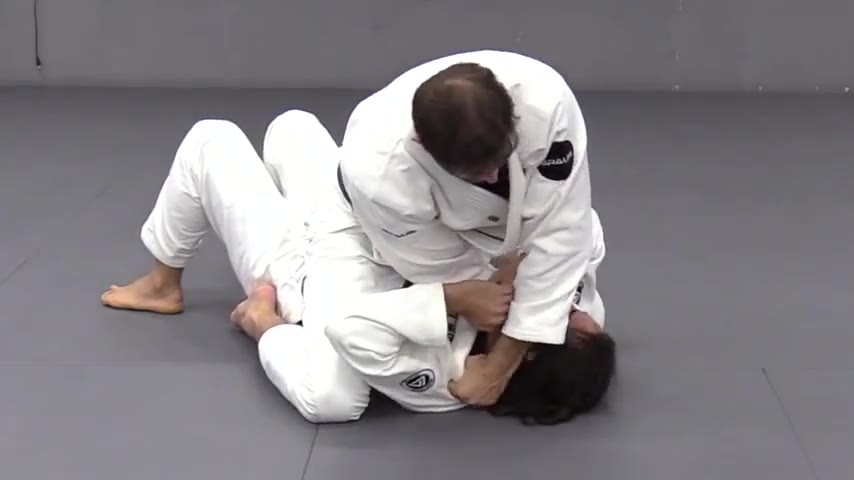
05 On top, get a fist in at the side of his neck, then drop your head to the mat past his head with your chest on him and stay there
Roger’s instruction at the end of the cross choke chapter: once the grip is in, drop down straight away.
Vol 3 · 43:46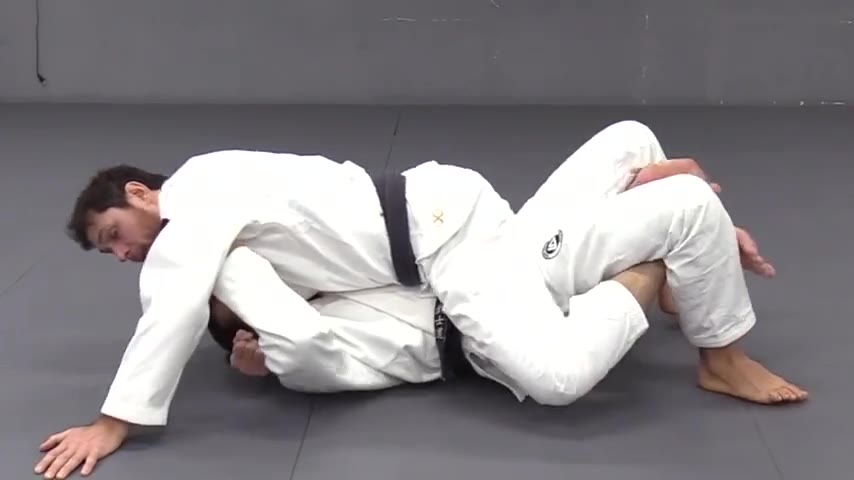 01
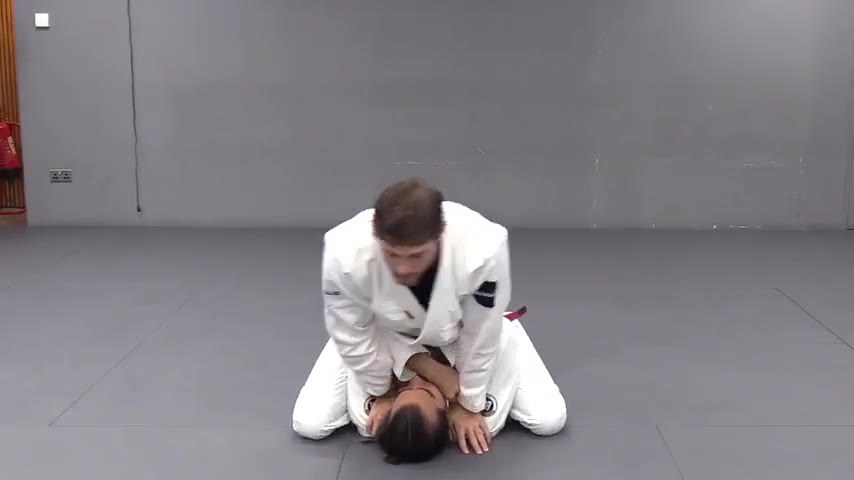 02
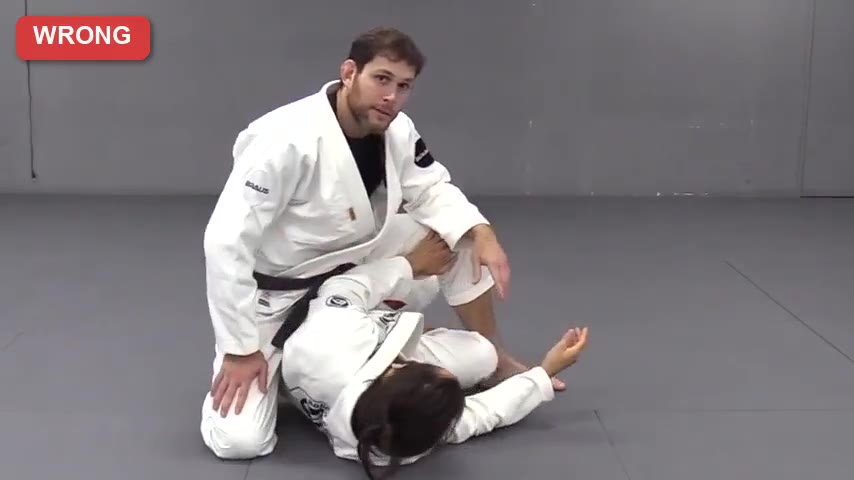 03
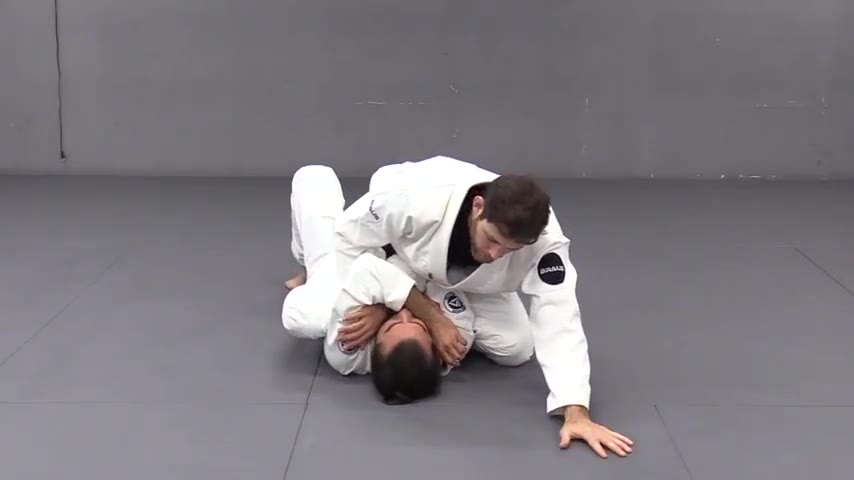 04
 05
Who should buy it
Which one are you?
- You get mount and lose it when you attackThat is the course. 39 minutes of holding and climbing come before the first finish chapter.
- You sit low on his belly and can’t get higherVolume 2 has two chapters on exactly that climb. Zachary C., a buyer on BJJ Fanatics (May 2026), wrote that he gets to high mount quicker now.
- You are the lighter oneAlex, a featherweight (March 2022), wrote that people used to bench press him off. He spent several months on the first volume and a half before he added the finishes.
- You teachThe order is a ready lesson plan: hold low, free the arms, climb, finish. Rick G. (January 2022) calls it a blueprint for teachers.
- You already hold high mount and only want finishesVolume 3 is yours, 47 minutes. The first 39 minutes of the course you may skim.
- You lose mount to the elbow escape before you ever attackRoger gives the push on your knee one chapter of under seven minutes.
 Pedro Sauer’s mount course spends its whole first volume there.
- No-gi only and you want chokesBoth chokes here need a gi. Take
 Danaher’s 4×4 Mount System or
 Gordon Ryan’s Top Pins: Mount.
- You can’t get to mount yetEvery chapter starts with you already on top. Claus J., a buyer (September 2023), wrote that after this course he had to go and find a passing game to get there.
- You want S-mount, mounted triangles or back takesNot here. The triangle gets half a minute at the end of Volume 2. Gordon Ryan’s course has a volume on high mount, S-mount and the mounted triangle.
- You want to see it against resistanceOne partner who helps on every rep. No live rounds, no match clips.
What buyers and other grapplers say
The buyer reviews that say something specific tell the same story as the course. Benoit B., a purple belt (January 2025), went from always losing the mount to keeping it and finishing from it. Raymond C. (November 2024), a smaller grappler who used to get bridged off by bigger men, describes the stages working in a roll in Roger’s order: low mount, high mount, then the submission. Claus J. (September 2023) drilled the sequence for six months as a blue belt and writes that he has not needed anything else from mount since.
Two buyers name a limit. JC (January 2023) wanted more detail for the different responses of the man underneath. Chris, a featherweight (July 2022), notes that there is not a lot of content, and adds that what is there is easy to follow and repeat.
Away from the shop, one owner calls Roger’s courses underrated. He watched the closed guard and the mount course and found mount the more eye-opening of the two, maybe, he says, because he started with a poor grasp of the position. Someone else who has seen them thinks mount is the best of the lot, for how Roger explains pressure and how he works up to high mount. That is the part we would point to as well. And the plainest advice we have come across for the gi: if you want the best mount you can have, study Roger, with the cross choke and the Ezekiel as main attacks. Which of his courses to start with is its own question. We rank them in our guide to Roger’s courses.
The doubt you hear is about size: does the game of a 6 ft 4 super heavyweight work for a small man? It is a fair thing to wonder, and people who like Roger’s work wonder it too. One of the doubters adds that he has been wrong about this before. We go by the ones who tried it. The smaller buyers on BJJ Fanatics, Raymond C. above and Alex under who should buy it, say it worked for them.
Our own cons are below.
Worth it? The pros and cons
- One order from the first second to the finish: hold him low, climb, then attack. Roger says why each step comes before the next
- 39 minutes on holding and climbing before any finish chapter: the low mount (detail 01), getting up past his arms (detail 02) and the answer to the push on your knee (detail 03)
- Few finishes, taught in depth: the armlock entry he uses nine times out of ten (detail 04), a second one for high mount only (the clip at the top), the Ezekiel and the cross collar choke
- Every finish comes with its control: how high to sit for the arm and for the neck, and how to stay on top once your first hand is in at his neck, head down to the mat and chest on him (detail 05)
- Short enough to finish and drill. Julien P., a buyer (June 2025), calls it just long enough to learn Roger’s system and nothing else
 $149 list for 1 h 38 is $91 an hour. Pedro Sauer’s mount course costs the same for 1 h 36. Bernardo Faria’s Mount Attack Encyclopedia lists at $79
- Nothing on getting to mount, no S-mount, mounted triangle or back take, and no live rounds. Gordon Ryan’s Top Pins: Mount starts with a volume on getting there from side control, has all three, and five live rolls
- The elbow escape gets one chapter of under seven minutes. Sauer gives it his whole first volume, 31 minutes
- Two of the four finishes are gi chokes, 26 minutes together. No-gi only? Danaher’s 4×4 Mount System is a no-gi course
Hold him low, climb high, then finish.
What’s inside the three volumes
13 chapters over three volumes, all in the gi, all taught on one partner. Tap a volume for what’s in it.
Vol 1 · 20:02Holding him lowcontrol first, the low mount, the Ezekiel threat, isolating both arms
Roger opens with two and a half minutes of talk before any technique: control before any submission, and a few attacks done well over many done badly. He attacks the arm the same way nine times out of ten, he says, and has perhaps two variations of his cross collar choke. Then the low mount (detail 01): an arm over the head or over the body, feet crossed under the man’s legs, what to do with the bridge, and why the Ezekiel is half there already. The second half of the volume frees the arms: the Ezekiel threat, the arm onto your shoulder, the bear hug, and a trap where he grips the gi and drives his shoulder in behind the man’s elbow. He does the same on the other side and hugs both arms. The volume ends while he is still explaining an arm attack from there.
Vol 2 · 30:41Getting up and staying upsitting up, reaching high mount, the knee push, breaking the armbar grip
The first chapter takes you from flat to sitting: knees tight, heels on his hips, hands on the mat, then up, hands behind his elbows, and back. Roger names the real problem here: the hard part of mount is finishing without losing it. The second chapter is for when the man’s arms block the climb (detail 02), and it holds the rule he repeats on purpose: the soles of your feet stay on his body. The third answers the push on your knee (detail 03). The last nine minutes skip ahead to the armbar and the man who will not let go of his grip: which arm to thread, which way to fall, why you keep your hand off the mat, which leg may push. Roger talks there as if the armlocks had already been shown. On the product they follow in Volume 3. The volume ends with half a minute on a triangle for when the man comes up.
Vol 3 · 47:10The finishesthree armlock entries, the Ezekiel, the cross collar choke, a wrist lock
Eleven minutes go to the armlock he uses most (detail 04), including where your other hand goes first and how high to sit for the arm and for the neck. Then come the version for high mount only (the clip at the top) and an entry from the Americana grip, where he pushes the man’s hand across to clear the way. The Americana itself is named, not taught. The Ezekiel takes 13 minutes: where the choke presses, which of the man’s hands defends it best, the grip, the angle of your elbow, your head. The cross collar choke takes another 13 (detail 05): why it is hard, where to sit, the first grip, staying on top without your hands, the second hand behind the ear, and what to do when the man covers his face with his palm. The last three minutes are a wrist lock he calls sneaky, off the main line of the course.
Compare to
- Unlocking The Secrets Of The Mount Position (Pedro Sauer, $149 list, 3 volumes, 1 h 36, gi): the same price, nearly the same length, and the opposite start. Sauer lets the escape begin and makes sure it never finishes; Roger locks the man down and then climbs. He escapes before you can attack: Sauer. You attack and lose the mount: Roger. See it on BJJ Fanatics. Or read our review.
- Systematically Attacking From Top Pins: Mount (Gordon Ryan, $349 list, 8 volumes, no-gi): most of what Roger leaves out. A volume on getting to mount from side control, S-mount, mounted and back triangles, a back take, and five live rolls with a volume of commentary. It costs more than twice as much and has no collar chokes. See it on BJJ Fanatics. Or read our review.
- New Wave Jiu Jitsu: Mounted Pin Attacks, The 4×4 Mount System (John Danaher, $197 list, 8 volumes, 11 h 09, no-gi): about seven times as long as Roger’s course, and by its chapter list it also covers getting to mount. Roger’s course fits in one evening. See it on BJJ Fanatics. Or read our review.
- Cheaper in the gi: The Mount Attack Encyclopedia (Bernardo Faria, $79 list, 4 parts).
Want the whole field? This course is one of eight in our best mount instructionals. List prices on BJJ Fanatics, November 13, 2026.
Get the next review like this one
New reviews in this format land in your inbox, with the details on video. You also get the free BJJMore email course and the instructional-platform discounts I use myself (worth $46).

BJJMore earns a commission if you buy through these links, at no extra cost to you. Released by BJJ Fanatics in April 2021; reviewed on all three volumes.
FAQ
Is The Roger Gracie Mount System worth it?
Yes, if you train in the gi, you can get to mount, and you lose it when you attack. It gives you one order to drill: hold him low, climb high, then finish. It is $149 list for 1 h 38. It does not show how to get to mount, and it has no live rounds.
Is it gi or no-gi?
Gi. Both chokes need the cloth: the Ezekiel uses your own sleeve, the cross choke his collar. Together they are 26 of the 98 minutes, and one arm trap in Volume 1 uses a gi grip too. The low mount, the climb, the answer to the knee push and the armlocks work without it.
Is it for beginners?
Roger does not say who it is for. The first volume and a half is something a white belt can drill: where your feet, your weight and your hands go. A white belt with about 35 instructionals puts it the same way: a very good course for beginners, thorough on the details of holding basic positions and easy to take in. The buyers who mention a belt are blue and purple belts.
Does it teach Roger’s cross collar choke?
Yes, in one chapter of 13 minutes in Volume 3. Much of it is about staying on top while your hands are in his collar, which Roger calls the hard part. The Ezekiel gets 13 minutes as well, and the armlocks get more than either: about 27 minutes with the grip break.
Does it show how to get to mount?
No. Every chapter starts with you already on top. If that is your gap, Gordon Ryan’s Top Pins: Mount starts with a volume on getting there from side control.
Roger Gracie or Pedro Sauer?
Same price, nearly the same length, both in the gi. Sauer is for the man who loses mount before he can attack: he spends his first volume on the elbow escape and teaches you to let the escape start and never let it finish. Roger is for the man who holds mount and loses it when he attacks: hold low, climb, and finish from high on the chest.
Roger Gracie, Gordon Ryan or John Danaher?
Roger, if you train in the gi and already get to mount: $149 list for 1 h 38. Gordon Ryan’s Top Pins: Mount is no-gi and $349 list for 8 volumes. It adds what Roger leaves out: getting to mount from side control, S-mount, the mounted triangle and five live rolls. Danaher’s 4×4 Mount System is no-gi too, $197 list for 11 h 09. Ask around and the choice gets made the same way: Roger’s for the gi, because it is cheaper, shorter and, as someone put it, easier to watch, and Gordon’s for no-gi. For mount control in general, Danaher’s 4×4 gets named at least as often as Roger. Read our reviews of Gordon’s course and Danaher’s course.
Is there a discount code?
On November 23, 2026 the Black Friday code BLACKFRIDAY2026 took 55% off at checkout: $67.05 instead of $149. BJJ Fanatics rotates its codes and sales, so check the price on the day you buy.
Hold him low, climb high, then finish
You get mount and lose it when you attack? This is the order: hold him through the first seconds, climb to his chest with your feet on his body, and finish from up there. Gi, 1 h 38.