
Home / Gordon Ryan / Front headlock / Systematically Attacking The Front Headlock Review
Gordon Ryan’s Systematically Attacking The Front Headlock Review
Your front headlock keeps dying? Gordon Ryan’s course keeps you on top first, then lets his elbow tell you what is open. Here it leaves his hip to grab your leg, and that arm is yours.
See the course on BJJ Fanatics →No-gi, from the knees. Who should buy it ↓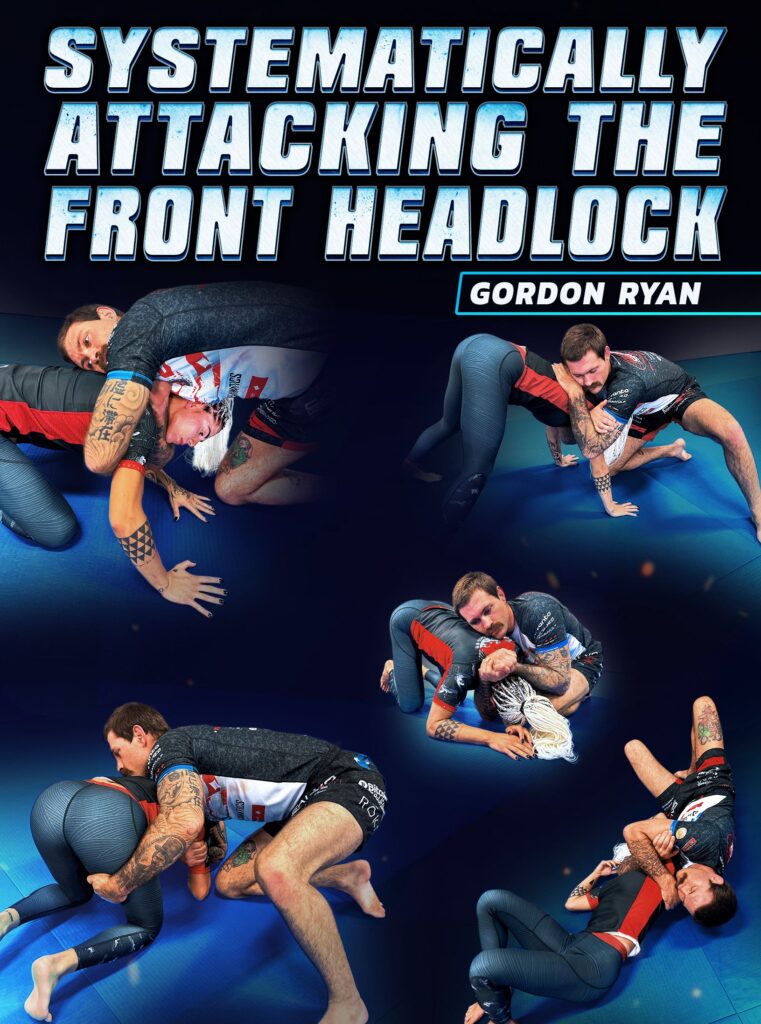
Systematically Attacking The Front Headlock is Gordon Ryan’s course on the front headlock from the knees, once you are already on a man’s head. It runs 4 hours 42 minutes over eight volumes, and the last two are five live rounds and Gordon talking you through them.
Yes, if your front headlock keeps dying
You sprawl, you land on his head, and then it dies: he grabs your choking hand, sits to guard or peeks out. Gordon first keeps you on top through that. Then he reads one thing, the man’s elbow: “the closer my partner’s elbow is to her hip, the easier it will be to hit strangles, specifically guillotines” (Vol 1 · 4:50). Elbow tight to his hip: a guillotine around the head alone. Elbow off his hip: a choke that traps his arm too, or his back.
Worth $349? Not at list price: that buys 3 h 33 of technique, 24 minutes of live rounds and 45 minutes of Gordon going back over them. The Black Friday code BLACKFRIDAY2026 took 55% off at checkout when we tested it on November 23, 2026: $157.05 on the $349 list. At that price, yes, if you get to the front headlock often and lose it there. No entries from standing, and it stops once you are behind him.
Keep him there, then read his elbow
Gordon’s course hangs on one read, the man’s elbow. Elbow tight to his hip: a guillotine around the head alone. Elbow off his hip: a choke that traps his arm too (the arm-in or high wrist guillotine, the d’arce, the anaconda), or his back. It comes off when he reaches for your legs or fights your hands. But none of that helps if he is gone before you can read anything, so the first stop is about staying on top.
- He tries to leavestay on top (Vol 2, Vol 3)
- He keeps his elbow tucked inthe guillotine (Vol 4)
- He holds your choking handchange sides (Vol 4)
- His elbow comes off his hiphis back, or the d’arce (Vol 6, Vol 5)
- He circles away from your kneestep around him (Vol 6)
- Nothing moves himroll under him (Vol 5)
- Someone who fights backa live round (Vol 7, Vol 8)
Most front headlocks never get as far as a choke, because the man leaves first. In jiu-jitsu he can simply sit to guard, and Gordon calls that the most common thing you will meet from people who do not wrestle. His answer is a knee at the man’s hip the second he sits. If the man’s elbow opens, Gordon’s elbow goes inside it and he lands in side control. If it stays shut, he runs to north-south. You lose the front headlock either way, but you land in a pin and not in his guard. And when a leg gets in anyway, Gordon makes sure it is a half guard with him chest to chest: “stay in the hips longer, then climb to the upper body” (Vol 2 · 20:17).
The other way out is the peek. The man steps a leg up, pulls his elbow back and brings his head out at your side, on his way to your back or your legs. Gordon first shows what it costs you with your elbows forward: his partner peeks and he is the one who lands on the mat. The fix is your own elbow, pulled back to your own hip the second the peek starts. If he gets a leg up anyway, re-wrap his head and follow him down.
01 He steps a leg up to come out of your front headlock: re-wrap your near arm around his head, keep his head tight to you, and when he drops to his hip, follow him down and stay on top
Gordon sometimes leaves his elbows loose on purpose to invite this. After this he moves to side control in his own time.
Vol 2 · 31:49Now he stays, and his elbow decides. A careful opponent keeps it tucked: Gordon tries to pull the arm out, the man pulls it back to his hip, and that is Gordon’s cue. Elbow tight to his hip: a guillotine around the head alone.
02 You grab his arm to pull it out and he keeps it tucked in: wrap your arm around his head, step your knee up and sit back into the guillotine
Gordon names this one the low elbow guillotine, and it is the third on his own list. The high wrist is his best by far, the arm-in comes second, and he says he does not really use the high elbow, the figure four or the power guillotine.
Vol 4 · 15:51With no hands in the way the guillotine goes straight in. Usually there are hands, and Gordon treats them one at a time. The hand that blocks both your wrist and your elbow he strips off toward the mat with a grip on the inside of the man’s wrist. A second hand on your wrist stops only the wrist, so he shoots his elbow across instead, the way he gets past a hand when he is on someone’s back. And when the man tucks his chin and it still will not go in, Gordon stops forcing that side.
03 When the guillotine will not go in on this side, open his chin with your hand, pass his head across to your other side and sit into the guillotine there
The man is guarding the hand he thinks will choke him. That hand only opens his chin, and the other one goes through on the far side, which is how Gordon explains it over one of the live rounds.
Vol 4 · 25:41This is where the hand fight turns into something else. To pull your hand down, his hand has to come up to it, and Gordon points at what that does: “As the defensive hand comes up notice the elbow has to come away from the hip.” (Vol 6 · 16:26) That is the other half of his rule. Elbow off his hip: a choke that traps his arm too, or his back. The clip at the top of this page is the same read: he reached for a leg, his elbow left his hip, and his arm was there to trap. In the course Gordon goes on from that trapped arm to the arm-in guillotine. From an elbow that has come away from his hip he has two more choices.
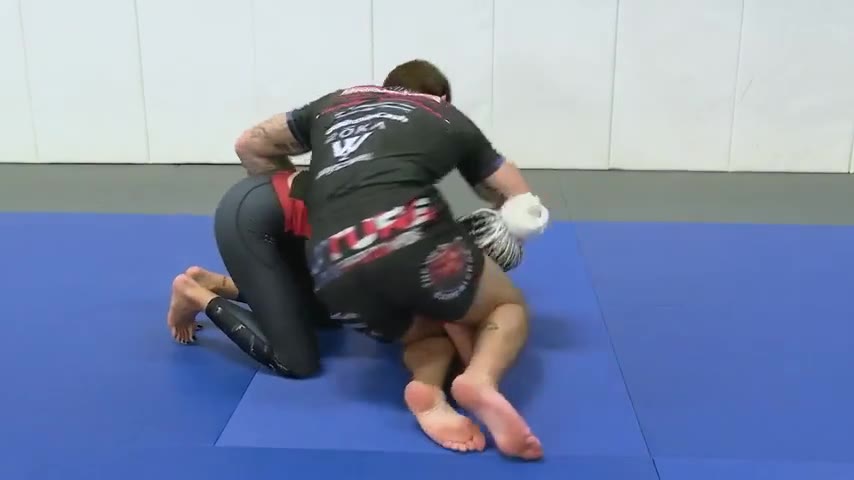
04 From the front headlock, hold his near arm above the elbow, spin your hips around to his side and climb up onto his back
His rule before locking anything from behind: both hands behind the man’s armpits, his hips between your knees. Go for the lock too early, he says, and you fall off the top the moment the man gets up on all fours.
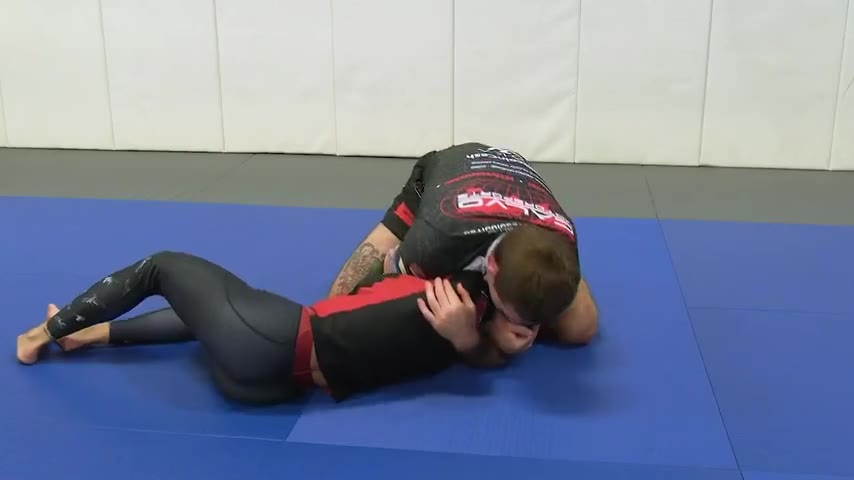
Vol 6 · 17:1305 Knock him down onto his hip first, then put your head on the mat, raise your hips and step over him to his other side to put the d’arce pressure on from on top
Locking the d’arce from the knees takes very long arms, he says, so everyone else breaks the man down to a hip first. He also says he rarely finishes with it: he threatens the d’arce and the anaconda so that the elbow goes back and the guillotine goes in.
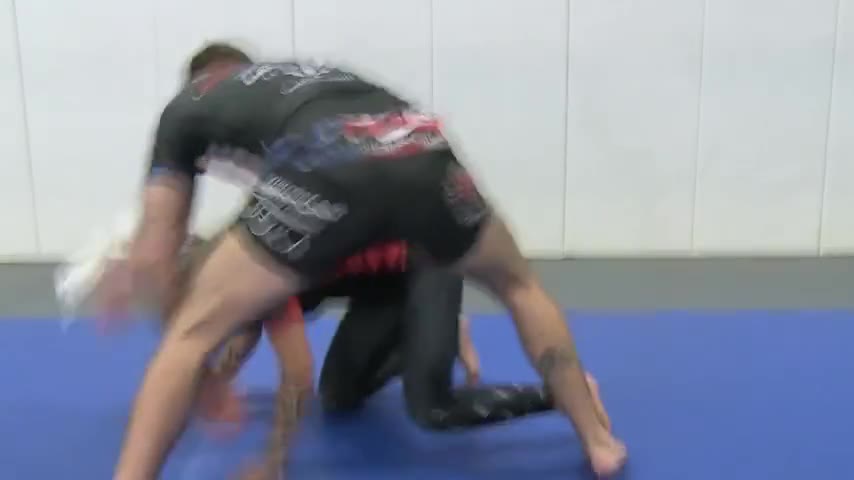
Vol 5 · 30:38A man who feels your knee coming for his elbow pulls it back and circles away from it. Gordon turns that into a choice with no good answer: “If she does nothing, I get behind it and I win.” (Vol 6 · 13:02) If the man keeps the elbow in, Gordon lets go of it and steps around his head to his back.
06 When he keeps his elbow tight: let go of it and step around his head to his back; you end straddling his back, your knee at his hip and your arm under his armpit
If the man is ready for this as well, Gordon fakes it and slides his knee across on the side he started from. He also shows an arm drag here, and says almost nobody at the top level bothers with one.
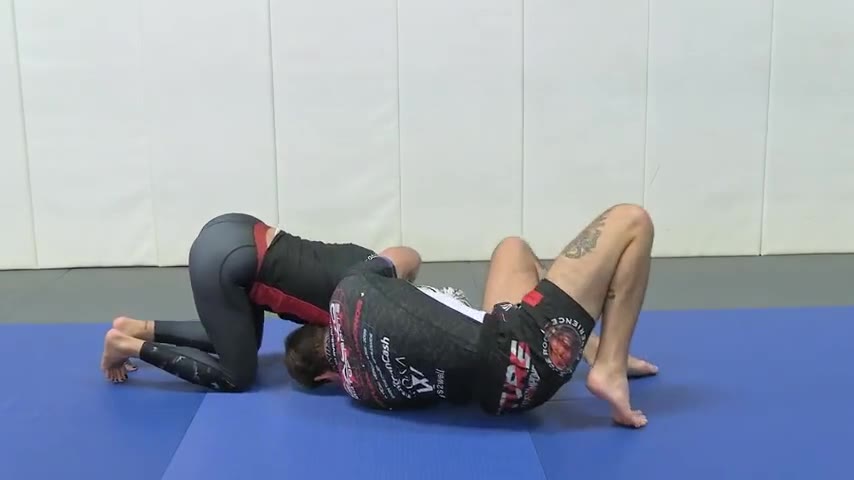
Vol 6 · 13:38Some people give you none of it: no reach, no hand high enough, a base you cannot shift. Gordon’s words for that are “Nothing’s working for me from here.” (Vol 5 · 15:27) His answer is to go under the man. He locks his hands palm to palm high in the armpit, pulls the arm through and rolls underneath, and the man has a hard choice: “If she resists from here, she will get strangled.” (Vol 5 · 15:45) So he falls to his side, into the anaconda.
07 When he will not come off his base, roll under him from the front headlock; he has to fall to his side, and you land with his head and arm wrapped up in the anaconda
Gordon calls this the Olympic roll and prefers it to feeding the anaconda straight from the knees, which he says a wrestler answers with an arm drag of his own. If the anaconda slips as the man rolls back up, Gordon swings up with him and is back in the front headlock with the guillotine there again.
Vol 5 · 15:39Everything above is drilled from a static position, Gordon says, and that is what the rounds are for. Volume 7 is five of them with nobody talking. Volume 8 plays the same rounds again while he explains each exchange.
08 Live training round: on top of his turtle with your arm around his head, you roll onto your back and pull him over on top of you, one leg over his back
In volume 8 Gordon says of this exchange: “As he pulls the elbow back, if I can shove that arm on my leg, I can switch pretty fluidly from that d’arce into arm-in guillotine.” (Vol 8 · 15:10) Pulling the elbow back does not free the arm here, so it is still a choke that traps his arm too. He does not claim a finish here. His partners in these rounds are a lot smaller than he is, and he says that too.
Vol 7 · 6:04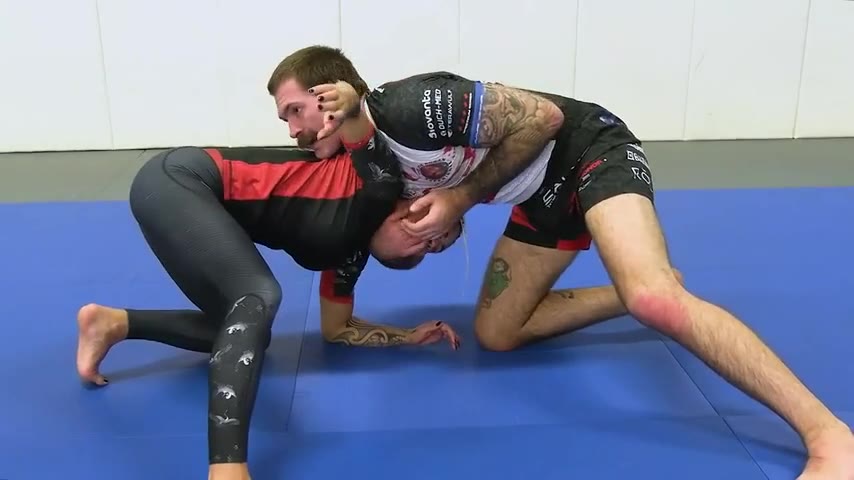 01
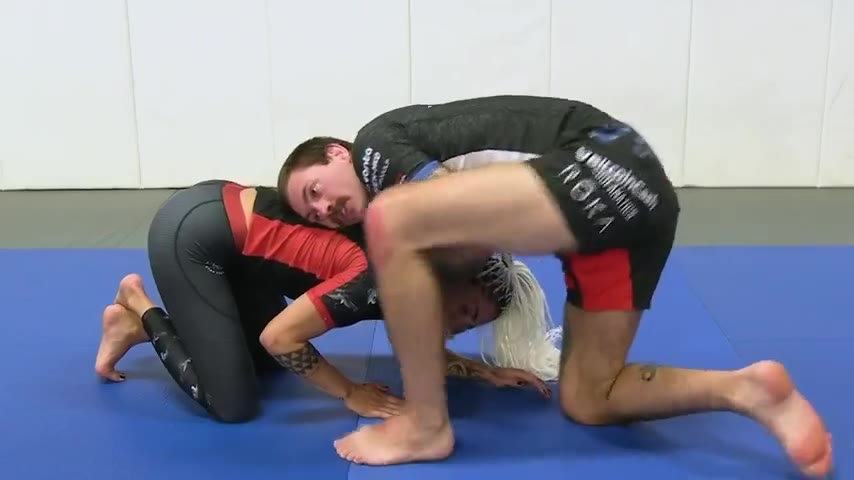 02
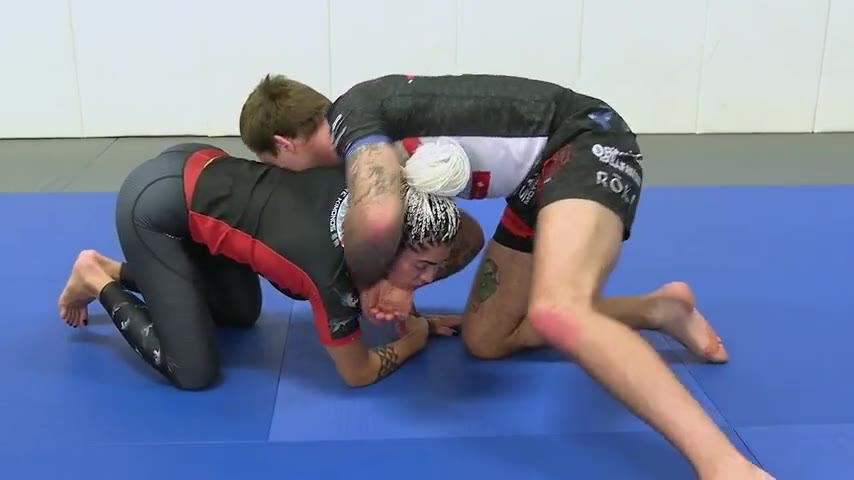 03
 04
 05
 06
 07
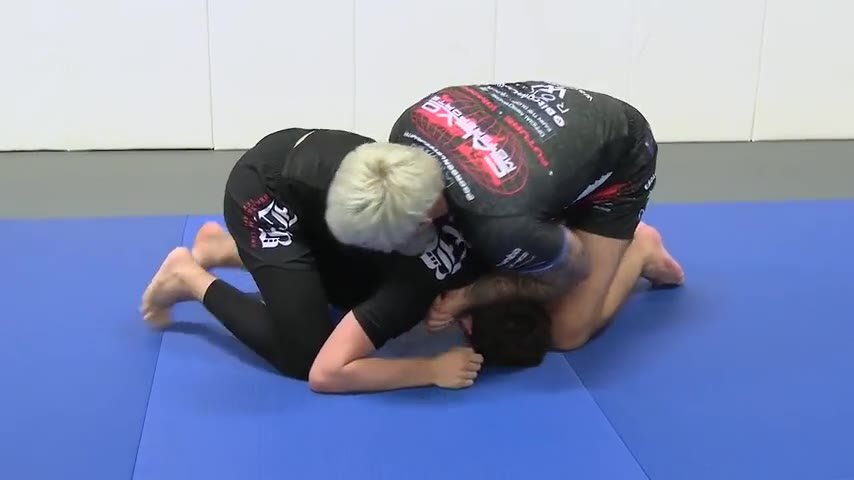 08
Who should buy it
Which one are you?
- Gets the front headlock and loses itA third of the technique is about exactly this: he sits to guard, he peeks, he gets two hands on your wrist, he gets up on all fours.
- Has one guillotine and a long hand fightThe elbow read gives you the other attacks, and Gordon uses them the way you would want to, as threats that make the guillotine go in.
- Wrestler moving to jiu-jitsuVolume 1 is about what changes. Knees down on purpose, because a man who reaches for your legs has taken his hands off your choke.
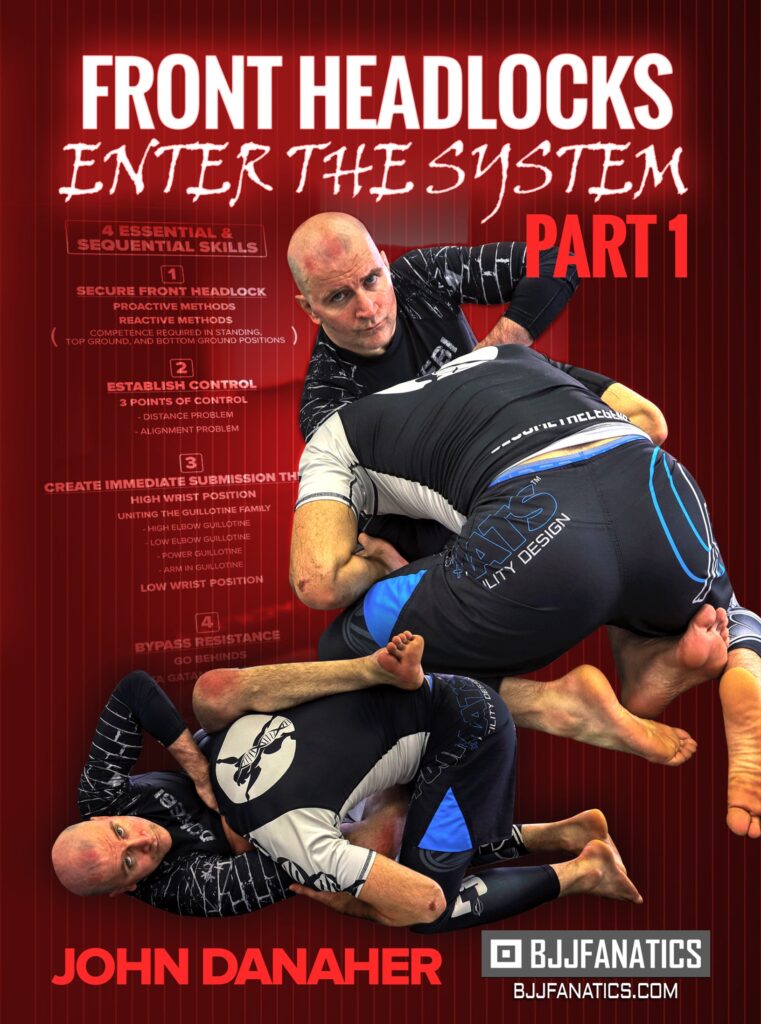 Owns Danaher’s The Front Headlock SystemGordon says himself that his version will be pretty similar. It is shorter, it is newer and it has live rounds. You will find less new material than the price suggests.
- Wants to see it work on someone who fights backYou get 24 minutes of rounds and 45 minutes of Gordon explaining them. The partners are much smaller than he is and, in his words, not world level.
- Trains mostly in the giIt is filmed no-gi and nothing is adapted for the gi.
- Cannot get to the front headlock yetEvery rep starts there. The only snap down in the course is on a man who is already on all fours. Danaher’s course spends 1 h 17 on getting there from standing.
 Wants a full guillotine courseGordon says this is not one. His own guillotine course, Systematically Attacking The Guillotine, came out in June 2024. Placido Santos’ Drill For Skill: Guillotines is 8 h 33 on the guillotine alone.
 Wants the back attacks after the go-behindThe course ends when you get behind him. Gordon’s own Systematically Attacking The Turtle Position starts there, and Craig Jones’ The Anti-Wrestling Equation keeps going.
What buyers say about it
Ben T., a buyer on BJJ Fanatics (June 2024), calls it a “clear and concise modernised update on Danahers original system”.
Otto B. (February 2025) is there for the rounds: “it explains how to react to common opponent reactions in a way that mere explanation or even demonstration can’t.”
Blaine L. (March 2025) says it “shows not only which options are available but the when, where, why and how for each one”, and igor b. (November 2026) says he “started finishing a lot of guillotines after watching it”.
Buyers on the product page do not bring up the limits. The ones in the list below are ours, from watching all eight volumes.
Away from the product page the picture is more mixed, and most of it lands on our own list below. The praise matches our pros: one owner says it really helped their front headlock game, and another puts the main value of any Gordon course in the rolling footage with his commentary, which here is volumes 7 and 8. The complaint matches our cons: someone who would rather point you to Bodoni or Craig Jones struggles to get through Gordon’s material because of how much he talks.
The hardest line comes from someone who rates Gordon’s courses top tier and still calls this one of his weaker ones, without saying why. Their pick instead is Bodoni’s Chest To Back: In Front of the Elbows. Our read: it starts on the feet and goes on to the back, the two things Gordon leaves out here.
Pros and cons
- One read for the whole position. Elbow tight to his hip: a guillotine around the head alone. Elbow off his hip: a choke that traps his arm too, or his back (details 02 to 06)
- A third of the technique is about not losing the position: 1 h 06 on the guard pull, the peek, the two-on-one, the elbow pass and the man on all fours
- It is jiu-jitsu and not wrestling. Gordon keeps his knees down on purpose to invite the reach for his legs, and explains why a wrestling stance gives that up
- Every defence is turned into the next attack, and he names which is the lever and which the finish: he threatens the anaconda, the d’arce and the go-behind, and finishes with the guillotine
- Five live rounds and 45 minutes of him explaining them. Danaher’s The Front Headlock System and Craig Jones’ The Anti-Wrestling Equation have no live rounds
- He says where things fail: the plain anaconda feed loses to an arm drag against a wrestler, the d’arce from the knees needs long arms, and three of the six guillotines he teaches he does not use himself
- No entries from standing. Every rep starts on the man’s head. Danaher’s course gives 1 h 17 to sprawls and snap downs from the feet, and Craig Jones opens his course with them
- Not a guillotine course, by Gordon’s own word. Grips are left for another video, and finishing gets about five minutes. Danaher gives the high elbow guillotine alone 15 minutes, and Placido Santos’ course is 8 h 33 of nothing else
- It stops at his back. Craig Jones goes on with two volumes on taking and attacking the back
- Volume 3 is about a grip with no submissions from it, as Gordon says in its first minute, and goes through the problems of volume 2 again
- Every technique is shown on a partner who lets it happen. The rounds are against much smaller partners, and the same five rounds fill two of the eight volumes, once bare and once with his commentary
- Long seated talks before some of the demos, about four minutes in volume 5 where his partner is made to explain the system as a joke, and swearing. Some people like his humour. It is slow if you do not
- $349 list for 4 h 42. Danaher’s 7 h 10 and Craig Jones’ 7 h both list at $197
Stay on top first, then let his elbow tell you what is open. Black Friday code BLACKFRIDAY2026
What’s inside the eight volumes
Six volumes of technique, then five live rounds, then the same rounds with Gordon’s commentary. Tap a volume for what’s in it.
Vol 1 · 25:37Why this is not wrestling, and the elbow rulethe rule, four grips, his hands, five ways out, knees down
Gordon starts with what changes when chokes are allowed: the man under you has to keep his hands on your choking hand, he can sit to guard, and when you get behind him his back is open to you at once. Then the elbow rule the whole course runs on, the four grips he uses (locked hands around head and arm, the chin strap, the chest lock and double triceps), the three ways a man can use his hands to defend, and the five ways he tries to leave. The last five minutes are the stance: knees on the mat, a leg left out to be reached for (the clip at the top).
Vol 2 · 39:56Staying on top with the head and arm or the chin strapguard pull, half guard, two-on-one, peek, elbow pass, all fours
Elbows back to your own hips, shoulder between his shoulder blades. Then the ways out one by one. When he sits to guard Gordon’s knee goes to his hip, and he lands in side control or north-south. If a leg gets in, he forces a chest to chest half guard and takes his time climbing from the hips to the head. Then the two hands on your wrist, the peek, the leg that steps up to get out (detail 01), the hand that pushes your elbow past, and the snap down on a man who is up on all fours.
Vol 3 · 25:56The same problems with a chest lock or double tricepshead on his centre line, north-south, three answers to the peek
Gordon says in the first minute that this grip has more to do with wrestling, because there are no submissions from it. He goes through the guard pull, the half guard and the snap down again, and gives the peek three answers: catch the underhook as the leg comes up, step over him, or as a last resort cover his head so it cannot come up. Double triceps stops the peek almost completely, he says, but slips on a sweaty man.
Vol 4 · 42:55Guillotinessix types, centre line shift, his hands, change of sides, finishing
Gordon calls this the bread and butter of the course. Six guillotines by name, with the elbow rule for choosing between them, the shift of your head across his centre line that gets your arm deep, and the chin crunched to the chest. Then the set-ups by what his hands are doing: no hands (detail 02), one hand, two hands, and the change of sides when the hand fight stalls (detail 03). Five minutes of finishing for all six types, where to put your legs, the finish from mount when he rolls you on top, and how to move from one guillotine to the next.
Vol 5 · 48:55Anaconda, d’arce, and how the four attacks feed each otherOlympic roll, pendulum, knee behind the elbow, hip first, seated kata gatame
Gordon opens by saying he rarely finishes either choke. He threatens them so the elbow goes back and the guillotine goes in. The anaconda half has the plain feed and why a wrestler drags out of it, the version on a man who is up on all fours, the Olympic roll (detail 07), and the swing back up to the guillotine when the man rolls out. The d’arce half has his rule that your chest and his must face opposite ways, the knee behind the elbow to get to the side, and the break down to a hip before you lock it (detail 05). Then about four minutes where his partner is made to explain the system on camera, his own summary, and a seated head and arm choke that he says everyone wrongly calls an arm-in guillotine.
Vol 6 · 29:29Getting behind himknee behind the elbow, throw-by, fake and switch, off the guillotine, arm drag
Why going behind matters more in jiu-jitsu than in wrestling, then the ways to do it. The knee behind the elbow comes first, with the rule about hands behind the armpits and hips between your knees. Then the same from the other side, the throw-by when he circles away from the knee, the step around his head when he keeps the elbow in (detail 06), a three step fake for when he is ready for that, the go-behind with a grip above his elbow (detail 04), and the arm drag. A short part repeats it from double triceps. The volume ends with his summary: movement is what makes the opening.
Vol 7 · 23:44Five live roundsno talking
Five rounds with three training partners, each starting from the front headlock. Nobody speaks. Detail 08 is from the second round.
Vol 8 · 45:05The same rounds, explainedGordon’s commentary
The rounds of volume 7 played back on a screen with Gordon in a small picture in the corner, slowing down and replaying the exchanges he wants you to see. Most of what the technique volumes teach turns up here, along with a few things they do not, such as an ankle pick and the cradle. He says twice that his partners are much smaller and once that they are not world level.
The course in numbers


$81 per hour of teaching at the $349 list price (4 h 18: everything but the bare rounds of volume 7). That is more than these four other $349 Gordon courses: Pin Escapes ($42), Systematically Attacking The Legs ($44), Leg Lock Escapes ($53) and Dismantling Octopus ($66).
$36 per hour with the Black Friday code BLACKFRIDAY2026 (55% off, tested at checkout November 23, 2026). With the same code on the other four, it is still the most expensive per hour of the five.
Gordon or Danaher?
The Front Headlock System (most people just call it ETS, short for Enter The System) is John Danaher’s course on the same position: 7 h 10 over eight volumes, $197 list (checked October 31, 2026), released in 2018. Gordon opens his own course with it: “Obviously, John has his. This is going to be my iteration of what my system is from front headlock.” (Vol 1 · 0:37) He adds that he expects it to be pretty similar.
It is. Danaher’s course already has a high wrist series and a chapter on the centre line shift, the two things Gordon’s guillotines lean on most, plus the Olympic roll into the anaconda, the d’arce, the seated kata gatame and the knee block and arm drag go-behinds. The differences: Danaher spends 1 h 17 of his volume 2 on getting to the front headlock from standing, while Gordon starts every rep on the man’s head; Danaher gives the ways out one chapter of about seven minutes, Gordon two volumes, 1 h 06; and Danaher has no live rounds, Gordon five, plus 45 minutes of him explaining them.
Take Danaher’s if you need the position from the feet down and want each guillotine in depth: his volume 6 gives the high elbow guillotine 15 minutes. Take Gordon’s if you already get to the front headlock and lose it there, or if you want the shorter, newer version with the rounds.
Compare to
- The Anti-Wrestling Equation (Craig Jones, $197 list): 7 h over eight volumes, no live rounds. It starts from the same idea, that this is jiu-jitsu and not wrestling, and puts the weight the other way round. Craig threatens the choke to get behind the man, and the back is the prize. Gordon threatens the anaconda, the d’arce and the go-behind, and finishes with the guillotine. Craig also starts on the feet and keeps going once he is behind, with two volumes on taking and attacking the back. See it on BJJ Fanatics. Or read our review.
- Drill For Skill: Guillotines (Placido Santos, $197 list): 8 h 33 on the guillotine alone, more than half of it recorded classes. Gordon tells you which guillotine the man’s elbow allows. Placido is the one to get if your problem is finishing it. See it on BJJ Fanatics.
One more that keeps coming up next to this one: Giancarlo Bodoni’s Chest To Back: In Front of the Elbows, for the entries from standing and the back takes this course leaves out. More options in our best front headlock instructionals, best guillotine instructionals and every Gordon Ryan instructional ranked. Prices are BJJ Fanatics list prices, checked October 31 to November 13, 2026.
Get the next review like this one
New reviews in this format land in your inbox, with the details on video. You also get the free BJJMore email course and the instructional-platform discounts I use myself (worth $46).

BJJMore earns a commission if you buy through these links, at no extra cost to you. Released by BJJ Fanatics in March 2024; reviewed on all eight volumes.
FAQ
Is Systematically Attacking The Front Headlock worth it?
Yes, if you get to the front headlock often and lose it there: he sits to guard, peeks out or holds your choking hand until it dies. Gordon first keeps you on top, then gives you one read, the man’s elbow. Elbow tight to his hip: a guillotine around the head alone. Elbow off his hip: a choke that traps his arm too, or his back. Not at the $349 list price for 4 h 42. With the Black Friday code BLACKFRIDAY2026 it is: the code took 55% off at checkout when we tested it on November 23, 2026, which is $157.05 on the $349 list. Skip it if you need to get to the front headlock from standing, or want a full guillotine course.
How long is it?
4 hours 42 minutes over eight volumes: 25:37, 39:56, 25:56, 42:55, 48:55, 29:29, 23:44 and 45:05. The first six are technique, 3 h 33 in all. Volume 7 is 24 minutes of live rounds and volume 8 is the same rounds with Gordon’s commentary. Gordon guesses five to six hours at the end of volume 6. It is shorter than that.
Does it have live rolling?
Yes. Volume 7 is five rounds with three training partners, each starting from the front headlock, with no talking. Volume 8 plays them again while Gordon explains what he was doing. They are training rounds against partners he calls a lot smaller than he is, so take them as a look at the timing, not as proof against someone your own size.
Does it teach how to get to the front headlock?
No. Every rep starts with Gordon already on the man’s head and both of them on their knees. The only snap down is on a man who is already up on all fours. For sprawls and snap downs from standing, Danaher’s The Front Headlock System has 1 h 17 of them and Craig Jones’ The Anti-Wrestling Equation opens with them.
Gordon’s course or Danaher’s The Front Headlock System?
Danaher’s if you want the whole position: 7 h 10, $197 list, entries from standing and from a seated guard, and each guillotine in depth. Gordon’s if you already get there and lose it: 4 h 42, two volumes on staying on top, one read for choosing the attack, and five live rounds. The systems are close, as Gordon says himself in the first minute. The high wrist position and the centre line shift that Gordon builds on are both in Danaher’s 2018 course.
Gordon Ryan or Craig Jones’ Anti-Wrestling Equation?
They want different endings. Craig uses the choke as the threat and takes the back, and his course goes on to back takes and back attacks. Gordon uses the anaconda, the d’arce and the go-behind as the threats and finishes with the guillotine, and his course stops when you are behind the man. Craig’s is 7 h for $197 list with no live rounds. Gordon’s is 4 h 42 for $349 list with five.
Gordon’s front headlock course or his turtle course?
They meet at his back. This course ends when you get behind a man on his knees (detail 04 and 06). In volume 6 Gordon says the turtle attacks from there have a full course of their own. That is Systematically Attacking The Turtle Position, eight volumes at $349 list: break the turtle down, get your hooks in and take the back. A grappler asked to tell the two apart drew the same line: chokes and go-behinds here, taking the back there. Start here if he sits to guard, peeks out or holds your hand before you can get behind him. Start there if he already gives you his back on all fours.
Gordon’s front headlock course or his guillotine course?
Different jobs. This one is the front headlock: staying on top, picking the attack from the man’s elbow, and getting behind him. Volume 4 has the guillotines, but Gordon says there that a full guillotine video would come separately. In June 2024, three and a half months after this course, BJJ Fanatics released his Systematically Attacking The Guillotine ($349 list, eight volumes). Ask what the difference is and the answer comes back the same each time: the guillotine course takes the choke to other positions too, such as guards and scrambles, and goes through set-ups, follow-ups and mechanics, while this one covers the position, the go-behinds and the other submissions. Get this one if you lose the front headlock you already have. Get that one if the guillotine is the choke you want from everywhere.
Is it a guillotine course?
Only in part. Volume 4, 43 minutes, is guillotines, and Gordon calls it the bread and butter of the course. But he also says more than once that this is not a guillotine video: grips are left for another one, and finishing all six types takes about five minutes. What you get is which guillotine to pick. Elbow tight to his hip: a guillotine around the head alone (the low elbow, high elbow, figure four or power). Elbow off his hip: a choke that traps his arm too, here the arm-in or the high wrist.
Which guillotine does Gordon use most?
The high wrist, by far, then the arm-in, then the low elbow. He says he does not really use the high elbow, the figure four or the power guillotine, because they are easy to defend. All six are taught.
Do I need long arms for the d’arce?
Not the way he teaches it. Gordon says locking a d’arce from the knees takes very long arms, and that the reliable way for everyone else is to knock the man down to a hip first (detail 05). He adds that there is still a limit when your arms are short and the man’s shoulders are broad.
Is it gi or no-gi?
No-gi. Nothing in the course is adapted for the gi.
Is there a discount code?
Yes. The Black Friday code BLACKFRIDAY2026 took 55% off this course at checkout when we tested it on November 23, 2026. On the $349 list that is $157.05. BJJ Fanatics rotates its deals and codes, so check the price on the day you buy.
Stop losing the front headlock you worked for
He sits to guard, peeks out or holds your hand until it dies? This keeps you on top first, and then his elbow tells you what is open. No-gi, from the knees, with five live rounds.