
Home / Takedowns for BJJ / New Wave Judo Review
Satoshi Ishii’s New Wave Judo Review
Buy it if you tie up in no-gi and then stall: you learn one short pull, and the way the other man blocks it tells you which throw is open.
See New Wave Judo →No-gi. Who should buy it ↓
- No-gi
- 4 volumes, 3 h 27
- 44 chapters
- No live rounds
- Released December 2022
Satoshi Ishii’s New Wave Judo is judo throws for no-gi, started from the ties you already get: underhook, overhook, collar tie, 2-on-1. Ishii won Olympic gold in judo in 2008 and trained at New Wave Jiu-Jitsu when he filmed it. The course is 3 hours 27 minutes of him and one partner.
Yes, if you get the tie and then stall
You win the underhook, try the one throw you know, and he blocks it. Then you both stand there and push. Ishii starts nearly every throw with the same short pull, which he calls whipping, and lets the block choose the throw. “When I do whipping, he doesn’t know which throw is coming.” (Vol 3 · 16:55)
$127 list for 3 h 27; with the daily deal and the Black Friday code BLACKFRIDAY2026 it came to $28.58 at checkout on November 13, 2026. One partner who goes along, no live rounds.
His block picks your throw
Ishii orders the course by throw: uchi mata, tai otoshi, sumi gaeshi, the foot sweeps, ouchi gari, osoto gari and so on. We have put it in the order you meet it in a round. You get a tie, you pull, and the man in front of you does something about it. Six moments, and the same pull in front of almost all of them.
This is where no-gi stand-up tends to stop. You have an underhook, he has one too, and there is no jacket to pull on. Ishii starts here. He calls the underhook the best grip for no-gi judo, and he also throws from the overhook, the collar tie and the 2-on-1, the two-handed grip on one arm that he takes when the man reaches for his neck. With an overhook he wants the wrist as well. An overhook on its own, he says, is very hard to throw from.
What turns the tie into a throw is the pull. Ishii calls it whipping: a short, sharp tug with the upper body, elbow up for a moment, while your legs stay out of it. Almost all of his throws start with it, and that is the point. If the pull looks the same every time, the man cannot tell which throw is behind it, and what he does to stop it tells you which one is open.
You pull and go for uchi mata, the first throw Ishii teaches. It needs your leg between the other man’s legs, so the block a lot of people use, Ishii says, is to close their knees. The man knows what is coming. Throw anyway and your leg finds nothing. Judo has a name for that counter: uchi mata sukashi.
So Ishii checks before he commits. He pulls with the upper body only and watches what the knees do. If they stay apart, it is uchi mata. If they close, he turns in front of the man for tai otoshi, the throw where your leg goes across the front of his legs and not between them. Knees that are already shut make that throw very easy, Ishii says.
The clip at the top of this page is that switch: knees shut, turn in, tai otoshi.
The other block is harder to see. His knees stay where they are, but he sinks his weight onto the leg you want to lift, and it will not come up. Ishii does not fight that. He shows the uchi mata again with the pull alone, and while the weight sits on that leg he steps in and reaps it. He calls the throw ouchi gari, and it is the one he reaches for when someone resists his uchi mata: very easy to chain, in his words. One hand is enough for the pull, he says, and the man goes down backwards, where he has no hand to post.
His rule for the step in: low and square, chest to chest. Go in tall, or with your hips turned to the side, and you are the one who gets countered.
So far the man stood his ground. The other way out of a throw is to step away from it, and with osoto gari, the big reap from the outside, Ishii wants him to. His example starts in same stance, which he calls ai-yotsu: you both have the same foot forward. It starts from a foot position where, he says, he cannot go straight to uchi mata. So osoto goes first. Here the osoto does the job of the pull: it is there to make him move. The man steps back out of it, Ishii puts his own foot down on the mat and steps in again, and the second step in is the throw.
What the man does picks the rest. When he overreacts to the osoto, Ishii takes one step and goes in for uchi mata. When he does not step at all and just hangs on, the foot goes down and Ishii switches to kosoto gari, a small reap from the outside.
01 Lift your leg to start osoto gari, put the foot back down, step in again and reap his leg from the inside. He falls on his back
Ishii always puts the foot on the mat first. Going straight in from the raised leg, he says, leaves you too far away to use your strength.
Vol 4 · 55:29Sometimes the throw is on and he still does not go over. He puts a hand on the mat and the throw stops halfway. Ishii expects this whenever the man has a hand free: from the overhook without the wrist, the grip he called hard to throw from, or from the 2-on-1, where the man’s other hand is loose. He does not try to force the throw through. His hand is already beside the man’s head from the pull, so he keeps the head, walks around and ends up on the man’s back, with the man on hands and knees.
His reason is worth writing down if you come from jiu-jitsu. No-gi judo is not judo, he says: the throw does not have to be clean, and the back is just as good. He also puts it as a warning. Throw too hard in no-gi, where nobody wears a jacket, and you lose your position.
02 Your throw stalls because he posts his hands on the mat: keep his head, walk around and land on his back while he is on hands and knees
If the man tries to stand back up while you still hold his head, Ishii has the next throw ready: sumi gaeshi.
Vol 1 · 25:59All of that starts with your pull. In no-gi the other man often goes first and drops onto your leg. Ishii calls that a very good moment for uchi mata, the same throw the closed knees stopped earlier on this page. This time the man’s own shot has done the hard part. His head is down, the head is the heaviest part of the body, and that makes him easy to throw. Ishii gets the man’s hand off his leg and throws the moment the grip breaks.
Ishii does not shoot real singles himself, and says why: a good jiu-jitsu player answers with a guillotine. He reaches for a leg only to make the man defend, comes up into the underhook, and is back at the tie where this page started.
03 He shoots a single on your leg with his head low: strip his hands off your leg and turn straight in for uchi mata over his lowered head. He lands on his back
Do not wait once his grip is off, Ishii says. Go at once.
Vol 1 · 19:43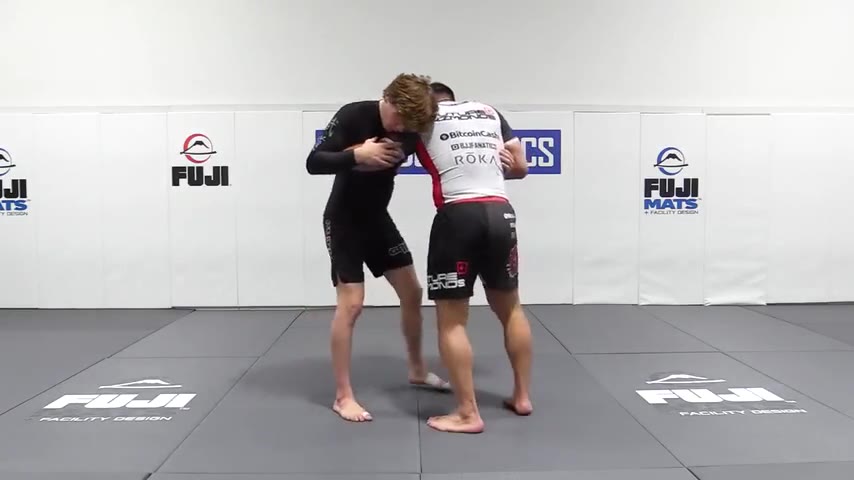 01
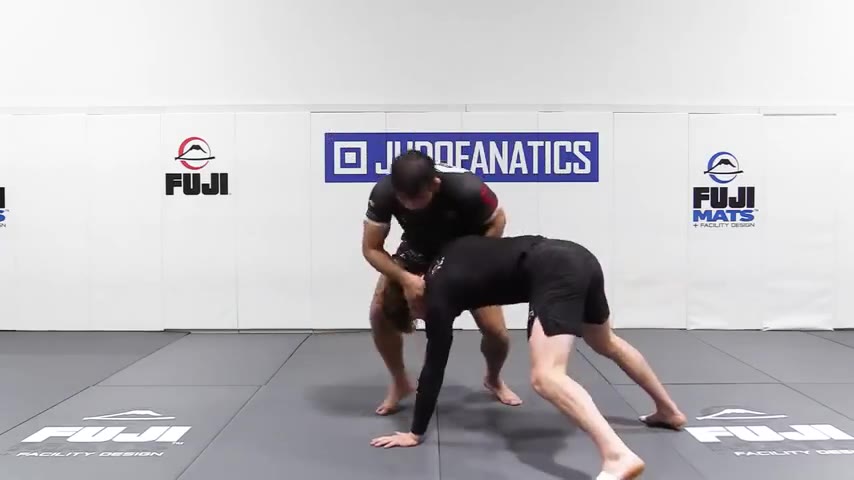 02
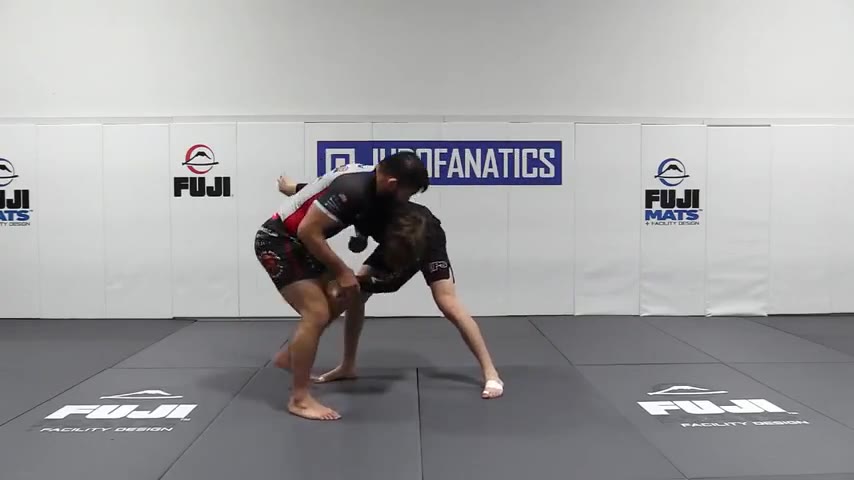 03
How many of these do you do?
Count the ones you already do in a roll, not just in drilling. If most are new to you, this course will change what happens after you get the tie.
Who should buy it
Which one are you?
- You get the tie and then stallUnderhook, overhook, collar tie and 2-on-1 are where the throws in this course start.
- You would rather throw than shootNobody shoots from the outside in this course. Danny R., a buyer (August 2026), recommends it to people who prefer upper-body control and trips to low singles and doubles.
- You come from judo and train no-gi nowThe throws you know, without the jacket. Andrea M., a buyer (September 2023), calls it a path every judoka can follow into no-gi. A judoka who never wrestled liked the first section too, and was fine with less theory than Danaher gives.
- You have never thrown anyoneYou can follow it, and more than once Ishii stops to give beginners a simpler version. But you will have to learn the Japanese names as you go.
- You and your partners stand the same wayUchi mata, tai otoshi, kosoto and ura nage are opposite-stance throws first. In same stance your share is ouchi gari, osoto, sasae and the foot sweeps.
- You train mostly in the giIt is no-gi only and no gi grip is shown. The underhook and the collar tie exist in the gi too.
- You want to see it against resistanceEvery throw is on a partner who goes along. No live rounds, no matches.
- You want wrestlingNo snap downs, no front headlock attacks (the one head hold comes after he posts a hand), no shots from the outside. See Compare to for the two courses that start there.


 You want one throw in depthEach throw gets between five and thirty minutes here. Ishii has separate courses on uchi mata, tai otoshi and foot sweeps.
What buyers and other grapplers say
Floyd B. (August 2024) writes that the course is built on basic wrestling tie-ups, which makes it easier for grapplers without judo. Ramon P. (February 2023) had no judo background and says the throws worked for him in class straight away. Benn R. (May 2024) puts it shortest: it is saving him from doing bad double legs.
 The limits buyers name are about words, not throws. Ryan K. (February 2023) says Ishii spends little time on theory and mostly shows the move and how to apply it; he uses the course next to Danaher’s Standing2Ground. Corey J. (May 2026) finds it a little longer than it needs to be because of the language barrier, and still worth the money. Mark (May 2024) found it hard to hear in places because of the echo in the room.
None of the buyer reviews on BJJ Fanatics is negative. Our own complaints are in the cons below.
Away from the shop, the course comes up less often than Ishii himself. In four years we found one write-up of it, plus short mentions where people ask for no-gi judo. What is said is mostly warm, and it matches the buyers: less theory than Danaher, more showing. A judoka who never wrestled liked it after the first section. New to him was the idea that once the man puts his hands on the mat, you can go around to his head or his back. Detail 02 shows the back take. Someone who bought it together with Travis Stevens’ Mastering No Gi Takedowns found the techniques easier to take in than in Danaher’s course. He had not finished it yet, so that one counts lightly. And one recommendation gives its reason: it goes deep on the throws with low risk and high reward.
On the language, one grappler finds Ishii’s judo instruction clear and uncomplicated, and says the language barrier means little when it is taught well. He does not name the title, so read it as a word about Ishii as a teacher. Corey J. above says the same from the other side: the language makes it a little long, and it is still worth the money. Outside the shop we found no negative report that is clearly about this course either.
Worth it? The pros and cons
- One pull in front of almost every throw, so one habit to build: pull, see how he blocks, throw what he left open (the clip at the top)
- It starts from the ties you already get in no-gi. No jacket and no judo grips needed
- It is adjusted for jiu-jitsu where it counts: a back take when he posts (detail 02), no real single legs because of the guillotine, and a warning that throwing too hard costs you position
- The moments jiu-jitsu gives you are in it: he shoots a single (detail 03), he has both underhooks, you are locked chest to chest with no room
- Also in it: eighteen minutes on what to do when he throws at you, and twenty-five on foot sweeps with rules you can check (the side of your foot, where his big toe points, his weight on that foot)
 No live rounds, no sparring, no matches. One partner, who goes along with every throw. Ishii says himself that some of the timing cannot be shown in drilling. Gordon Ryan’s Upper Body Takedowns ends with a volume of rolling
- The language. Throws, grips and stances keep their Japanese names, the English is halting, and two buyers, Corey J. (May 2026) and Mark (May 2024), mention it
- Little theory. Ten minutes on grips, then throw after throw. For the why, Ryan K. (February 2023), a buyer, pairs it with Danaher’s Standing2Ground

 No snap downs, no front headlock attacks, no shots from the outside. That is a choice, but it means Closing The Gap and Slay The Hand Fight cover ground this course does not
- Little after the throw. The back take in detail 02 and staying on top after sumi gaeshi are the only follow-ups: no pins, no submissions
- Half the throws depend on stance. Uchi mata, tai otoshi, kosoto and ura nage are for opposite stance first, so check how you and your partners stand before you count on them
- No drills section. The training advice is scattered through the chapters
Pull, see how he blocks, throw what he left open. Black Friday code BLACKFRIDAY2026
What’s inside the four volumes
44 chapters over four volumes, all no-gi, all on one partner. Tap a volume for what’s in it.
Vol 1 · 50:36Grips, uchi mata, tai otoshiunderhook, overhook, 2-on-1, wrist control
Ten minutes on grips by stance open the course: where your thumb goes when he has an underhook too, why the wrist matters, and how to win it when he reaches for your neck. Ishii meets the arm with what he calls a defensive punch and takes the wrist as it stops. Uchi mata follows. His version takes two steps: the first only lifts the man’s lead leg a little, the second goes between his legs, and you aim at his hip, not his knee. Then come the versions for jiu-jitsu moments: against a single leg (detail 03), against both underhooks, which Ishii calls a very bad position to be in, and from the overhook and the 2-on-1 with the back take (detail 02). Tai otoshi gets twenty minutes. The timing is the moment he steps his back leg. Leave yourself room to turn, and point your knee in, so he cannot land on it. The switch from uchi mata to tai otoshi when he closes his knees is in this volume too (the clip at the top).
Vol 2 · 36:35Sumi gaeshi and foot sweeps2-on-1, collar tie
Sumi gaeshi is the throw where you drop under the man and roll him over you. Ishii shows it three ways: from the 2-on-1 when the man resists the uchi mata fake, when he tries to stand up out of the head hold from detail 02, and against a single leg, with his outside hand gripped so he cannot post. Follow him all the way over, Ishii adds, or you lose the top. The other twenty-five minutes are foot sweeps. Sweep with the side of your foot and your shin, not the sole. Sweep the way his big toe points. Make sure his weight is on that foot. Ishii’s favourite timing: push his head down with the collar tie and sweep as he pulls it back up. When the man has learned to lift his foot, the first sweep becomes a touch and the second takes his back leg. Ishii is frank that sweeps do not always work and keeps them anyway. You never turn your back for one, and a miss still moves the man for whatever comes next.
Vol 3 · 58:36Ouchi gari and osoto gariunderhook, overhook, 2-on-1, shoulder lock
About half an hour each. Ouchi gari comes first: two straight steps, in low, chest to chest, and the reaping foot never leaves the mat. Beginners, Ishii says, should not reap at all at first, only open the man’s legs. Then come the versions: off the uchi mata fake from the overhook, off the same pull from the 2-on-1, and from the shoulder lock. Osoto gari: step in parallel to his foot, keep your own foot pointed like a ballerina’s, head up, chest to chest, and hop after him if he backs away. Beginners put the foot down before they hop. Here Ishii says again that the two-step entry is the same for four throws, so the man cannot tell them apart. The volume also covers the leg reach that ends in an underhook, and two ways out of bad spots. Locked chest to chest with no room: change level, slip a shoulder out and throw on the way up. Both underhooks locked on you, which he calls the worst place in the clinch: head to the side, enter from the side, and feel for the counter before you commit.
Vol 4 · 1:01:09Kosoto, sasae, ura nage, defence, chainsall ties
Kosoto gari opens the volume, with a warning not to fall to the mat with it in training. Then sasae, a foot block that Ishii uses less to throw than to set up the throw after it, and ura nage for the man who resists uchi mata or tai otoshi. Five minutes go to harai goshi, which he rarely uses because it shows your whole back. Then eighteen minutes with the roles turned round and the partner attacking: turn your knee out against osoto, put your hip on his hip against uchi mata, turn your toes against a foot sweep, step in chest to chest against ura nage and kosoto. The last eight minutes are chains. Osoto first, to make him step (detail 01). Ouchi gari used like a jab that pushes him off and makes room for tai otoshi. And tai otoshi started halfway and dropped, with ouchi gari as the real throw.
Free sample: BJJ Fanatics has a preview video on the product page.
Compare to
- Systematically Attacking The Scrimmage: Upper Body Takedowns (Gordon Ryan, $349 list, 8 volumes, 5 h 43): many of the same throws from the same ties. Uchi mata, tai otoshi, sasae, ouchi gari, kosoto and sumi gaeshi are all on its chapter list, next to snap downs and arm drags, and the last volume is rolling with commentary. Want a volume of live rolling with commentary at the end: Gordon Ryan. Want the throws from the judoka, with an answer for each block, for far less: Ishii. See it on BJJ Fanatics.
- Standing2Ground: Takedowns & Standing Skills (John Danaher, $197 list, 10 volumes): the theory this course leaves out. Stance, motion, hand fighting, snap downs, shots, body locks, foot sweeps and trips. Its chapter list has no uchi mata, tai otoshi, osoto gari, ura nage or sumi gaeshi chapter. The two fit together, and at least one buyer uses them that way. See it on BJJ Fanatics.
- Closing The Gap (Michael Pixley and Heath Pedigo, $98.50 list, 4 volumes, 1 h 58) and Slay The Hand Fight (Nick Rodriguez, $194 list, 4 volumes, 3 h 10): the wrestling answers. Pixley starts in a collar tie as well and goes to snap downs, slide bys and an angled single leg. Rodriguez spends a whole course on the hand fight and stops at the shot. Ishii stays with throws, reaps and foot sweeps. See them on BJJ Fanatics: Closing The Gap, Slay The Hand Fight. Or read our reviews: Closing The Gap, Slay The Hand Fight.
- Mastering No Gi Takedowns (Travis Stevens): a course people name next to this one. Someone who bought both finds much of the same content in them, with less theory than Danaher. Read our review.
- Ishii’s own single-throw courses: New Wave Tai Otoshi No Gi ($99 list, 2 volumes), New Wave Uchi Mata For Everyone ($127 list, 3 volumes) and New Wave Foot Sweeps For Lazy People ($127 list, 3 volumes). Each goes deeper on one throw. New Wave Judo is the broad one, and the only one of the four with ouchi gari, osoto, kosoto, ura nage, sumi gaeshi and the defence chapters in one place. His older No Gi Judo For Grapplers ($47 list, 2 volumes, 2019) overlaps on topics for less money. See them on BJJ Fanatics: Tai Otoshi No Gi, Uchi Mata For Everyone, Foot Sweeps For Lazy People, No Gi Judo For Grapplers.

Want the whole field? See our best takedown instructionals for BJJ. List prices on BJJ Fanatics, November 2026.
Get the next review like this one
New reviews in this format land in your inbox, with the details on video. You also get the free BJJMore email course and the instructional-platform discounts I use myself (worth $46).

BJJMore earns a commission if you buy through these links, at no extra cost to you. Released by BJJ Fanatics in December 2022; reviewed on all four volumes.
FAQ
Is New Wave Judo worth it?
Yes, if you already get the underhook or the collar tie in no-gi and nothing comes of it. It gives you one pull, and a throw for each way the man blocks it. Skip it if you want live rounds, wrestling shots or a lot of theory.
Is it gi or no-gi?
No-gi only. Ishii says so in his opening lines, both men wear no-gi kit, and no gi grip is shown. BJJ Fanatics lists it as no-gi too.
How long is it?
3 hours 27 minutes over four volumes and 44 chapters: 50:36, 36:35, 58:36 and 1:01:09. There are no live rounds and no promo in that time.
Do I need a judo background?
No. Ramon P., a buyer with no judo background (February 2023), reports that the throws worked for him in class straight away, and in more than one chapter Ishii gives beginners a simpler version. What you do need is patience with the names, which the next answer covers.
What do the Japanese names mean?
The ones you hear most: uchi mata, the inner thigh throw. Tai otoshi, the body drop. Ouchi gari and osoto gari, the major inner reap and the major outer reap. Kosoto gari, the minor outer reap. Sasae, a block on his foot or shin. Ashi barai, a foot sweep. Sumi gaeshi, where you drop under him and roll him over. Ura nage, a lift and throw to the rear. Kuzushi is breaking his balance, ai-yotsu is same stance and kenka-yotsu is opposite stance.
Does it teach takedowns without shooting?
Yes, that is nearly all it teaches: throws, reaps and foot sweeps from a tie. Ishii reaches for a leg in a few chapters, but only to make the man defend so he can come up into the underhook. His reason: a good jiu-jitsu player answers a real single leg with a guillotine. The one exception is a double leg as the second move after a failed reap, in Volume 3.
What happens after the throw?
Not much. Ishii keeps hold of the arm, and in training he tells you to stay on your feet after the throw to build balance. The follow-ups he does teach are the back take when the man posts a hand, and following a sumi gaeshi over to end on top. There are no pins and no submissions.
Do I have to keep my foot on the mat in ouchi gari?
In this course, yes. Ishii says never to lift the reaping leg: the big toe stays in touch with the mat (Volume 3, at 8:17). He goes in low and straight, chest to chest, because a high entry is easy to counter, and a second step out to the side invites ouchi gaeshi (at 3:38 and 4:09). That does not make the hopping version, ken-ken ouchi, wrong. A judoka who had picked up Ishii’s rule asked whether he should stop using ken-ken, since it works best for him. Other judoka told him to keep it if it works in rounds and is safe: it is a valid variation. One explanation we heard for the foot staying down: chest to chest gives control all the way to the ground. And a small judoka prefers ken-ken because bigger men counter his regular ouchi. Our reading: learn Ishii’s version from the course, and keep what already works for you in rounds.
Is it part of Danaher’s New Wave series?
No. It is Ishii’s own course. He says in the first minute that he trains at New Wave Jiu-Jitsu. Nobody else teaches in it or is named. It was filmed on a Judo Fanatics set.
Is there a discount code?
On November 23, 2026 the Black Friday code BLACKFRIDAY2026 took 55% off at checkout: $28.58 instead of that day’s deal price of $63.50. BJJ Fanatics rotates its codes and deals, so check the price on the day you buy.
Pull first, let his block pick the throw
If you already get the underhook or the collar tie in no-gi, this is what to do with it: pull, see how he blocks, and throw the one he left open. Judo throws only, one partner, no live rounds, 3 h 27.