
Home / Reviews / John Danaher / New Wave No Gi Guard Passing Review
John Danaher New Wave No Gi Guard Passing Review
Buy it if you want to stop getting pushed off and put back in guard: a way past each of four guards, and a fallback for when the pass stalls.
See No Gi Guard Passing on BJJ Fanatics →No-gi course. Who should buy it ↓
- No-gi
- 8 volumes, 12 h 3 min
- 4 guards, 1 plan
- No live rounds
New Wave Jiu Jitsu: No Gi Guard Passing is John Danaher’s long no-gi passing course. It sorts every guard into four: your partner locks his legs round you, sits up, lies back, or has caught one of your legs.
Yes, if you get pushed off or put straight back in guard
You stand in front of your partner’s feet and push at his legs, and his legs are stronger than your arms. Danaher: “That means I have to fight his legs with my upper body. And in general, that’s a losing battle.” (Vol 1 · 11:49) Danaher’s whole plan is built to avoid that fight. When the pass stalls anyway, you drop into half guard, where his legs can only pull, and pass from there.
Today’s price is on BJJ Fanatics. No-gi, 12 hours, no live rounds, and a lot of it is Danaher talking.
See No Gi Guard Passing on BJJ Fanatics →Get past his legs, guard by guard
Danaher names four guards you have to pass, and one thing to avoid in all of them: fighting your partner’s legs with your arms. Three come first: legs locked round you, sitting up, lying back. Then what to do once you are past. Half guard is last, because Danaher sends you there on purpose when the others stall.
No pass starts until his ankles come apart. In the gi you hold his lapels, get your posture, then stand. Without lapels he pulls you down and swaps one grip for the next, so Danaher turns it round: “The philosophy I teach my students is stand up first, posture second.” (Vol 2 · 16:30) Danaher’s reason: once your knees are off the mat, he cannot reach from side to side for a new grip. Then comes the reach back, which Danaher says is how his students most often open the ankles.
01 Stand up first while he still holds your head
In his closed guard with your head pulled down: stand up first while he still holds your head, then break his grip and straighten up, with his legs still around your waist.
Vol 2 · 18:3302 Reach one arm behind your back to his leg
Standing in his guard with him up on his shoulders: reach one arm behind your back to his leg, hold it, then turn and step back out of his legs.
Vol 2 · 34:44With his ankles open he can play guard two ways: sitting up or lying back. Sitting up, he can get his feet under you and lift you. Danaher’s answer is to lock your hands round his waist: the body lock. With his feet pinned back near his own backside his legs lose their push. First you need a gap between his elbows and his hips, and Danaher makes it by getting him to put a hand on the mat. Then, Danaher says, you put his shoulders down, slide your legs back off his hooks, step one leg over his knee and bring the other leg after it. That last step is where Danaher sees the most mistakes: “Land with your pelvis flush down to the mat.” (Vol 6 · 1:04:49)
03 Push until one of his hands goes to the mat
He sits up and hand-fights you; with a collar tie, push until one of his hands goes to the mat behind him, then drop in and wrap both arms around his waist.
Vol 5 · 49:1904 Slide your legs back, then plant both feet beside his hips
Chest to chest with your head under his chin, slide your legs back; then lift one leg, plant both feet beside his hips and move your head across to the middle of his chest.
Vol 5 · 1:39:3505 Kick your trail leg through and back
Wrong: chest to chest with your lead leg already over his leg, you step your trail leg back behind you, land on your side with your hips turned up, and he rolls you over. Right: kick that leg through and back instead and you land chest to chest with your hips down.
Vol 6 · 1:03:47A man on his back cannot move much, and you on your feet can. So you do not stay in front of his feet. You go round them to the side of his hips, the spot Danaher calls the J point, where his legs can no longer push you away. That is the toreando pass. Grips do not last without a gi, so you throw his legs past and step in. Next comes the hip and knee post, the one grip Danaher says holds without a gi: forearm inside his hip, head lower than his knee, a hand on his knee. Danaher’s favourite finish is to step back in and cut a knee across: “Why is this my favorite? Because I’m getting old.” (Vol 4 · 14:32) Detail 07 is how that pass ends.
06 Throw both legs to one side and step in
He lies on his back reaching with his feet; hold his feet, throw both legs to one side, and step in so your knee is in front of his knees.
Vol 3 · 1:06:3607 Come down chest to chest across his upper body
Standing over his legs, step in, drop your head to his chest and wrap his head, then swing your legs back and come down chest to chest across his upper body.
Vol 4 · 19:56Good guard players know all this, and their whole game is to stop you getting to the side. Against him Danaher has a second way in: “When you can’t get angle, go right up the center line and use the floating pass.” (Vol 5 · 5:11) Your hands go on the mat past his head and hold you up, so your legs are free to fight his legs. Legs against legs, Danaher says, is a fair fight.
08 Bring one knee down inside his legs
On your hands and feet over his raised legs, bring one knee down inside his legs, push them aside and come across with your knee onto his belly.
Vol 5 · 14:32The body lock, the toreando and the floating pass all end here, and here is where a lot of people give it back. They go for his head at once and his legs come back in. Danaher’s rule: “Chase the hips first and the head second.” (Vol 1 · 54:22) By that Danaher means your knee at his tailbone and your elbow on your own knee, held while he tries to shrimp. In detail 09, watch your head: up too early and his legs come back in, low on his chest and they stay out.
09 Keep your head low on his chest
Wrong: on top, chest to chest, lift your head up to his face too early and his legs come back in under you and tip you off. Right: keep your head low on his chest and his legs stay out.
Vol 4 · 5:44Sometimes he will not let you settle. He turns away rather than give you the pass. “Don’t think you’ve failed.” (Vol 1 · 1:02:57) Danaher says that in an open guard scramble the back is usually easier to take than the pass is to finish, and that it is the better prize. So you follow him.
10 Follow him: chest onto his back
When he turns away from your pass, follow him: chest onto his back and your knee on the back of his thigh.
Vol 1 · 1:08:10Those were the good endings. Against anyone good, Danaher expects the passes above to stall six or seven times out of ten. Then the plan sends you into half guard on purpose. You stop trying to finish the pass: “I will concede that I cannot pass and I’ll be happy with half guard.” (Vol 7 · 37:02) You use the pressure of the pass to drop in and let him catch one leg. He will often let you: Danaher’s point is that people who fight like dogs against a pass will accept half guard. You can get there from the hip and knee post, and from the man who sits up.
11 Drop your knee to the mat in front of his hip
Drop your knee to the mat in front of his hip and fall into his half guard, chest to chest.
Vol 7 · 37:5912 Throw your leg over his knee
He sits in butterfly; wrap his waist, drive him to his back, then throw your leg over his knee and you land in his half guard.
Vol 7 · 28:44This is where you want to be: you are past his knee, and the knee is the last thing he can push with. His legs can hold your leg but they cannot shove you off. And here the hips-first rule flips: “Now we can control the head first and then pass.” (Vol 7 · 5:36) He will try to get a knee back in front of you as a shield, and one of Danaher’s two answers is to stand up out of it. After that the job is small. Free your knee, put it on the mat, and Danaher calls you “95% passed” (Vol 7 · 1:04:13). The pass at the top of this page comes from here.
13 Come up to standing over him, then kick your trapped foot free
Against his knee shield in half guard, come up to standing over him, then kick your trapped foot free and step it back, out of his legs.
Vol 7 · 19:40One idea the whole way: don’t fight his legs with your arms.
How many of these do you do?
Count the ones you do in a roll, not just in drilling. If most are new to you, this course gives you a plan for the guard you get stuck in.
Who should buy it
Which one are you?
- You get pushed off or put back in guard, and have no planFour guards, a pass for each, and a place to finish when it stalls.
- You get stuck in closed guard without a giVolume 2 is 1 h 22 on standing up and opening it with no lapels to hold.
- You want the body lock in depth3 h 26 of it, the biggest block in the course.
 You own The Fastest WayMuch of this you have. New here: the closed guard, the floating pass and about three times the body lock.
- You are a white beltThe plan is simple, but guards are named, not explained, and Volume 1 is concepts.
- You train in the gi
 Passing the Guard: Go Further Faster is Danaher’s gi course on the subject.
- You want it shortThe Fastest Way has the same plan in 7 h 31.
- He grabs your legs before you can startSingle leg X and X guard get no chapter here.
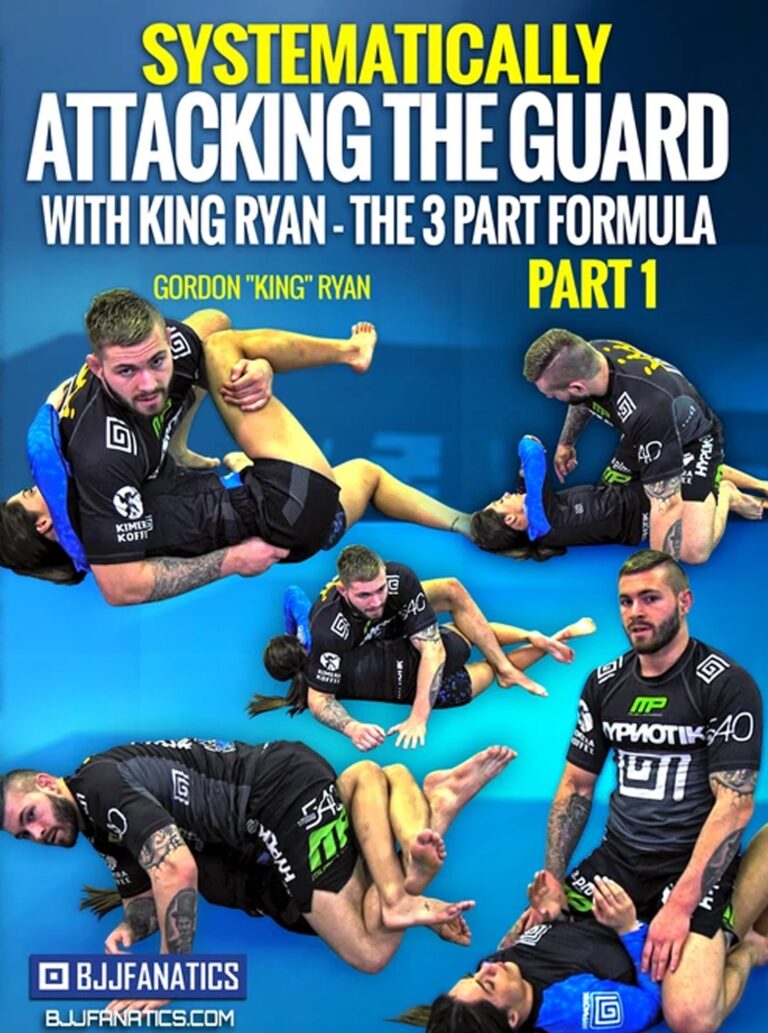 Gordon Ryan’s Systematically Attacking The Guard 1.0 passes the leg-lock guards (ashi garami, X guard, 50/50).
Other guard passing courses to consider
- The Fastest Way: To Become an Effective Guard Passer (John Danaher, 8 volumes, 7 h 31, no-gi, 2024)
For you if: you want the same plan in 7 h 31 instead of 12 hours. It also has passes this course lacks, among them tripod passes, the hand block and the sit-out half guard pass, and it leaves out the closed guard and the floating pass. See it on BJJ Fanatics. Or read our review. - The Body Lock Pass (Lachlan Giles, 6 volumes, 7 h 6 min, no-gi, 2019)
For you if: the body lock is the one pass you want. Four volumes teach the pass in order, about 4 hours against 3 h 26 here, and there is about an hour and a half of narrated rolling, most of it in the last volume. See it on BJJ Fanatics. Or read our review. - Systematically Attacking The Guard 1.0 (Gordon Ryan, 8 volumes, 10 h 18, no-gi, 2019)
For you if: he grabs your legs before you can start. It passes the leg-lock guards (ashi garami, X guard, 50/50) and ends with eight rolls that Gordon Ryan talks you through. See it on BJJ Fanatics. Or read our review. - Passing the Guard: Go Further Faster (John Danaher, 8 volumes, gi, 2020)
For you if: you train in the gi. Danaher’s fundamentals course on passing. See it on BJJ Fanatics. Or read our review.
Want the whole field? See our best guard passing instructionals.
Worth it? The pros and cons
- One plan for all four guards: stand up out of the closed guard, body lock the man who sits up, go round or over the man who lies back, and finish from half guard
- It tells you what to do when the pass stalls, and shows the way into half guard from the toreando, the floating pass and the body lock
- A whole volume on opening the closed guard without a gi, including what to do when he knocks you down
- The finish is taught as its own skill: hips first, head second, shown wrong and then right
- Danaher keeps saying which version his students use most and which is his own favourite, so you know what to learn first
- It is 12 hours and a lot of it is talk: 21 minutes of toreando grips go by before the first toreando pass, and Danaher jokes about it himself. Danaher’s shorter course, The Fastest Way: To Become an Effective Guard Passer, has the same plan in 7 h 31
- Against a man who sits up there is one answer: the body lock, with the tight waist (one arm round his waist, one hand free) next to it. There is no tripod pass family. The Fastest Way has about 40 minutes of tripod and pop-up passes
 No live rounds and no match shown, and the partner lets most of it happen. Lachlan Giles’s The Body Lock Pass has about an hour and a half of narrated rolling
- No chapter on the guards that grab your legs first: single leg X is never mentioned and X guard once. Gordon Ryan’s Systematically Attacking The Guard 1.0 passes ashi garami, X guard and 50/50 in its sixth volume
What’s inside the eight volumes
Eight volumes, all no-gi. The body lock is the biggest block, 3 h 26. Tap a volume for what’s in it.
This route is about an hour and gives you the plan:
- Volume 7 from 0:48, 90 seconds. Danaher’s whole passing plan in one breath.
- Volume 1 from 8:36, 4 minutes. Why your arms lose to his legs.
- Volume 1 from 51:57, 4 minutes. Hips first, head second.
- Volume 2 from 16:16, 3 minutes. Stand up first, posture second.
- Volume 3 from 51:13, 6 minutes. The hip and knee post.
- Volume 4 from 13:30, 7 minutes. Danaher’s favourite finish, the step back knee cut.
- Volume 5 from 0:12, 6 minutes. When to go up the middle.
- Volume 5 from 1:33:30, 11 minutes. Getting one leg over his knee with the body lock.
- Volume 6 from 1:00:57, 5 minutes. The mistake Danaher sees most.
- Volume 7 from 1:02:24, 3 minutes. The two knee positions in half guard.
- Volume 8 from 12:50, 9 minutes. The pass at the top of this page, and the mount after it.
Want a free look first? BJJ Fanatics has three short excerpts from this course on YouTube: the inverted cross grip (Volume 3), front against side body locks (Volume 5) and a floating pass entry into half guard (Volume 7). About six and a half minutes together.
Vol 1 · 1:22:44Why passing is hardthe problem, the J point, hips first, the back
After a six minute voice-over, the problem the whole course answers: your legs are busy holding you up, so your arms end up fighting his legs. Danaher gives four ways out of that: get to the side of his hips, get past his knee, pin his feet near his backside, or put your hands on the mat and use your legs. He names the four guards you have to pass and the three things that put you back in guard: his inside leg, his outside leg and his arms. The part to watch starts at 51:57: hips first, head second, shown wrong and then right (detail 09 is the same lesson from Volume 4). From 59:27 he argues for taking the back when a man turns away (detail 10). The volume ends on his idea that all guard is control between the knees.
Vol 2 · 1:22:10Opening the closed guardstand up first, three ways to open, getting knocked down
No-gi closed guard only. First make yourself safe: break a grip and go straight to both his biceps, every time. Then the idea that sets this volume apart from the gi habit, stand up first and posture second (detail 01), which Danaher argues twice over. There are three ways to open: the reach back (detail 02), two hands on one knee for a man with short legs, and a knee post at his tailbone for when you cannot get upright. The second half is the price of standing: he grabs your ankles and knocks you down. Danaher puts it at 30 to 50% of the time against someone your own level and tells you to get back up. Getting knocked backwards, he says, is a small problem next to being pulled forwards.
Vol 3 · 1:21:11Toreando, part onefootwork, reading him, grips, the hip and knee post
Thirteen and a half minutes of footwork to start: seven kinds of step for moving round a man on his back. Then how to read his feet and knees from the distance where he has to reach for you, and why your hands should touch his legs before his feet touch yours. Twenty-one minutes of grips follow before the first pass, and Danaher knows it. At 51:13 he gets to the point of it all, the hip and knee post, which he calls the king of no-gi toreando positions. The five and a half minutes from there give you the volume. His second position is for a man whose knees are tight to his chest: you run his toes to the mat over his head. The last eighteen minutes are throw-bys (detail 06), one of which ends in a leg drag.
Vol 4 · 1:36:21Toreando, part twofinishing from the side, the spin, side to side, the knee cut
How to finish from the hip and knee post. You run round his legs, away from his arms, and settle over his hips. Detail 09 is the mistake people make there, the head up too early. Then Danaher’s favourite, the step back knee cut (detail 07 is how it ends), and a tighter pin from the same step. When his knees stay glued to his chest, Danaher spins him and passes above his shoulders, with versions that end on his back and in a leg drag. Next comes side to side pressure, with a stepping pattern Danaher says his students use. Then the cross shin pin, what to do when he does tangle one of your legs, and why the toreando and the knee cut work as a pair: the tighter he curls up, the easier it is to get to his side, and the more he opens up, the easier the knee cut. Most moves are shown two to four times from new angles.
Vol 5 · 1:50:58The floating pass, then the body lock38 minutes of float, 1 h 13 of body lock theory and entries
Two subjects. The first 38 minutes are the floating pass for the man who will not give you his side (detail 08): the start position, then a family of ways to work your foot or knee past his. The cross knee version is Danaher’s favourite. From 37:57 the body lock: why it works on a man who sits up, the lock from the front against the lock from the side, how to make the gap at his waist (detail 03), where your head goes, three ways to join your hands and a fourth for sore wrists, which Danaher has. Then the two ways over his knee: make his knee lower or your hip higher. The volume ends with the step over method, which Danaher says covers more than 80% of cases (detail 04 is from this part), and the knee drive.
Vol 6 · 2:13:26Body lock passesthe back leg, the most common mistake, tight waist, the lock from the side
The longest volume. The front lock first: the double shin, the leg scissor (the one Danaher says his students use most), the shoelace, a knee cut for when you cannot get over his knee, the kick out, and the high hip scissor. The kick out is for when he tries to lift you with the hook he has left: you keep your hands locked, hop, and land flat. Danaher’s line for it is “trust in your body lock”. Then a step straight over into mount, and at 1:00:57 the mistake he sees most (detail 05). His own favourite follows, a low lock switched to a high one behind the neck. Then the tight waist, which Danaher says Georges St-Pierre passed with in MMA, and the lock from the side, which he rates as the best one and the hardest to get. About eight minutes have almost no talking, and there are a lot of repeats.
Vol 7 · 1:15:43Half guard, part onewhy, the knee shield, five ways in, the start position
If you watch one volume, watch this one. In the first two minutes Danaher gives his whole passing plan, and from 2:17 the three reasons half guard sits at the end of it: his legs can only pull, you can hold his head before you pass, and you control his hips and his shoulders at once. Two answers to the knee shield follow (detail 13 is the second). Then five ways to drop into half guard from the earlier passes (details 11 and 12), a start position that takes away his three main escapes, and the two knee positions Danaher calls 95% of a pass. The four steps that sum it up are said three times.
Vol 8 · 1:00:44Half guard, part twofive grips, the power prop, half butterfly
The tightest volume. Five ways to hold him while you free your leg: top head and arm, the head block for when he stops your crossface, double underhooks (the pass at the top of this page is from this chapter, and a walk into mount follows it), the plain crossface that Danaher says he uses most himself, and a half arm triangle. Then what to do when he props up on an elbow with an underhook, and four passes for the half butterfly, where the problem is your balance more than getting your leg out. The course stops there, without a closing summary.

BJJMore earns a commission if you buy through these links, at no extra cost to you. Reviewed on all eight volumes.
Get the next review like this one
New reviews in this format land in your inbox, with the details on video. You also get the free BJJMore email course and the instructional-platform discounts I use myself (worth $46).
FAQ
Is Danaher’s New Wave No Gi Guard Passing worth it?
Yes, if your partner’s legs keep pushing you off or you keep landing back in guard, and you have the patience for 12 hours of it. You get a way past each of four guards, and a place to go when the pass stalls. It has no live rounds, and Danaher’s shorter course covers much of the same ground. On r/bjj, u/GZ_Omega33 (April 20, 2026), a black belt by his own account, wrote: “Haven’t been through ‘The Fastest Way’, but ‘New Wave’ is the best instructional I have ever watched and it completely changed my game.”
New Wave Guard Passing or The Fastest Way?
Same teacher, same no-gi plan, and both finish in half guard. This one is 12 hours and goes deeper: about three times the body lock, plus the closed guard and the floating pass. The Fastest Way: To Become an Effective Guard Passer is 7 h 31 and adds tripod passes, the hand block and the sit-out half guard pass. On r/bjj, u/TofuManGC8 (April 2024): “They’re both good. Just depends on how much detail you want, what style of Torreando, and whether or not you want to listen to Danaher longer than you have to.” You do not need both. Short on time: The Fastest Way. Want the body lock and the closed guard: this one.
Is it good for beginners?
It is not built as a beginner’s course. Volume 1 is concepts, and guards like de la Riva, ashi garami and 50/50 are named, not explained. But the plan itself is simple, and Danaher keeps telling you which version his students use most. If you know which guard you get stuck in, start with that guard under “Get past his legs” above.
Does it work in the gi?
The ideas do: get to the side of his hips, hips first and head second, and half guard, which Danaher calls the best single way to pass with or without a gi. The grips do not. The toreando here is built on grips that last a second, and in closed guard Danaher teaches the opposite of the gi habit. For the gi, his course is Passing the Guard: Go Further Faster.
Does it cover leg drags and the knee shield?
Yes, both, though you will read otherwise. There are two leg drag chapters, in Volume 3 from 1:17:29 and in Volume 4 from 51:08, about eleven minutes together. Volume 7 has two answers to the knee shield in half guard, seventeen minutes. What is missing is a knee shield chapter for the open guard.
Danaher or Gordon Ryan for passing?
Danaher gives you one plan: four guards and a way past each. Gordon Ryan’s Systematically Attacking The Guard 1.0 goes guard by guard, passes the leg-lock guards this course has no chapter on, and ends with eight rolls. On r/bjj, u/HalfButterfreeGuard (December 26, 2023): “Get New Wave NoGi for an overview, then when you’re getting it and would like to zoom in on an area, get one of Gordon’s new passing instructional.”
It is 12 hours. Where do I start?
On r/bjj, u/mess_of_limbs (April 2024) summed up the length: “All that content just for ‘get past the dangerous legs’…” Fair. I’ve watched a lot of Danaher’s courses, and you do not have to watch this one front to back. Start with the first two minutes of Volume 7, where he gives the whole plan. Then the one-hour route under What’s inside. Then the volume for the guard you get stuck in.
Is this the New Wave half guard course?
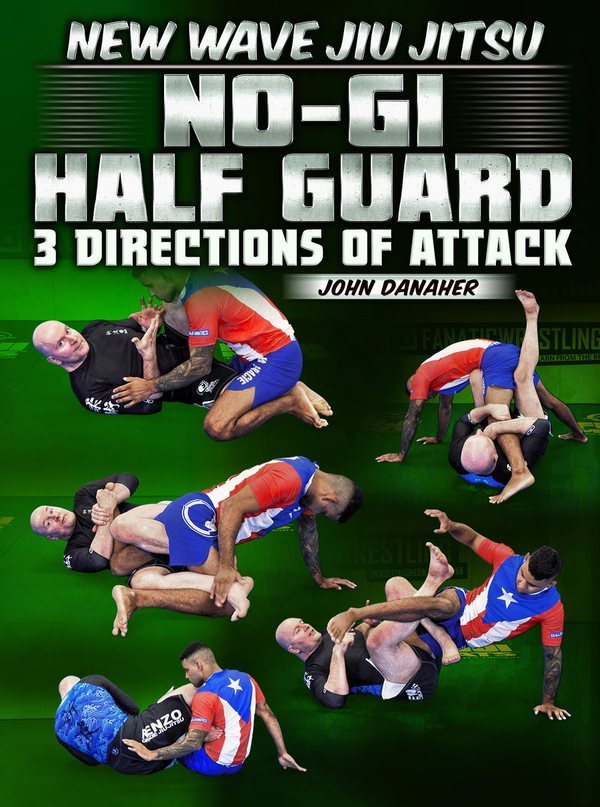 No. Volumes 7 and 8 here are about passing his half guard from the top. Danaher’s course on playing half guard from the bottom is a different one: New Wave Jiu Jitsu: No Gi Half Guard 3 Directions of Attack.
Is there a discount code?
We have not been able to test a code on this course yet, so we do not list one. BJJ Fanatics runs sales and discount codes often, so check the price on the day you buy.
Stop fighting his legs with your arms
If your partner’s legs keep pushing you off, or you get past them and land straight back in guard, this course gives you a way past each guard and a place to finish when the pass stalls. No-gi, and it takes patience.