
Home / Reviews / Guillotine / Drill For Skill: Guillotines Review
Drill For Skill: Guillotines Review (Placido Santos)
Buy it if you get to the front headlock all the time and never finish the guillotine: threaten his back first, then take the neck as he turns to face you.
See today’s price on BJJ Fanatics →
Drill For Skill: Guillotines is Placido Santos’ no-gi guillotine course. Six studio volumes teach the high wrist grip (his words: “essentially a rear naked from the front”, Vol 1 · 24:55), when to go for it and how to finish it; five more are his own classes, with the drills and the sparring rounds he uses to train it.
The fix is when you go for it
You snap him down and you have his head.
Go for the choke right away and he shells up: the chance is gone. Placido takes his hand off the head instead: “First, make them think you want to get behind them. As he turns to face, then you get what you really wanted, which is your guillotine.” (Vol 7 · 23:25) The drills make that catch automatic, and the finish comes from your legs.
$197 at list, $88.65 with the Black Friday code BLACKFRIDAY2026 (tested at checkout on November 23, 2026). More than half of the 8 h 33 is recorded classes, it is no-gi only, and if you learned the high wrist from Danaher, the grip won’t be new, as Placido says himself.
12 details that are worth the money
The rule Placido keeps coming back to: “The most dangerous attack will always be the one that you don’t see coming.” (Vol 4 · 5:49)
Here is what that means on the mat, sorted by where you are in the exchange, not by volume. First you have his head, then the choke is on, then he tries to get out. The last two stops are for when you are not at his head yet.
Count how many of these you already do.
- 1You have his head and he knows itthreaten his back (Vol 1, Vol 7)
- 2He turns back to face youthe catch (Vol 1)
- 3He breaks your anaconda openthe same opening (Vol 3)
- 4The grip is onlegs and head (Vol 1)
- 5He rolls out or steps over your kneestay on the neck (Vol 2)
- 6You are sitting in front of himget above his head (Vol 4, Vol 7)
- 7His hands won’t come down to the matthe snap, and two fixes (Vol 5, Vol 8, Vol 11)
The moment you hold his head, he guards his neck.
You are in front of him, and the head is where everyone is most alert. So Placido takes his hand off the head and goes for the back. It only counts as a threat if your weight is on him.
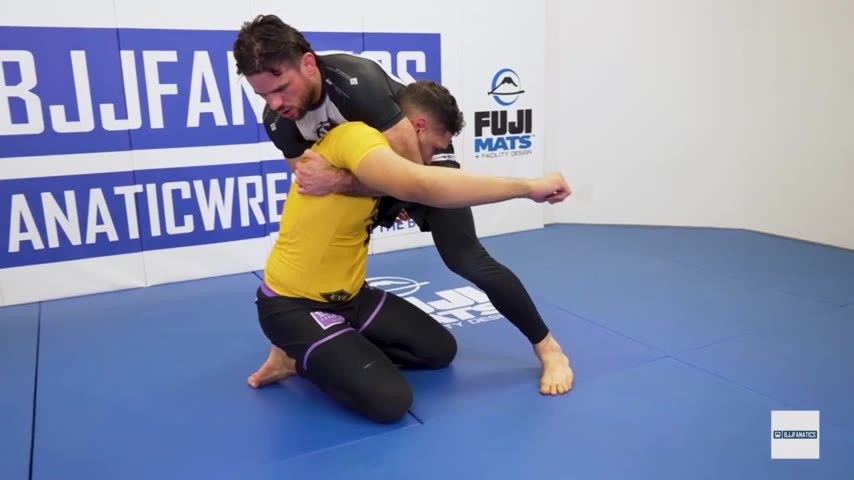
01 Go-behind on the turtle: knees off the mat
With your knees down, your weight rests on the mat. Up on your toes it rests on him. Placido calls the first a very classic beginner mistake: “Knees on the mat means my weight’s on the mat.” The red and green labels mark the wrong way, then the right one.
Vol 7 · 14:13If he stays put, you are behind him, and that is a good result too.
To face you again he has to step up and pull his elbow back, and he can’t pull that elbow back and cover his neck at the same time. Placido: “One has to give.” (Vol 1 · 38:09) That pull is your cue.
The drill at the top of the page trains this half second.
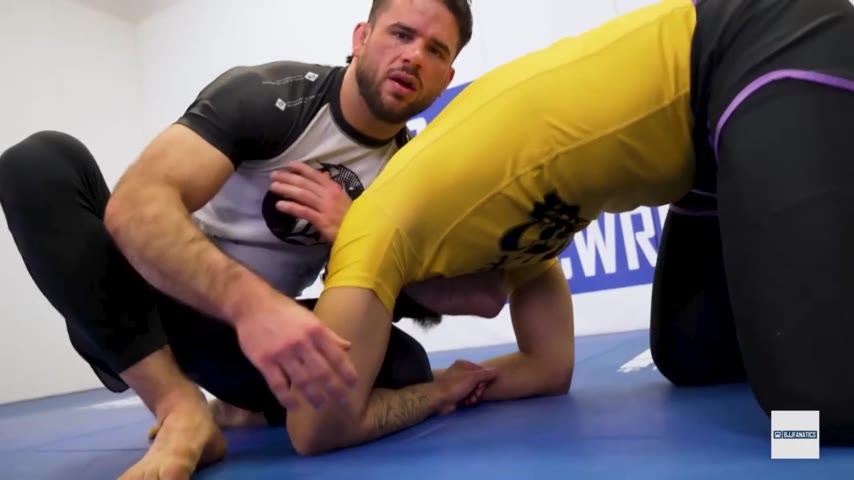
02 Assist hand: thread it in under his armpit
Your second hand goes in under his near armpit and closes under his chest, out of view. Placido: going behind the armpit, “I control the head and a shoulder at the same time” (Vol 1 · 25:46).
Vol 1 · 26:36The threat does not have to be his back.
Roll him over with the Olympic roll and he has an anaconda to deal with. To break it he pulls his elbow back between yours, and that is the opening of stop 2 again: elbow back, neck free. Placido: “As he breaks the lock, I shoot my hand into a high wrist and I shoot my ear to his back” (Vol 3 · 20:59).
Below: the roll that starts it, and how his legs swing through while the anaconda is still locked.
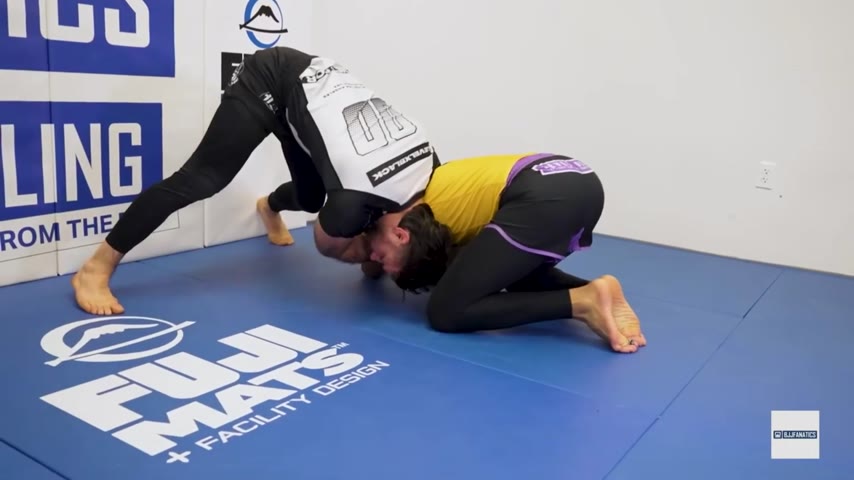
03 Olympic roll: walk your hips to his, then turn belly up
With your head in the hole, don’t try to turn him from there. Walk your hips round to his first, then turn belly up: he goes over you and his head stays wrapped. Placido: “now my belly button faces the ceiling and that turns anybody and everybody”.
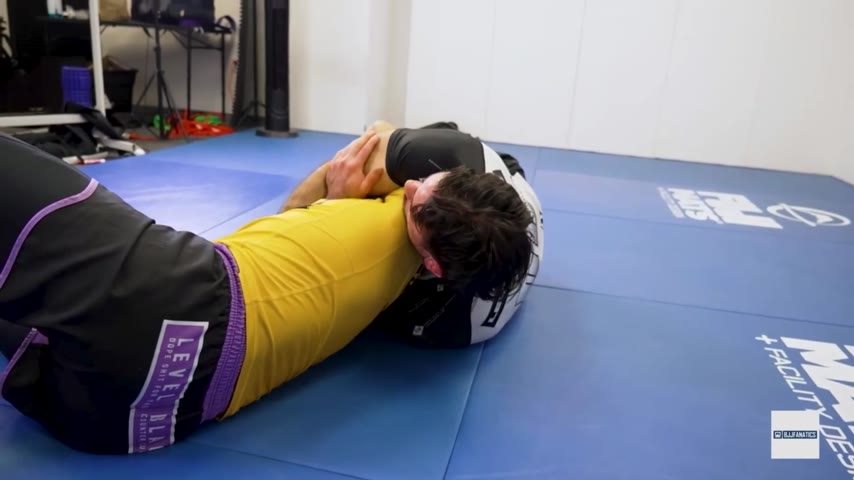
Vol 3 · 15:2204 Swing your legs through, keep his head locked tight
Placido’s cue: “Do you see my left ear? It connects to the back of his neck.”
Vol 3 · 23:02Now the choke has to come from the strongest part of your body, and that is not your arms.
Placido connects his legs to the man first. Closed guard is his strongest option because it brings your hips closest to his; a shin on his hip or a half guard also do the job. And the head stays down the whole time.
05 Connect your hips: light leg, then touch, sit, lock
Shift your weight onto one leg so the other goes light, step it in front of his thighs, then sit and lock your guard with his neck still wrapped. “With that light left leg, I touch, sit, and lock.”
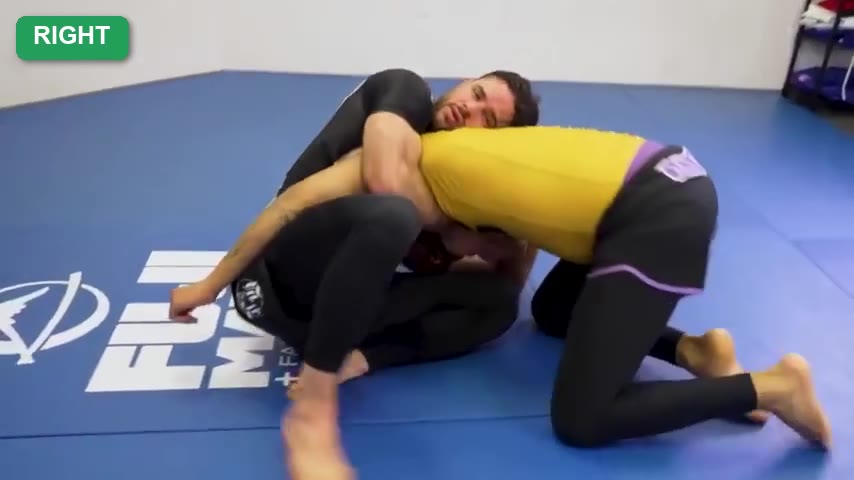
Vol 1 · 47:3106 Finishing: head low, ear on his back
Placido calls this one of the biggest mistakes he sees: you chase hip extension, your head goes back and away, and the hole around his neck gets bigger. “High hands, low head.” Keep your ear on his back as you sit and roll. The red and green labels mark the wrong way, then the right one.
Vol 1 · 52:12A good opponent knows the choke is over once your legs connect.
So his escapes all keep his hips away from yours. Placido covers three, and two are below. When he steps over your knee and you feel it early, put a hand on the mat and get up (Vol 2 · 6:26); detail 08 is the late answer. The third is the four-point: he lifts his hips and pulls his head back and out, and Placido hooks both his legs and pushes him down onto his seat (Vol 2 · 9:36).
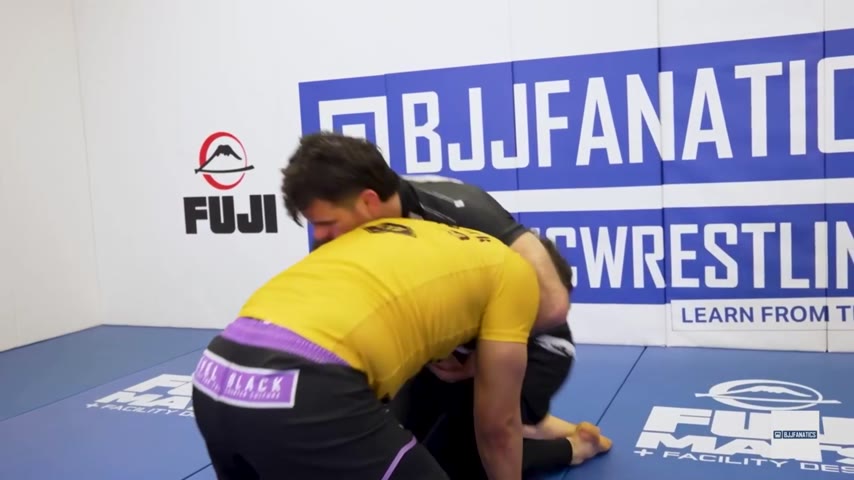
07 He rolls through: roll with him, ear on his back
Hold on while he rolls and you are fighting the whole momentum of his hips. Chase him and you are chasing where his hips were. Placido rolls with him, to “where the hips will be”, and both come up on their knees with the front headlock still on.
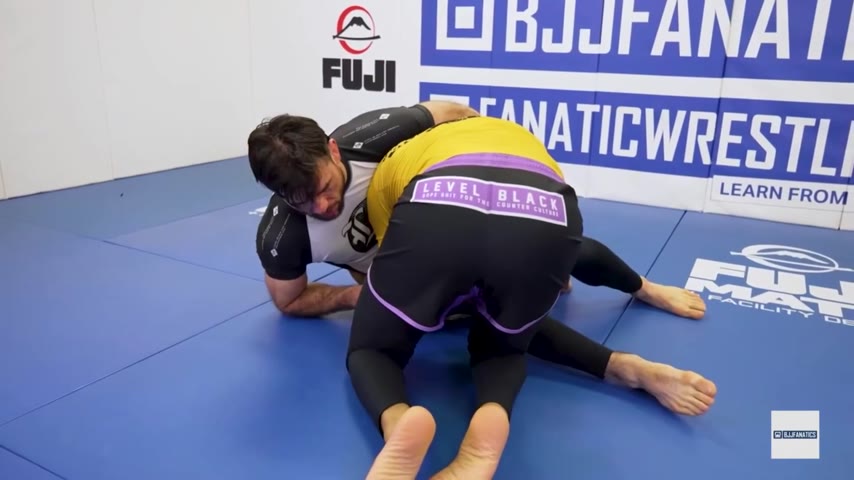
Vol 2 · 5:0408 Late knee-hurdle counter: shoulder down, roll through, come up on top
He has stepped over your knee, so your legs can’t reach him any more. Shoulder to the mat, roll through, “and I come up on top”, back in the front headlock.
Vol 2 · 7:59From your seat you can’t reach his head: your shoulders have to get above it first.
Placido gives three ways up: get outside his elbows, lift him, or knock him back. The knock-back is below: hand on his throat, drive him back to a hip. In class he sets it up off a two-on-one the man pulls against, and when the man comes back up, Placido snaps him down (Vol 7 · 21:44 to 22:55).
Then you are at stop 1 again, and Placido tells his class to skip the temptation of going straight for the neck (Vol 7 · 24:06). Threaten his back first.
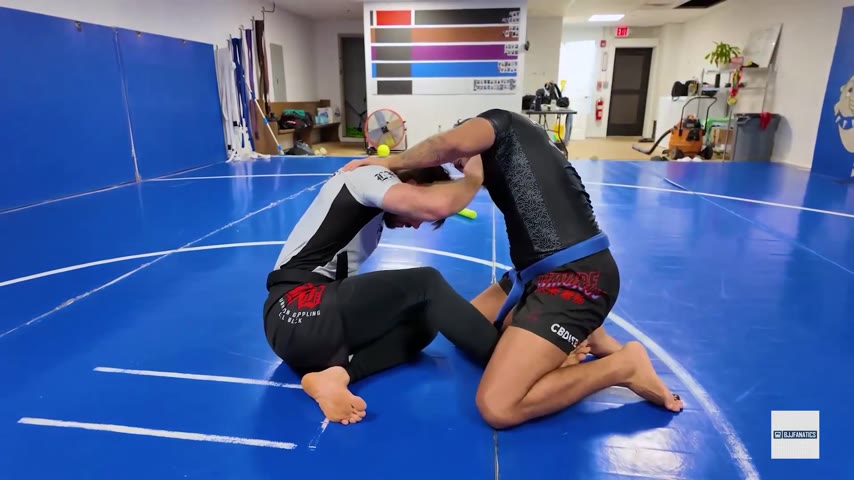
09 Seated throat post: drive him back to a hip
One hand on the front of his neck, the other on the mat, one foot under you, then drive: he goes back to a hip. “It’s a very strong grip, the throat post, okay?”
Vol 7 · 22:38Stop 6 ended with a snap down. This stop is the snap itself, and what to do when it fails.
On the feet Placido does not try to finish the choke: the man’s hips are free there, and a good one gets out (Vol 5 · 0:30). The job is to get his hands on the mat and take the fight down there. One thing matters most for the snap: make him push back into you.
In his last class he drills this against a man with one knee down and one foot up (Vol 11 · 7:29); details 10 and 12 come from that class. Details 11 and 12 are for when the first snap fails. Once his hands are on the mat and you are above his head, you are at stop 1 again.
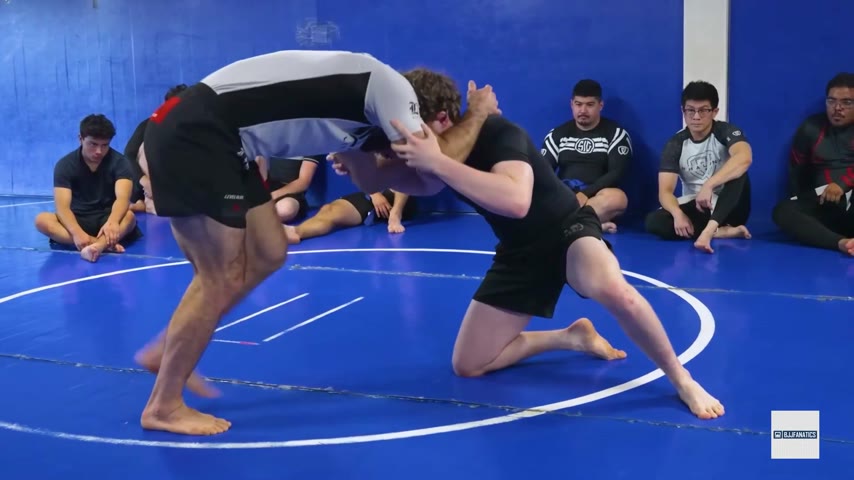
10 Forehead on his collarbone, lean, then snap down and away
Lean your forehead into his collarbone and his foot has to go back to hold you up. That leaves him no base in front. Then step out, step back and snap him down and away: his hands hit the mat.
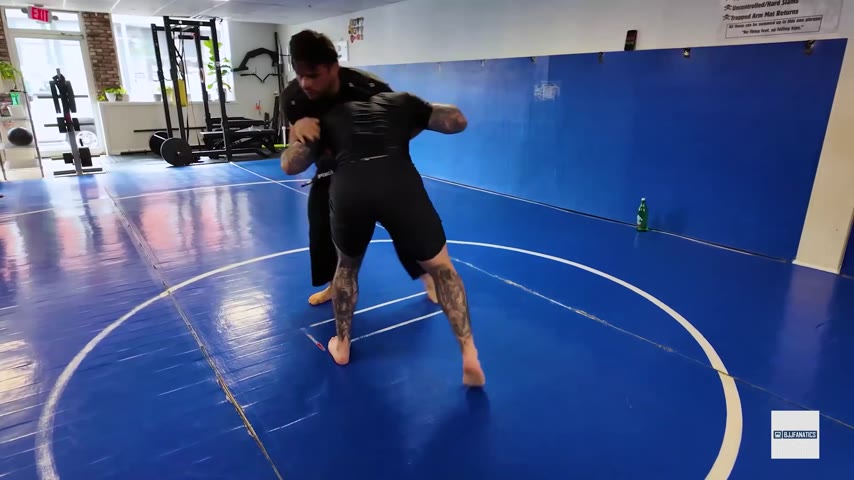
Vol 11 · 8:3311 Two-stage snap: no hands on the mat? Circle and drop your knee
The snap did not bring his hands down. Keep the head, circle, and let your knee drop to the mat, so your body weight brings him down. “I circle and my knee just hits the mat.”
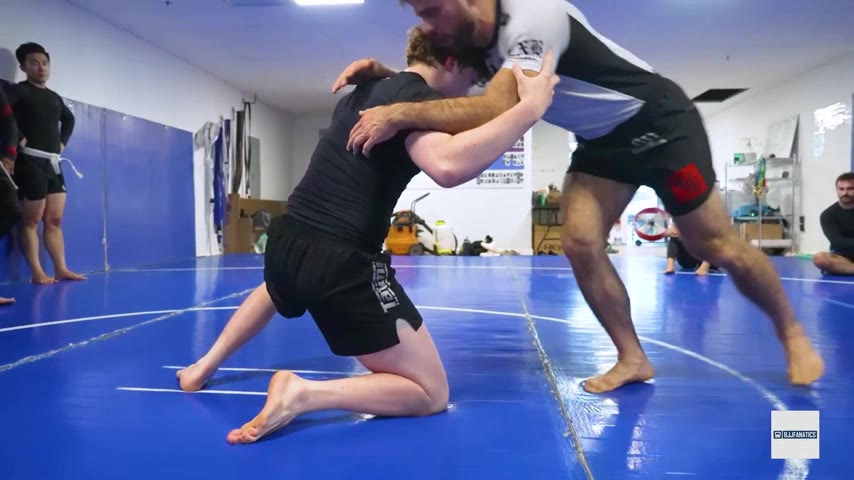
Vol 8 · 35:3912 Ankle pick, then the guillotine as he comes back up
He steps his base leg forward, and now you are snapping into his base. Drop your hand to that ankle and put him down. He won’t stay there: “as he comes back up into me, that’s when I get my guillotine”.
Vol 11 · 21:39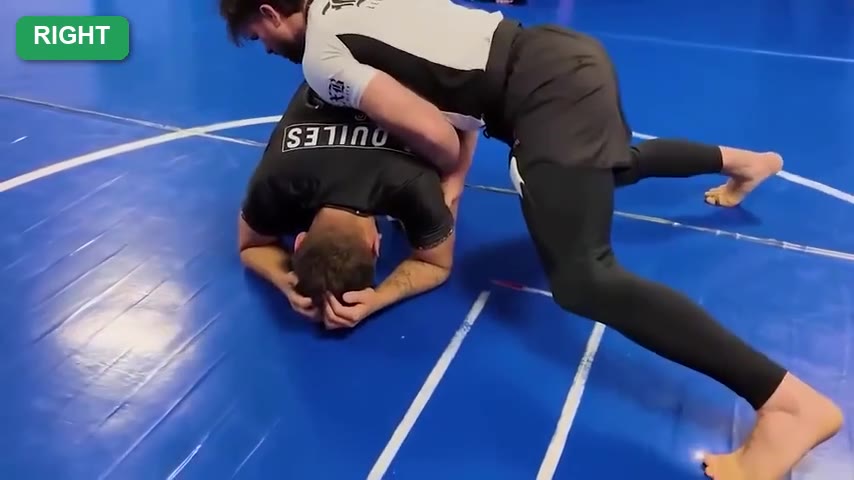 01
 02
 03
 04
 05
 06
 07
 08
 09
 10
 11
 12
How many of these details do you do?
Count the ones you do in a live round, not only in drilling. If most are new to you, this course will change what you do once you have his head.
- No-gi
- 11 volumes, 8 h 33
- 55 studio chapters
- 5 recorded classes
- 3 h 47 of technique, 4 h 46 of classes
- Released July 2026
Who should buy Drill For Skill: Guillotines
Find yourself in a bucket, one reason each.
- You get the head and lose the chokeThe whole course is about that moment: when to go for it, and how to hide it until then.
- You wrestle up or snap people downThe seated and standing volumes end where the choke starts, with his hands on the mat and you above his head.
- You coachFive full classes show the drills and the sparring rounds, down to how a round is scored.
- You already know Danaher’s high wristThe grip won’t be new to you, as Placido says himself. He thinks the drill may be, and the five classes are his own.
- Newer grapplerVols 1 to 6 work for you. The class drills assume you already know a few go-behinds and breakdowns.
- Gi playerNo-gi throughout: no lapel or collar grips.
- You want a short courseMore than half of the 8 h 33 is recorded classes. The technique alone is 3 h 47.
What you need before the classes make sense
He says it himself in the fourth class (Vol 10 · 35:24): he would not give that drill to someone who knows no go-behinds or breakdowns yet. The studio volumes teach several of each. And bring a partner who gives you real reactions: the flow drills of Vol 6 are built on feeling his defence and answering it.
Worth it?
- One idea that changes when you attack: threaten his back, then take the neck when he pulls his elbow back to face you (detail 01 and detail 02)
- A drill for the catch itself, so your arm knows the way before the chance comes (the clip at the top)
- The finish is taught as legs and head position, with the mistake that loosens it shown next to the fix (detail 05 and detail 06)
- An answer for each of three common escapes: the roll through, the knee hurdle and the four-point (detail 07 and detail 08)
- Seated and standing lead to the same place: his hands on the mat, you above his head (details 09 to 12)
- Five full classes show how to train it, with sparring rounds where getting behind him counts too, so the man underneath has to move
- He gets to the point: 55 studio chapters in 3 h 47, about four minutes each. Buyers call it short and practical, and people said the same about his first course
- Placido drilled the high wrist after Danaher showed it to him, and says so: if you already know it from Danaher, the grip won’t be new (Vol 1 · 17:06)
- 4 h 46 of the 8 h 33 is classes, filmed handheld and wide. He talks about 60% of that time, the rest is mostly students drilling and sparring, and small details (a knee, a hand) are hard to see there
- No standing finish: on the feet the course is about getting his hands to the mat, and the choke is finished on the ground. Placido’s reason is that the man’s hips are free there (Vol 5 · 0:30)
- It teaches the guillotine you set up. The one you catch on his shot gets a six-minute talk in Vol 2 and one drill in the last class
- No-gi only: no lapel or collar grips
Does he use it himself? At the 2021 ADCC North American Trial, Placido beat Mahmoud Jabr by submission, and Drew Darce’s breakdown of that finish shows a high wrist guillotine.
What buyers say: Henry says it helped him “understand and also hit guillotines”, and Simo P. says that even if you have Danaher’s, it is “a more than decent supplement”.
What five buyers say
“I have over 90 fanatics videos and this ranks at or near the top.” Trent G., BJJ Fanatics buyer, Sep 2026
“Helped me to understand and also hit guillotines.” Henry, BJJ Fanatics buyer, Sep 2026
“short, concise, and practical” Zack G., BJJ Fanatics buyer, Aug 2026
“even if you have John’s instructionals, it is a more than decent supplement to them.” Simo P., BJJ Fanatics buyer, Aug 2026
“I really only have Lachlan’s no gi chokes. And have seen Danaher’s front headlock. If you have those, this is still very much worth getting.” Sovann P., BJJ Fanatics buyer, Sep 2026
All eleven volumes, the five classes included. Black Friday code BLACKFRIDAY2026
What’s inside
Vols 1 to 6 are studio volumes with one partner at a time: the grip, the finish and the escapes first, then the ways to his head from your knees, seated and standing, then six flow drills. Vols 7 to 11 are five of his classes, one topic each, filmed in his gym.
- Technique volumes, studio (3 h 47)
- Skill Sessions: five recorded classes (4 h 46)
The order is his. Kneeling comes first because, in his words, “Kneeling is in my opinion the position from where you’re going to get the most guillotines from” (Vol 3 · 0:30). Seated and standing come after it because they lead there.
The eleven volumes
Tap a volume for its chapters. The times are volume times, so you can jump straight to the part you want to rewatch.
Vol 1 · 52:28The grip, the catch and the finishHow to use the course and why the guillotine is hard to get, then the drills: the high wrist catch, a relaxed arm, a hollow chest, the second hand, and the low wrist for people whose shoulder won’t reach the high one. Two drills already carry the idea of the whole course: the catch off a go-behind, and the catch as he builds up from under you. The last chapter is the finish with your legs and your head.
How to use the course (0:00), the map and compass (2:01), the power of rewind (6:58), the challenge with guillotines (8:59), uchikomi (13:37), the high wrist (16:05, the clip at the top), the relaxed arm (19:49), the hollow chest (22:34), the assist hand (24:24, detail 02), the low wrist (27:14), over under (32:53), the hand block go-behind (35:17), attack the build (40:18), leg and head positioning (44:45, detail 05 and detail 06).
Vol 2 · 17:35When he escapesThree escapes that all keep his hips away from yours, and an answer to each: the roll through, the knee hurdle and the four-point. It ends with a talk on the guillotines you catch off his attack, which Placido says he does not teach scene by scene here.
Assumptions (0:00), the roll through (1:55, detail 07), the knee hurdle (5:16, detail 08), the four-point (8:16), reactive guillotines (11:52).
Vol 3 · 38:41From your knees: threats that open his neckThis is where Placido expects most of your guillotines to come from. One go-behind, then two in a row, then breakdowns and chokes as the threat: the knee tap, the Olympic roll, the anaconda, the darce, a quarter nelson and the cow catcher. Each one ends the same way: he recovers, and the high wrist goes in as he does.
Layers of movement (0:00), chaining go-behinds (3:18), doubling up (6:41), the knee tap (8:28), the Olympic roll (13:19, detail 03), chaining the anaconda (17:01, detail 04), chaining the darce (23:37), the quarter nelson breakdown (29:22), the cow catcher and roll through dilemma (32:56).
Vol 4 · 51:53Seated: getting above his headFrom your seat the goal is your knees, with your shoulders above his head. Placido names three ways: lift him, break him down, get outside his elbows. The shove at 12:30 is the studio cousin of detail 09: a post on his throat, then drive.
Goals of the seated section (0:00), the most dangerous attack (5:35), heisting mechanics (8:26), the simplest setup (12:30), reverse X (20:26), sumi gaeshi (28:50), yoko sumi gaeshi (34:20), the thigh whizzer (39:21), elbows flanking (45:28).
Vol 5 · 42:14Standing: his hands to the matPlacido says standing guillotines are rare, and why: the man’s hips are free. So this volume is snap downs. First the conditions (his back at 45 degrees or lower, his stance square, his weight pushing into you), then loose hands, so the snap is a snap and not a pull. Then the snaps themselves.
The purpose of the section (0:00), finding the conditions (1:28), a snappy snap down (5:26), straight snaps (9:38), cross snaps (13:53), football snaps (16:29), pass-off snaps (20:13), double pits (24:34), the underhook snap (27:37), the whizzer shuck (33:18), uchi mata (36:16).
Vol 6 · 24:30Flow drillsSix chains with a partner who defends for real. The drills of Vol 1 train your arm. These train the decision: you act, he defends, you answer.
Why flow drills (0:00), underhook snap (2:15), whizzer (5:20), knee tap and roll through (7:41), anaconda and heist (12:41), four-point and arm drag (16:27), sumi gaeshi (20:29).
Vol 7 · 1:00:21Class 1: seatedHis first class: the drills, three ways up from seated guard, then sparring from the lift.
One chapter, 1 h 00. The class opens with the high wrist drill and the go-behind drill (detail 01 is at 14:13), then three ways up from seated guard: the throat post (detail 09), getting outside his elbows, and the lift. It ends with sparring rounds that start from the lift, where a submission, a sweep or a go-behind wins.
Vol 8 · 1:05:06Class 2: snap downsA class on snap downs, from posture to the two-stage snap.
One chapter, 1 h 05. Posture and stance, the lean drill, snap to one side and go behind on the other, the knee tap, pulling his head to the side of yours, and the two-stage snap (detail 11). Then rounds that start the moment his hands touch the mat.
Vol 9 · 49:34Class 3: kneelingA class from the knees: a roll to the high wrist, the go-behind as your default, sparring to five points.
One chapter, 49 minutes. The high wrist drill, a roll to the high wrist, the go-behind as your default, a te guruma breakdown, then sparring to five points.
Vol 10 · 50:14Class 4: standingA class on the feet: the underhook snap, uchi mata, and the finish once more.
One chapter, 50 minutes. The underhook snap, uchi mata to get him down, a drill where you pick your own go-behind and breakdown, then the finish once more: ear on his back, legs connected.
Vol 11 · 1:00:21Class 5: putting it togetherThe last class puts it together, down to the guillotine on his shot.
One chapter, 1 h 00. The centerline shift, the forehead lean (detail 10), snap and go-behind as one move, the ankle pick (detail 12), a double leg when he postures up, the guillotine on his shot, and two sparring formats played to five points. BJJ Fanatics also lists a short closing chapter, You Must Be Born Again, after the class; it is not in the 8 h 33.
None of it is free on YouTube
None of the volumes is cut up for free on YouTube. Three free videos of Placido show how he teaches, and none of them is the course.
The three free videos worth watching first
1. “Simple BJJ Concept For Better Guillotine Success With Placido Santos”
Giancarlo Bodoni’s channel, January 2022, 8 minutes: the guillotine idea years before the course.

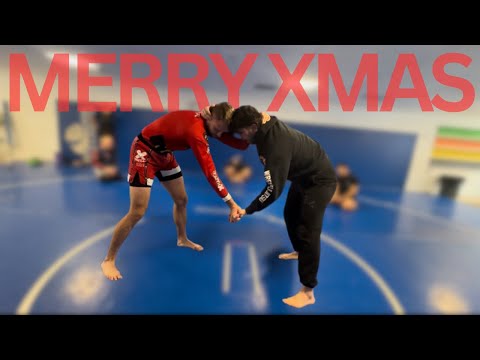
2. “Jiu Jitsu Snap Downs – FULL 5 Stones Jiu Jitsu Christmas Eve Class”
Placido’s own channel, 26 minutes: a full snap down class, close to what Vol 8 does.
3. “3 Counter Takedowns Against a Front Head Lock”
Placido’s own channel, 6 minutes: the other side of the position.

Compare to
Four front headlock and guillotine courses, and where Placido’s fits next to them. More guillotine courses are in the best guillotine instructionals.
- The Front Headlock System (John Danaher, Enter The System): The whole front headlock, from the coach who showed Placido the high wrist: control, go-behinds and every choke from there. Get it for the position. Get Placido’s for the moment the guillotine goes in. See it on BJJ Fanatics.
- Systematically Attacking The Guillotine (Gordon Ryan): A guillotine system from guard, top and the transitions. More positions, less drilling: a library next to Placido’s training plan. See it on BJJ Fanatics.
- The Anti-Wrestling Equation (Craig Jones): What to do when people turtle or come back up on you, front headlock included. It teaches the high wrist too, as one of several front headlock chokes, with Placido as Craig’s partner on screen. Craig’s is the wider wrestle-up course; for the guillotine itself, one grappler who knows both now prefers Placido’s. See it on BJJ Fanatics. Or read our review.
- Front Head Lock (Kaynan Duarte): The front headlock as a whole system: guillotine, darce, anaconda, back takes and crucifix. Wider; Placido’s goes deeper on the guillotine alone. Read our review.


Get the next review like this one
New reviews in this format land in your inbox, with the timestamps and clips. You also get the free BJJMore email course and the instructional discounts I find.

BJJMore earns a commission if you buy through these links, at no extra cost to you. Released by BJJ Fanatics in July 2026; reviewed on all eleven volumes.
FAQ
Is Placido Santos’ Drill For Skill: Guillotines worth it?
Yes with the code, if you train no-gi and you reach the front headlock without finishing. It teaches when to go for the guillotine and gives you the drills to make the catch automatic. On November 23, 2026 the code BLACKFRIDAY2026 took 55% off at checkout: $88.65 instead of $197, about $11 per hour of the course. At the $197 list it is $23 an hour.
Is it the same as Danaher’s guillotine material?
Partly. Danaher showed Placido the high wrist when they filmed Danaher’s guillotine course, and Placido says that if you watched it, the high wrist “won’t necessarily be new information for you, but the drill itself may not be one that you have thought of doing before” (Vol 1 · 17:06). He also credits Danaher for the line the course is built on, that the most dangerous attack is the one you don’t see coming (Vol 4 · 5:55). The second half is Placido’s own: five of his classes, with his drills and his sparring rounds.
How long is Drill For Skill: Guillotines?
8 hours 33 minutes over 11 volumes. Vols 1 to 6 are 3 hours 47 minutes of studio technique in 55 short chapters; Vols 7 to 11 are five recorded classes of 50 to 65 minutes each, 4 hours 46 minutes in all.
What are the Skill Sessions?
Vols 7 to 11 are five of Placido’s classes, filmed with a handheld camera: seated, snap downs, kneeling, standing, and one that puts it all together. Most classes drill the catch, show two or three ways to the head on a partner, then end in sparring rounds where getting behind the man or putting him down counts as well as a submission. About 60% of that time he is talking; the rest is drilling and sparring.
Is it gi or no-gi?
No-gi. Every grip in the course is a no-gi grip. Gi players still get the idea, the head position and the finish, not the grips.
Is it good for beginners?
The studio volumes, yes: short scenes, one idea at a time. The classes less so: Placido says a drill like the one in his fourth class assumes you already know some go-behinds and breakdowns (Vol 10 · 35:24).
High wrist or low wrist guillotine: which does it teach?
Both, with the high wrist as the main grip. He calls it “essentially a rear naked from the front” (Vol 1 · 24:55). The low wrist gets its own chapter (Vol 1 · 27:14) for people whose shoulder won’t reach the high wrist, and he says you can swap it in anywhere in the course.
Does it teach the darce and the anaconda too?
As threats that open the guillotine, yes: chaining the anaconda (Vol 3 · 17:01) and chaining the darce (Vol 3 · 23:37). When he defends one of them his elbow moves away, and the neck is open. If you want the darce as a system of its own, see arm-in guillotine vs darce.
Is there a free version?
No. None of the volumes is cut up for free on YouTube. Three free videos of Placido cover related ideas (a guillotine concept with Giancarlo Bodoni, a full snap down class, counters to the front headlock), but none of them is the course. Free uploads of the volumes are pirated copies.
Who is Placido Santos?
A no-gi grappler who has done jiu jitsu for about 12 years (Vol 9 · 5:29) and teaches his own classes, five of which are in this course. Many buyers know him as John Danaher’s training partner on camera; he filmed Danaher’s guillotine course with him. This is his second course on BJJ Fanatics, after one on pin escapes in April 2026; a third, on armdrags from guard, followed in October 2026.
Threaten his back, take his neck
If you get to the front headlock and the guillotine never lands, the missing piece is probably not your squeeze. It is the moment you choose. This course gives you that moment, a drill for the catch, and five classes that show how to train it. Get it with the code, not at list.
The Black Friday code BLACKFRIDAY2026 took 55% off at checkout on November 23, 2026: $88.65 instead of $197. BJJ Fanatics rotates these codes.