
Home / Reviews / John Danaher / New Wave Closed Guard Review
John Danaher New Wave Closed Guard Review
Buy it if your no-gi closed guard is just holding on: a plan to break him down, attack from his side, and go after his legs when he stands up.
See New Wave Closed Guard on BJJ Fanatics →No-gi course. Who should buy it ↓
- No-gi
- 8 volumes, 9 h 34 min
- 3 steps, 1 plan
- No live rounds
New Wave Jiu Jitsu: Closed Guard is John Danaher’s no-gi closed guard course, from July 2022. It builds everything in closed guard around one fight.
Yes, if your no-gi closed guard is just holding on
You close your guard and nothing happens. Your partner puts his hands on you, sits up, stands, and opens it. Danaher: “Every battle from closed guard is essentially a battle for posture.” (Vol 7 · 39:00) Win it and you attack from his side, where each defence hands you the next move. Lose it and he has left his legs behind: you knock him down or go after them.
$197 list; the code BLACKFRIDAY2026 took 55% off on November 23, 2026, which makes it $88.65. No-gi, nine and a half hours, no live rounds, and Danaher takes his time.
See New Wave Closed Guard on BJJ Fanatics →Break him down, get to his side, go after his legs
Danaher sums up the whole course in three steps: break his posture, get to a dominant position, and when he wins the posture fight anyway, go after his legs. It is the one fight from the verdict, in order. Out to his side is the most dominant position he teaches, so that is our name for step two, and when your partner will not give you his side there are attacks for that too.
Below is what your partner does along the way, and what you do next, with a plan for short legs at the end. Tick the ones you already do in a roll.
This is where a closed guard stalls, and where Danaher’s first step starts: break him down.
He props himself up with his hands on your biceps, your armpits or your throat, and you pull at him with your arms. Danaher on that: “This is to condemn yourself to failure right from the start.” (Vol 1 · 25:32) What holds him up, he shows, is his hands on you and not his back. So your hands have one job, taking his hands off you, and your legs do the pulling, both knees in towards his armpits.
Danaher gives four signs that it worked: his hands on the mat, his backside on the mat, chest to chest with you, or his shoulders lower than his hips when he tries to stand.
01 Break his posture so he falls forward
He kneels upright with his hands on your chest; you break his posture so he falls forward and posts a hand on the mat past your head, and you wrap an arm over the back of his head and pull it down next to yours.
Vol 4 · 5:28Now he is broken down, and you are still underneath him.
Danaher’s second step is to get out from under: past his elbow, out to his side, and up, until you are higher than he is. He calls it the side scissor and wants you to go for it every time: “It’s my belief that if you only had one move from closed guard this would probably be the one you want to invest most of your time in.” (Vol 3 · 47:52) Danaher’s rule for getting there goes by your partner’s hands. High on your chest: push his elbow across. Down by your hips: drag his arm.
From his side he has three ways to defend. The first is to do nothing, and then you climb onto his back; Danaher says to try that first. Detail 03 is the last step of it. His other two come next.
02 Turn out to his side with your top leg over his back
He kneels up straight in your closed guard; you break his posture so his hands go to the mat, then turn out to his side with your top leg over his back while he stays down on his hands: the side scissor.
Vol 1 · 1:10:0803 Put your forehead down to the mat
He is on his hands and knees with you high on his back; you put your forehead down to the mat, he tips over with you, and you end up behind him on the mat with his back against your chest.
Vol 2 · 18:26A partner who knows what is coming will not let you climb.
He leans in and puts his head over yours, so you cannot get higher than him. But the arm you pushed across is still trapped, and on that side he has nothing to put on the mat. Danaher: “If you lose the battle for height, you win the battle for posting and sweep your opponent over.” (Vol 2 · 13:22)
There are two sweeps for it. The quick one is for when he comes in fast: you slide back underneath him, stay lined up with him, and bump him over (detail 04). The pendulum is for when he knows it is coming and you need more power. That one is the sweep at the top of this page.
04 Bump him over with your legs
His head is over yours and he is chest to chest on you; you bump him over with your legs and come up on top of him.
Vol 2 · 50:01His last way out is to pull the trapped arm free and put it back around your body.
Now you have no angle, and height is no use to you. But he cannot pull that arm out without pushing off the mat with his other hand. So you know where that hand is, you go inside it, and you trap his head and one arm between your knees: the clamp. His hands can no longer meet to defend.
Beginners, Danaher says, just squeeze their knees together, and that holds nobody (detail 05). And when he lifts his head to get out, Danaher says he walks into a triangle: the higher the head comes, the easier it gets. Detail 06 is the start of it: his head comes up, and your leg goes over his shoulder.
05 Swing your hips out onto one hip
Wrong: flat on your back with your knees squeezed around his head, he simply sits up straight. Right: swing your hips out onto one hip with his head trapped between your knees, and he stays bent down: the clamp.
Vol 3 · 6:4906 When he lifts his head, your leg goes over his shoulder
He kneels in your closed guard with his head down; when he lifts his head, your leg goes over his shoulder, you turn to the side and lock your legs high around his head and shoulder.
Vol 3 · 15:49Once he has been caught from the side a few times, he stops it early: he plants his other hand on the mat so you cannot turn him.
That hand is now off you. You slide an arm under it, then under the other one, and lock your hands around his back. Danaher’s line is that “the more resistance you get to side scissor, the more success you’re going to have with your double underhook series.” (Vol 4 · 3:47) With both your arms under his he cannot even get the posture to open your guard.
The main attack is to slide out past one of his arms and onto his back (detail 07). Danaher warns that in live rolling it looks messy: you wriggle past, you do not glide.
07 Come up on top of his back
He is down on his hands over you and you are on your side under him; you swing your top leg over his back and come up on top of his back while he stays on his hands.
Vol 4 · 18:56Every pull so far has been forward, and some partners just sit back against it and stay up on their knees.
Then you go up to him. You sit up onto one hand until your hips are on top of his: “if my hips are on top of his and my chest is the same height as his chest, who’s really on top here?” (Vol 5 · 39:44) The move Danaher wants from there is the hip sweep, and he says it almost always ends in mount.
He gives two ways to finish it: drop a knee to the mat to land mounted, or spring off your toes to throw him higher. Detail 08 is the spring: he is kneeling over you when you sit up into him, and you end above him on your hands and feet.
08 Sit up on one hand into him, then throw him over
He kneels over you while you lie on your back; you sit up on one hand into him, then throw him over onto his back and end above him on your hands and feet while he lies flat.
Vol 5 · 1:01:33Everything up to here needs you higher than him or out to one side.
Some partners give you neither: you turn and they turn with you, you sit up and they push you back down. Danaher: “You can be highly effective from closed guard despite never having dramatic advantages in height or angle.” (Vol 6 · 32:15) His first answer is to move your feet from his lower back to behind his head and shoulders: the top lock (detail 09).
He treats the spine as a lever, and up there your legs pull on the long end of it. The armbar from the top lock, he says, is less than half the trip it is from a plain closed guard.
09 Lock your feet behind his head and shoulders
He is sitting up in your closed guard; you pull his head down, bring your legs up high and lock your feet behind his head and shoulders, and he stays bent down: the top lock.
Vol 6 · 37:25Good partners stand up in your closed guard as soon as they can.
The best moment to stop it is early: he gets up one foot at a time, and Danaher lets the first foot go and pulls him down on the second. If he gets up anyway, look at his shoulders. Lower than his hips, and his back is a ramp: you walk your legs up it until one comes over his shoulder, and Danaher locks the same top lock from there (detail 10). Upright, and you can no longer pull him forward, so you sit him down on the mat instead (detail 11).
Danaher: “All his athletic potential goes out the window the second his butt touches the mat.” (Vol 6 · 10:19) With him sitting, Danaher picks the next move by his arm. Bent short: triangle. Hand on the mat: hip sweep. Long and straight: armbar.
10 Walk your legs up his back
He stands up in your guard with his head down below his hips; you walk your legs up his back until one leg comes over his shoulder, and you cross your feet above his back.
Vol 6 · 53:2911 Roll back under him and sit him down
When he stands up in your guard with your leg on his shoulder, you roll back under him and lift him with your hips; he lands sitting on the mat, propped on one hand, and you come up on top of him, chest down.
Vol 6 · 7:51Sometimes he wins. Danaher expects a skilled partner to stand up and open your guard at least half the time.
This is his third step, and his answer to the idea that leg locks killed the closed guard. To get his chest up and away from you, your partner had to leave his legs where they were. They are long now, and his weight is on his heels. Danaher: “If you lose the battle for posture, you’re going to win the battle by submission on leg locks. Or you’re going to knock your opponent back onto his butt.” (Vol 7 · 38:46)
So you do not wait. You open your guard yourself, before he does, and drop one knee inside his knee, so that a leg locker finds your knees already between his. Then you go to his legs.
Detail 12 is the start of the first of three ways in to a heel hook; it stops where his hands reach the mat. Detail 13 is the knock-down Danaher prefers, the double shin sweep. What drops him is your knees: “all you have to do is take your two knees and just push them outwards” (Vol 8 · 24:48).
12 Swing both your legs around one of his
He stands over you with your guard open; you swing both your legs around one of his legs, and he tips forward until both his hands are on the mat.
Vol 8 · 5:4813 His legs give way and he sits on the mat
He stands up in front of you with your legs inside his; he leans forward over you, then his legs give way and he drops down and sits on the mat between your legs.
Vol 8 · 28:53A lot of the above asks your legs to lock high on his back or climb over his shoulder.
Danaher does not pretend that is the same for everyone: “I think I’d be a liar if I said that someone who’s 5’3 and weighs 150 pounds is going to be as good at closed guard as someone who’s 6’4 and 200 pounds.” (Vol 1 · 18:40) So he gives you a second plan, in two stages. Use the closed guard only to hold him still and get his hands to the mat. Get a grip around his upper body: both arms under his, or over them. Then open your legs, sit up, and sweep him from an open guard with that grip already won.
Danaher’s advice for short, thick legs is that butterfly guard and half guard are your best friends, and this is how you get to them from closed guard.
14 Fall back, then roll him over
Sitting up with your arm wrapped around his head, you fall back and take him down onto you, then roll him over and end on top of him as he lands on his back with his head still trapped.
Vol 4 · 41:37One fight the whole way: his posture. Win it and you attack from his side. Lose it and you take his legs.
How many of these do you do?
Count the ones you do in a roll, not just in drilling. If most are new to you, this course gives your closed guard a plan for each thing he does.
Who should buy it
Which one are you?
- Your no-gi closed guard is just holding onThree steps, and an attack whether he stays down or stands up.
- You lost your closed guard when you took the gi offEvery grip here is a no-gi grip, and Danaher says where the gi version differs.
- You have short legs, or you roll with much bigger peopleVolume 4 has 40 minutes built for you.
- Leg lockers make you afraid to close your guardVolume 7 shows you how to open your guard first, with your knees in the right place, and Volume 8 shows you how to go after his legs instead.
 You own Danaher’s gi closed guard courseThe backbone is the same. New here: double underhooks, the high cross (lying crosswise under him), the plan for short legs and the leg attacks.
- You are a white beltIt starts from first principles, but it is nine and a half hours. Start with the 35 minute route under What’s inside.
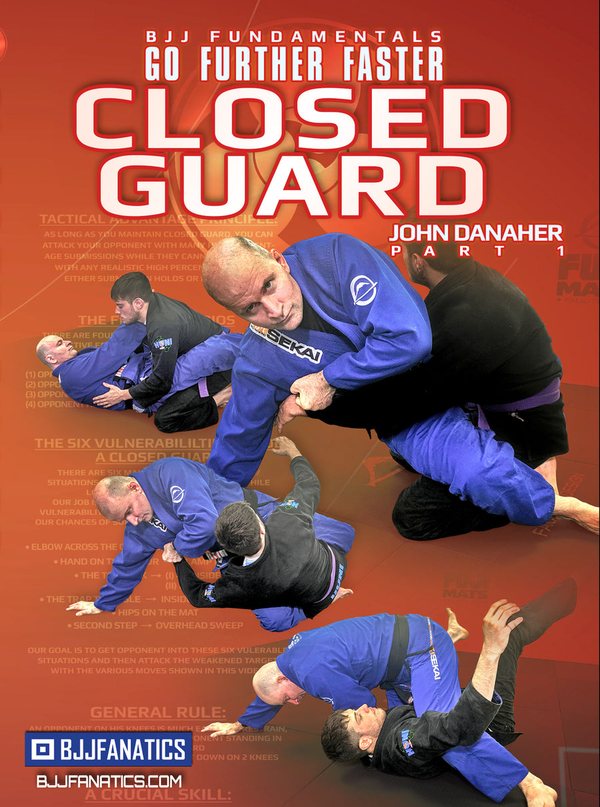
- You train in the giClosed Guard: Go Further Faster is Danaher’s gi course on the same positions.
Other closed guard courses to consider
- Closed Guard: BJJ Fundamentals, Go Further Faster (John Danaher, 8 volumes, 9 h 37 min, gi, 2019)
For you if: you train in the gi. The same backbone as this course, the side scissor, the clamp, the top lock and the classic sweeps, taught with collar and sleeve grips. See it on BJJ Fanatics. Or read our review. - Next Generation Closed Guard (Mica Galvao, 4 volumes, 3 h 10 min, gi, 2021)
For you if: you compete in the gi and want a short course built on grips: a two-on-one grip to the back, an underhook game, and sweeps on a standing man. See it on BJJ Fanatics. Or read our review. - Systematically Attacking From Closed Guard (Gordon Ryan, 6 volumes, no-gi, 2019)
For you if: you want a no-gi closed guard system in six volumes instead of eight. One person who recommends it over this course finds it more direct and less wordy. That is one opinion, and we have not reviewed it. See it on BJJ Fanatics.

Want the whole field? This course is one of the picks in our best closed guard instructionals.
Worth it? The pros and cons
- One plan in three steps, and each step comes with what to do when it fails
- The attack from his side gets the room it needs: almost three hours, with an answer for each of his three defences
- A real section for short legs and bigger partners, and Danaher says plainly where long legs still win
- Danaher tells you where the live version differs from the demo: which move looks messy, which one works half the time
- Nine and a half hours, nearly all of it Danaher talking over slow reps with a partner who lets it happen. No live rounds, no match shown. Volume 1 spends its first twenty minutes on a voice-over and the pros and cons of closed guard, and the last 29 minutes of Volume 8 repeat the course
- If you own Danaher’s gi course, Closed Guard: Go Further Faster, you have the backbone already: the side scissor and its sweeps, the clamp, the top lock and its armbar
 No guillotine, and the kimura only turns up inside other moves. Henry Akins’s The Black Hole: No-Gi Closed Guard covers both
 No-gi only. The positions carry over to the gi, the grips do not. Mica Galvao’s Next Generation Closed Guard is three hours built on gi grips
What’s inside the eight volumes
Eight volumes, all no-gi. The biggest block is the attack from his side, the side scissor and the clamp: almost three hours across Volumes 1 to 3. Open a volume further down for what’s in it.
This route is about 35 minutes and gives you the plan:
- Volume 8 from 54:54, 45 seconds. The three steps in one breath.
- Volume 1 from 20:07, 5 minutes. Why everything is a fight over his posture.
- Volume 1 from 25:07, 8 minutes. What holds him up, the knee pull, and when to pull as he stands.
- Volume 2 from 8:34, 7 minutes. His three defences from the side, and your answer to each.
- Volume 7 from 36:14, 3 minutes. Why losing the posture fight gives you his legs.
- Volume 7 from 42:11, 11 minutes. Opening your own guard, safe from leg locks.
Want a free look first? Danaher talks through the ideas of this course in an 18 minute interview on the Bernardo Faria BJJ Fanatics channel on YouTube, “John Danaher Explains Closed Guard Fundamentals”. It is mostly the thinking. The one technique in it is the pull to closed guard from Volume 4.
Vol 1 · 1 h 28 minWhy closed guard, and the fight for his posturepros and cons, his hands on you, the knee pull, four signs, getting to his side
A three minute voice-over gives the whole plan. Then sixteen minutes of talk on what closed guard gives you and what it costs. What it gives: he can do almost nothing to you until he opens it, and because your hips sit on top of his, a sweep lands in mount. What it costs: leg locks when it opens, it is tiring to hold, and it is harder with short legs. The course proper starts at 20:07 with the idea everything hangs on, the fight for his posture. Danaher shows what holds a man up (his hands on you), how to take them off, the pull with your knees, and the best moment to pull when he stands: as his second foot comes up. The four signs that you are winning start at 43:14. The last forty minutes are the side scissor: how it is built, and four ways in: a push on his elbow, an arm drag, a scrappy version with an underhook, and one for the partner who knows it is coming. Detail 02 shows where they all lead: out to his side with your top leg over his back.
Vol 2 · 1 h 17 minEverything from his sideelbow, angle and height; his three defences; back, mount, sweeps, armlocks
If you watch one volume, watch this one. It opens with three fights you have at once: stay past his elbow, get out to an angle, get higher than him. Danaher calls height the most important. From 8:34 comes the map of the whole series: he does nothing and you take his back (detail 03), he brings his head over yours and you sweep him (detail 04 and the sweep at the top of this page), he pulls his elbow out and you take the clamp. In between are two sweeps to mount, an armbar, and Danaher’s own favourite finish from here, a triangle locked from behind. For the man who arches up to stop the sweep there is an armbar, and for the hand he posts with an armlock that Danaher admits wins few matches at the top level, so he shows what to do when it fails.
Vol 3 · 59 minThe clampwhy, how, four attacks, and a better side scissor
What to do when he gets his elbow back. The first ten minutes are why and how: his head and one arm between your knees so his hands cannot meet, with you on one hip (detail 05) and, Danaher adds, your knee higher than his head. Then the attacks. The triangle when he lifts his head, which Danaher calls the best all-rounder (detail 06 is how it starts). An armbar for the man who keeps his head down and waits. A kimura from inside the triangle. An omoplata that rolls him over. Then what to do when he squares back up. The last twelve minutes return to the side scissor with a fix for better partners: stay on your shoulder and win the height with your hips, so there is no room for his elbow to slip back. It takes more agility, and Danaher’s answer to that is: “I’m 55 years old with a hip replacement and a crippled leg. If I can do it, you guys can easily do it.” (Vol 3 · 51:49)
Vol 4 · 1 h 13 minDouble underhooks, and the plan for short legsfour ways in, the slide to his back, two stages
Two halves. The first 32 minutes are both arms under his: why it doubles what a closed guard can do, four ways in (detail 01 is from this part), and the slide to his back (detail 07), which Danaher calls the attack they use more than any other from this grip. He is honest that it looks messy against someone who fights it. From 32:41 comes the two-stage plan for short legs or a much bigger partner: hold him in closed guard, get a grip around his upper body, then open your legs and sweep from butterfly guard or half guard. There are three sweeps (detail 14 is from the first), a straight “you get up about half the time” on the third, a way into half guard, and one more sweep with both arms over his. Danaher repeats the two-stage idea a lot. The plan starts with a way to pull closed guard from open guard, the one technique you can also see in the free interview.
Vol 5 · 1 h 27 minThe high cross, then the side sit up38 minutes on one, 48 on the other
The high cross first: a hand behind his neck, a hand inside his knee, then you throw a leg and turn until you lie crosswise under him, ear to his knee, knee behind his head, hips off the mat. Danaher says it needs little flexibility and gives a test at 1:17. The attacks come in his order: armbar, a triangle when the arm comes out, a kimura from inside the triangle, and an omoplata used only as a way down to his heel. From 38:21 the side sit up and its main move, the hip sweep (detail 08). Three standard ways up, then Danaher’s own favourite with a forearm across his collarbones, the sweep itself, how to trap his arm, and what to do when he pushes you back down (armbar) or takes his hands away (triangle). Danaher calls the side sit up one of the longer moves in jiu jitsu, so expect to be stopped. The hip sweep gets summed up twice.
Vol 6 · 1 h 09 minHe stands up, and the top lockthe scoop sweep and what follows, the top lock on a kneeling and a standing man
The first half hour is the man who stands up straight. You put him on his backside with the scoop sweep (detail 11), which Danaher rates the best first attack on a standing man without a gi, and then choose by his arm between triangle, hip sweep and armbar. If he scrambles back up, you go back to the side scissor or the high cross. From 31:14 the top lock, for when you get no height and no angle (detail 09): the lock, its armbar, a way in for when he strips your grip on his head, the way up to the same lock on a standing man (detail 10), what to do when he pulls his arm out, and a figure four version that Danaher says needs long legs. One thing not to copy: Danaher pushes off the mat with his fingers pointing away because of his shoulders, and says so himself.
Vol 7 · 1 h 02 minTwo more for no angle, then losing the posture fighttrap triangle, elbow overhook, the golden rule, opening your own guard
Two more attacks for when you get no height and no angle. The trap triangle is a triangle with only the ankles crossed, which Danaher says suits short, thick legs, and it comes with two armlocks for people who cannot lock the full triangle. The elbow overhook armbar works on a kneeling and on a standing man, and it breaks the usual order: the leg goes across his face first and the hips come out last. Then, at 36:14, the turn of the whole course: he can only win the posture fight by leaving his legs behind. It is six minutes of talk and worth every one. After that it gets practical: open your guard yourself before he does, drop a knee inside his so a leg locker gets nothing, tangle his legs if he wants to pass, and if you are late, pull your knees to your chest. For what comes after that, Danaher points you to guard retention material, which is not in this course.
Vol 8 · 60 minHis legs, then the summarythree ways to a heel hook, knock-downs, the three steps
Sixteen minutes on three ways from a standing man in your guard to a heel hook: spinning around his leg (detail 12), X-guard, and ashi garami. Then knock-downs. Danaher’s rule is that if you hold both his legs and push, he falls. He explains why the old double ankle sweep is risky in a room full of leg lockers, and shows the one he prefers, the double shin sweep (detail 13). From 30:57 the last 29 minutes sum up the course: the three steps, the positions sorted by how much height and angle they give you, and the plan for short legs again. The whole course in 45 seconds is at 54:54.

BJJMore earns a commission if you buy through these links, at no extra cost to you. Reviewed on all eight volumes. Code tested at checkout on November 23, 2026.
Get the next review like this one
New reviews in this format land in your inbox, with the details on video. You also get the free BJJMore email course and the instructional-platform discounts I use myself (worth $46).
FAQ
Is Danaher’s New Wave Closed Guard worth it?
Yes, if you close your guard without a gi and nothing happens, and you have the patience for nine and a half hours of Danaher. You get one fight to win, your partner’s posture, and an attack on both sides of it. It has no live rounds, and if you own his gi course you have part of it already. Buyer Kyle K. (August 9, 2023) says that without the grips of the gi it can feel like you have no control, and that “this instructional helps a lot.”
New Wave Closed Guard or Go Further Faster Closed Guard?
Same teacher, same backbone, nearly the same length. Closed Guard: Go Further Faster is the gi course and leans on collar and sleeve grips. This one is rebuilt for no-gi: you hold the lat, the tricep and the back of the neck. It adds double underhooks, the high cross, the plan for short legs and the leg attacks. Train only no-gi: this one. Train only in the gi: Go Further Faster. The positions here work in the gi too, the grips do not. If you own the gi course and train both, buyer Isaic R. (January 22, 2023) has it right: “If you have the material from his fundamental closed guard video then you have a good portion of this no-gi video already.. but that missing portion makes all the difference with your game.”
Is it good for beginners, and where do I start?
It starts from first principles: what holds a man up in your guard, and how to pull him down. Buyer Daniel D. (June 18, 2023): “I’d recommend this video to any white belts starting out.” The catch is the amount, and the pace. So start with the 35 minute route under What’s inside, then Volume 2. One no-gi player got through only the first part and the side scissor, and says those two changed his closed guard: he now takes the back from there, which he never did before. Buyer Ryan K. (March 30, 2023) sets it against Danaher’s other courses: “A common criticism of his videos is that he spends too much time on talking and theory and too little on actual technique instruction, but out of all his courses I’ve seen, this one probably has the most actual technique breakdown”
What is the high cross?
A position from closed guard where you turn until you lie crosswise under your partner: your ear by his knee, one knee behind his head, your hips up off the mat. Danaher calls it one of his personal favourites, and it takes the first 38 minutes of Volume 5. He says it needs little flexibility, and his test is simple: lie on your back, take your legs over your head and put your toes on the floor. Not everything from there is that easy. Buyer Joshua S. (April 22, 2023): “Most techniques are practical, some seem beyond my flexibility but he does a good job of mentioning modifications for different body types.”
I have short legs. Is this for me?
Yes, and it says so up front. Danaher says outright that long legs are better at this, and then gives you 40 minutes in Volume 4, from 32:41, on a plan that does not need them: hold him with the closed guard, get a grip around his upper body, then open your legs and sweep from butterfly guard or half guard. Volume 7 adds armlocks for legs that cannot lock a full triangle. Buyer Tye B. (November 10, 2022): “This instructional was the best closed guard I’ve seen and gives great options for the short leg folks”
Does it teach leg locks?
It teaches how to get to them, and how not to get leg locked yourself. Volume 7 shows where your knees go when your guard opens. Volume 8 has three ways from a standing partner to a heel hook, sixteen minutes together, and a way from the high cross to his heel is in Volume 5. That is the leg lock part. It is a way in, not a leg lock course.
Is there a discount code?
On November 23, 2026 the house code BLACKFRIDAY2026 took 55% off at checkout, which makes this course $88.65 instead of $197. BJJ Fanatics rotates its codes and sales, so check the price on the day you buy.
One fight to win: his posture
If you close your guard without a gi and nothing happens, this course gives you a plan for each thing your partner does in it. No-gi, nine and a half hours, and it rewards patience.