
BJJ for Beginners
The Complete Guide to Surviving Your First 3 Months in BJJ
You will get smashed by people half your size and forget every move five minutes after class. Everyone did. Here is what to bring, what to expect, and what to learn first.

That is normal.
The short version: before you learn to escape, get one position you can escape to. We say half guard. Most advice says escapes first, and further down we explain why we think that skips a step.
The rest of the page: what to bring, how to behave on the mat, what it will feel like, and the habits that keep you training. A lot of people stop in the first months.
Before your first class
Call the gym first and ask whether the class is gi or no-gi. Then bring:
- A gi, or a rash guard and shorts. Most gyms lend you a gi for the first class. Buying your own? Use our gi size guide and our gi brands breakdown. For no-gi: a tight rash guard and shorts without pockets or zippers.
- Water. At least a liter. You will sweat more than you expect, even in a fundamentals class.
- Flip flops or slides. Wear them off the mat, in changing rooms and showers too. Footwear helps reduce exposure to the fungi that cause ringworm. See CDC’s ringworm-prevention guidance.
- Short nails. Trim fingernails and toenails before every class. Long nails scratch your partners.
- A mouthguard. A cheap boil-and-bite one works. You probably will not need it in your first class, but get one before your first live round.
On the mat
- Arrive early. There may be paperwork, and it gives you time to meet the coach.
- Shower before class and take off jewelry. Rings and earrings catch on fingers and gis.
- Do what the gym does. Some schools bow onto the mat and call the head coach Professor, others use first names. Copy the people around you.
- Know the class order. Usually a warm-up, a technique shown by the coach, drilling with a partner, then sparring (rolling).
- Tap early and tap often. Tap when you are caught, not when it hurts. Nobody is impressed by an injury.
What it will feel like
The first weeks look the same for almost everyone:
- You get the move in drilling. Then someone resists and it is gone.
- You go flat out for two minutes and have nothing left for the other three.
- You escape side control, feel great for half a second, and get passed again.
Two things make it worse than it needs to be.
You hold your breath. Almost every beginner does it when someone is on top, and gasses out in 90 seconds. Breathe out when you bridge or hip escape.
You use full effort on everything, because you do not know yet which movements matter. That comes with time.
You will be sore, and you will get mat burns. Build up slowly.
All of that is normal.
What to learn first
The biggest mistake I see white belts make is that they focus too much on survival.Max, black belt
Surviving is where you start.
Training gets a lot more fun once you have one place on the mat that is yours. That place is half guard. The order, one month at a time:
- Month 1LandGet to half guard and stay there.
- Month 2Escape backFrom side control and mount back to half guard.
- Month 3Keep your guardStop him getting past your legs.
Your gym sets the class plan. Use this for your drilling time and your rounds.
Start with half guard, not with escapes
The usual advice is: learn escapes first. We disagree.
An escape needs somewhere to go. Escape side control without a guard and you are passed again two seconds later, so nothing feels like it works. An escape also runs on skills you build in guard, like frames.
Half guard is easy to get: trap one leg and you are there.
Once you have it, the escape has a destination: from side control back to half guard, and this time you feel great for longer than half a second. Yes, that goes against Danaher too.
Month 1: half guard, a place to land
Half guard means you are on the bottom with one of his legs trapped between yours.
Start simple. Get there, put a knee shield in (your top knee and shin across his body, so he cannot drop his chest on you), and stay on your side, not flat on your back. Goal: hold it for thirty seconds.
New to the position names? White belt techniques, one by one.
In our half guard ranking the one to start with is Craig Jones’ Make Z Guard Great Again, the first card below. It is built on the knee shield, the easiest half guard to learn: start with Volumes 1 and 2. In the gi, or older and less athletic? Danaher’s Ageless Jiu Jitsu is the other route: long, so start with the Bottom Game in the uniform you train.

No-gi
Make Z Guard Great Again, Craig Jones. Your half guard keeps getting flattened: one knee shield that holds him off. Start with Volumes 1 and 2.

Gi
Half Butterfly: Victory Blueprint, Adam Wardzinski. Your butterfly hook is in, but he will not go over: one sweep and what comes next. Gi only.
Month 2: escape back to half guard
Now escaping pays off: you have somewhere to go.
From mount: elbow escape back to half guard. From side control: frame, hip escape, get a knee back inside. Goal: recover half guard once per round.
One of these is enough. Danaher for depth, Lachlan for breadth.
Gi, works no-gi
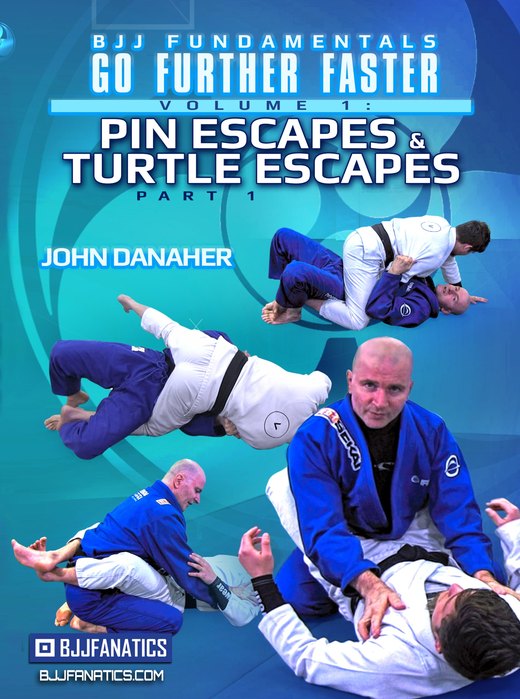
Pin Escapes & Turtle Escapes: BJJ Fundamentals, Go Further Faster, John Danaher. Stuck under mount or side control? One way out from every pin, back to guard. The deep one: almost 11 hours, and our review gives you a 2 hour route through it.

Mostly no-gi
Fundamentals of Brazilian Jiu Jitsu Escapes (Gi & No Gi), Lachlan Giles. Your rounds end under side control or mount: the first escape to learn for each. The broad one: more positions, less depth, shorter.
Also looking at Gordon Ryan’s pin escapes? Gordon Ryan or Danaher, side by side
Month 3: keep your guard when he tries to pass
By now you can get back to half guard. The next step is needing it less.
When he starts to pass, keep a knee or a foot between you and him. If he gets around your legs anyway, go back to half guard before he settles. Goal: one round against another white belt where he never settles in side control.

No-gi
The Fastest Way To Develop An Unpassable Guard, John Danaher. Passed every round? One plan to keep your guard, not a pile of loose techniques.
After that: a closed guard that does something. Most white belts hold closed guard and wait. That is the next step in the rest of the white belt path, with our reviews for it.
Not sure which course fits you? Our white belt ranking says who each one is for.
That is what to learn. The rest of this page is how to keep showing up long enough to learn it.
Habits that keep you training
- Two or three classes a week to start. That is a starting point, not a rule. Ask your coach, and see how often to train at each stage.
- Ask one question per class. “What do I do when they block my hip escape?” beats repeating the same mistake in silence.
- Keep a journal. The technique, plus one thing you noticed in sparring. After a month the notes tell you what to work on.
- Find one training partner your size. Close to your weight and experience, to drill with before or after class without getting bulldozed.
- Set one goal per roll. Not “win”, but “I get back to half guard every time I get passed.” Then every round counts, whoever taps.
- Film a round. With your partner’s OK. You will see habits you miss in the moment, like lying flat or reaching with your arms.
Hygiene and injuries
- Shower right after training. It helps reduce the risk of skin infections. Use your own towel and soap. See CDC’s advice for athletes.
- Wash your gi or rash guard after every session. Every session.
- Clean and cover grazes. Keep the dressing clean and dry (NHS guidance on cuts and grazes). If you suspect a skin infection, get medical care quickly.
- Tell your partner about injuries. Rest a day when you need it: that beats a week off later. Get medical advice for severe or worsening pain, real swelling, or a joint you cannot use normally (NHS injury guidance). Do not assume bruising or pain is just your body adapting.
- Work on mobility at home. A simple stretching routine for BJJ helps. Start gently and stay within a comfortable range, as in the NHS flexibility guidance.
After three months
Three months is not a long time in BJJ. You will not be good yet. But if you trained two or three times a week, you know the basic positions, you survive against other white belts, and you know what to ask. That is real progress, even when a blue belt taps you six times in a five-minute round.
The people who keep going stop measuring progress by who they can tap and start measuring it by what they understand. Can you tell when you are about to get swept? Can you get back to half guard without thinking? Those are the wins at this stage. And when someone newer walks in, show them what you know: explaining a move shows you where you do not really get it yet.
White belt lasts a while: about 2.3 years on average. Your coach decides when you get promoted, and how BJJ belts work explains stripes, belt order and who can promote you.
Your next step
- Best instructionals for white belts: ranked, with who each one is for.
- The rest of the white belt path: closed guard, and what changes at blue belt.
- How long white belt takes: the averages per belt, and what you can do about the wait.
Gym without a fixed syllabus? White to blue belt curriculum courses. On a budget? Free BJJ instructionals.
The BJJ Map: free opening chapters. For deciding what to practice next: preview the 40/40/20 training split and beginner guard choices. Email is required; signup includes BJJMore training emails, and you can unsubscribe.